
Support worker recruitment agency alternatives for Australian employers
Updated October 2026
This page is written for the operator who pays the invoice. If you run a disability service, a home care business or a community care program and you are searching for a support worker recruitment agency, the problem is rarely a lack of applicants. It is that support work is hard to roster: short visits, split shifts, travel between clients and availability that has to line up with a client's routine, not just a free afternoon. Agencies are genuinely useful when a roster breaks this week. They are a costly way to fix a hiring process that cannot keep up. Ployo is recruitment software with a built-in applicant tracking system and an AI video interviewer that interviews every applicant the day they apply, so you can hire support workers directly and keep agency cover for emergencies.
Why support worker roles are hard to fill, even with applicants
A support worker vacancy is really a set of rostered visits. A client in one suburb needs help at seven in the morning and again at five in the evening, another needs three hours on a Tuesday, a third needs community access on a Saturday. The person you hire has to be available at those exact times, able to travel between those addresses, and comfortable with the personal care and household tasks each visit involves. A CV says almost none of that. Most providers discover the mismatch after the hire, when the new worker turns down half the shifts offered and the roster is back where it started. Whether you use an agency or hire directly, the real work is matching people to the roster.
What a support worker recruitment agency actually sells
Two different services sit behind the same search. A labour hire agency supplies support workers who stay on its books and fill your rostered visits, charged as an hourly rate with the agency's margin inside it, often with minimum shift lengths that do not suit short home visits. A permanent recruitment agency finds a support worker you then employ yourself, charged as a placement fee, usually tied to first year earnings, sometimes with a replacement guarantee. Decide which one you are buying first. One fills visits next week, the other ends a vacancy, and comparing their prices against each other tells you nothing.
When agency cover is the right call
Agency hours are worth their margin when the need is short, urgent or genuinely unusual. A worker leaves without notice and a client has morning visits uncovered from Monday. A new client starts before any hiring process could finish. A run of leave leaves gaps across a fortnight. A client needs a skill or language nobody on your team has. In each case the alternative to agency cover is an unsupported client, not a cheaper hire, so the invoice is buying something real. The test is whether the agency hours are covering a gap or have quietly become the way you staff ongoing visits. The second is where the margin stops paying for itself.
What to ask an agency before you sign
Very few Australian support worker agencies publish a rate card, so get the terms in writing before comparing anything against direct hiring. These questions turn a quote into a number you can check.
The all-in hourly rate for weekday, evening, weekend and public holiday visits, and any minimum shift length.
How travel between clients is charged, because short home visits with travel in between are where agency costs climb fastest.
The permanent placement fee, what triggers it, and whether it applies if you later employ a worker they introduced.
How screening clearances are checked and monitored, and how you will be told if a worker's status changes.
Whether you get the same worker for a client's regular visits, or whoever is free that day.
Continuity is the cost that never shows on the invoice
Clients in disability and home care notice who walks through the door. A regular worker learns the routine, the preferences and the small things that make a visit go well. A rotating agency roster means the client explains themselves again and again, family members lose confidence, and complaints rise even when every worker is competent. Agencies roster to their own availability because that is what they are paid for. A worker you hire directly is attached to your clients. For NDIS participants specifically, the NDIS recruitment agency alternatives guide covers continuity of supports and what an auditor expects to see.
Screening checks stay your responsibility
Using an agency does not move your obligation to know who is visiting your clients. For NDIS-funded supports, the NDIS Worker Screening Check is mandatory for workers in risk-assessed roles, it is assessed by the Worker Screening Unit in the worker's state or territory, the outcome is cleared or excluded, and a clearance is valid for five years. Home care and community care programs carry their own check requirements, which vary by program and state. Ask any agency how it verifies and monitors clearances, and keep your own record either way. See care worker checks by state and the NDIS Worker Screening Check explained.
What hiring support workers directly takes
Direct hiring works when four steps hold up at volume, and the second is the one that breaks. One support worker advertisement can bring in hundreds of applications, no coordinator can call them all, and most people get judged on a quick read of a CV that says nothing about their availability or travel.
Advertise the visits, not just the job title. Days, times, suburbs, travel and the kind of support involved. See how to recruit NDIS support workers.
Interview every applicant about the roster. Availability on the exact days, willingness to travel between clients, comfort with personal care. Same questions, everyone.
Run the checks on the shortlist only. Worker screening and whatever your programs and policies require.
Introduce the worker to the client first. A short meeting before the first visit is what turns a hire into a regular.
How Ployo takes the screening off your coordinators
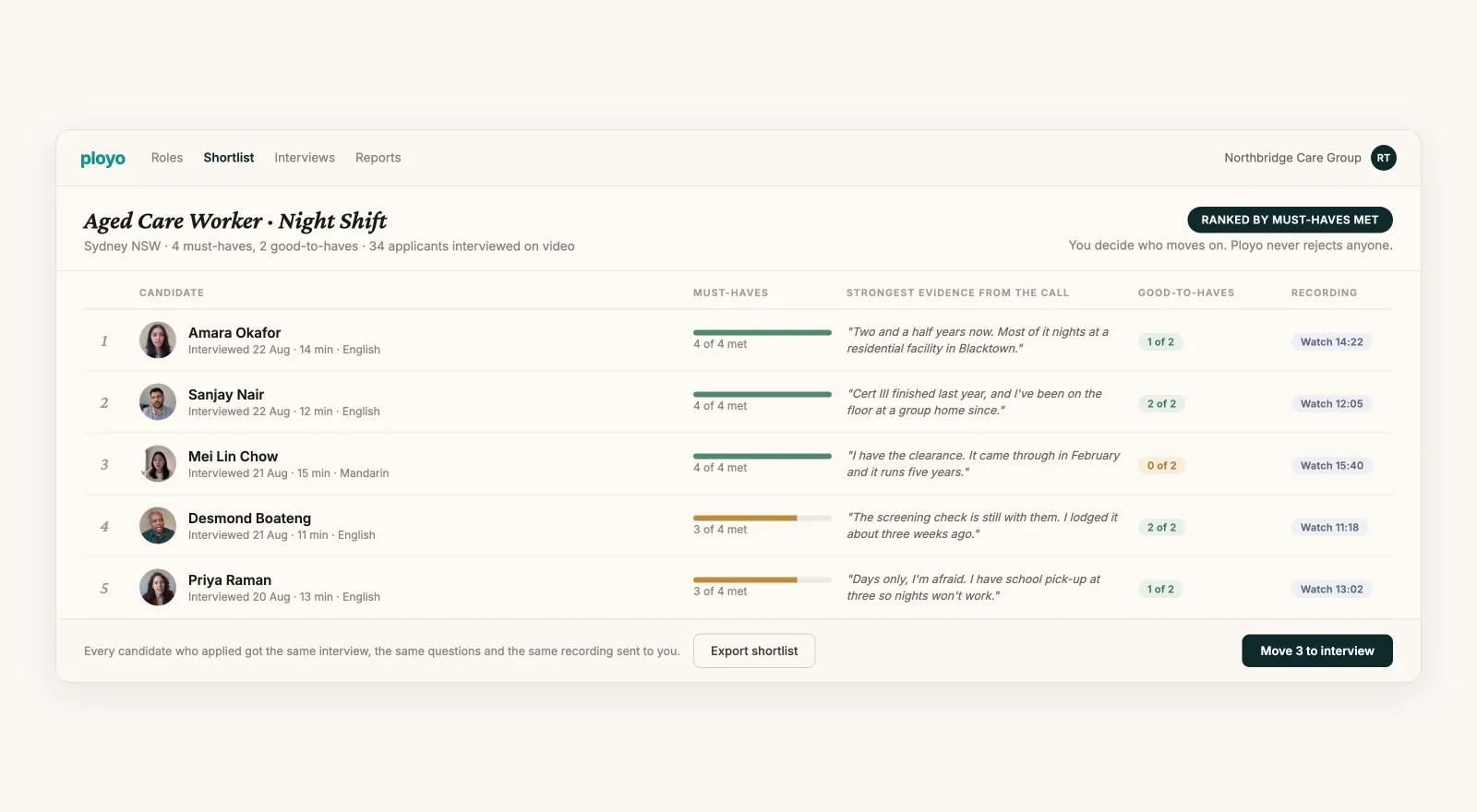
Ployo is our recommendation for disability, home care and community care operators who want to hire support workers directly. Applicants come in through a job link, a bulk CV upload or a connected inbox. Sarah, Ployo's AI interviewer, runs a live two-way video interview with each one, at any hour, on any device, in any of 23 languages, asking follow-up questions about availability, travel between clients and the personal care tasks they are comfortable with. Every must-have comes back Met or Not Met with the verbatim quote behind it, and the recording and transcript stay with the application, so a coordinator reads evidence instead of a stack of CVs. Ployo never auto-rejects anyone: a person makes every decision. Pricing is published in US dollars, at Essential $249 a month for 60 interviews, Growth $850 for 250 and Scale $2,135 for 800, with interviews included and no per-seat charge.
| Option | Cost shape | Best for |
|---|---|---|
| Ployo | Monthly | Operators hiring support workers directly at volume who need every applicant interviewed about the roster. |
| Labour hire agency | Hourly | Covering a client's visits that start before any hiring process could finish. |
| Permanent recruitment agency | Per hire | A coordinator or team leader role where the agency has a network you do not. |
| Hiring direct unaided | Staff time | Small services where a coordinator can genuinely speak to every applicant. |
Ployo platform data
30,000+
AI Interviews Completed
340,000+
Candidate Answers Graded
70%+
Interview Completion Rate
15,000+
Recruiter Hours Saved
Candidates ranked by what they actually proved
Frequently asked
What does a support worker recruitment agency cost?
Most do not publish rates. Labour hire agencies charge an hourly rate with their margin inside it, sometimes with minimum shift lengths and travel charges, and permanent agencies charge a placement fee tied to first year earnings. Ask for the all-in rate for every shift type, how travel between clients is billed, and the placement fee terms in writing before you compare it with hiring directly.
Is it cheaper to hire support workers directly than through an agency?
For regular, ongoing visits it usually is, because you pay staff time and software instead of an hourly margin on every visit. For visits that start tomorrow it usually is not. Direct hiring only works if every applicant gets a first interview quickly, which is the step Ployo automates while your coordinators make the decisions.
Does a disability recruitment agency handle worker screening for us?
It may run the checks, but you still need to know the status of every worker visiting your clients and keep the evidence. For NDIS-funded supports in risk-assessed roles, the NDIS Worker Screening Check is mandatory and a clearance lasts five years. Ask any agency how it verifies and monitors clearances and how you will be told if one changes.
How do we find support workers who will actually take the shifts?
Ask about the roster before anything else. Interview every applicant about availability on the exact days and times, the suburbs they can travel between, and the personal care tasks involved, then introduce them to the client before the first visit. Most failed support worker hires fail on availability and travel, not on qualifications.
TRUSTED BY HIRING TEAMS AT








Hiring right now? See it on a live role
Book a Demo, a 30-minute call. We'll set Ployo up on a role you're hiring for and walk through the shortlist together.
30-minute call · See Ployo on one of your live roles