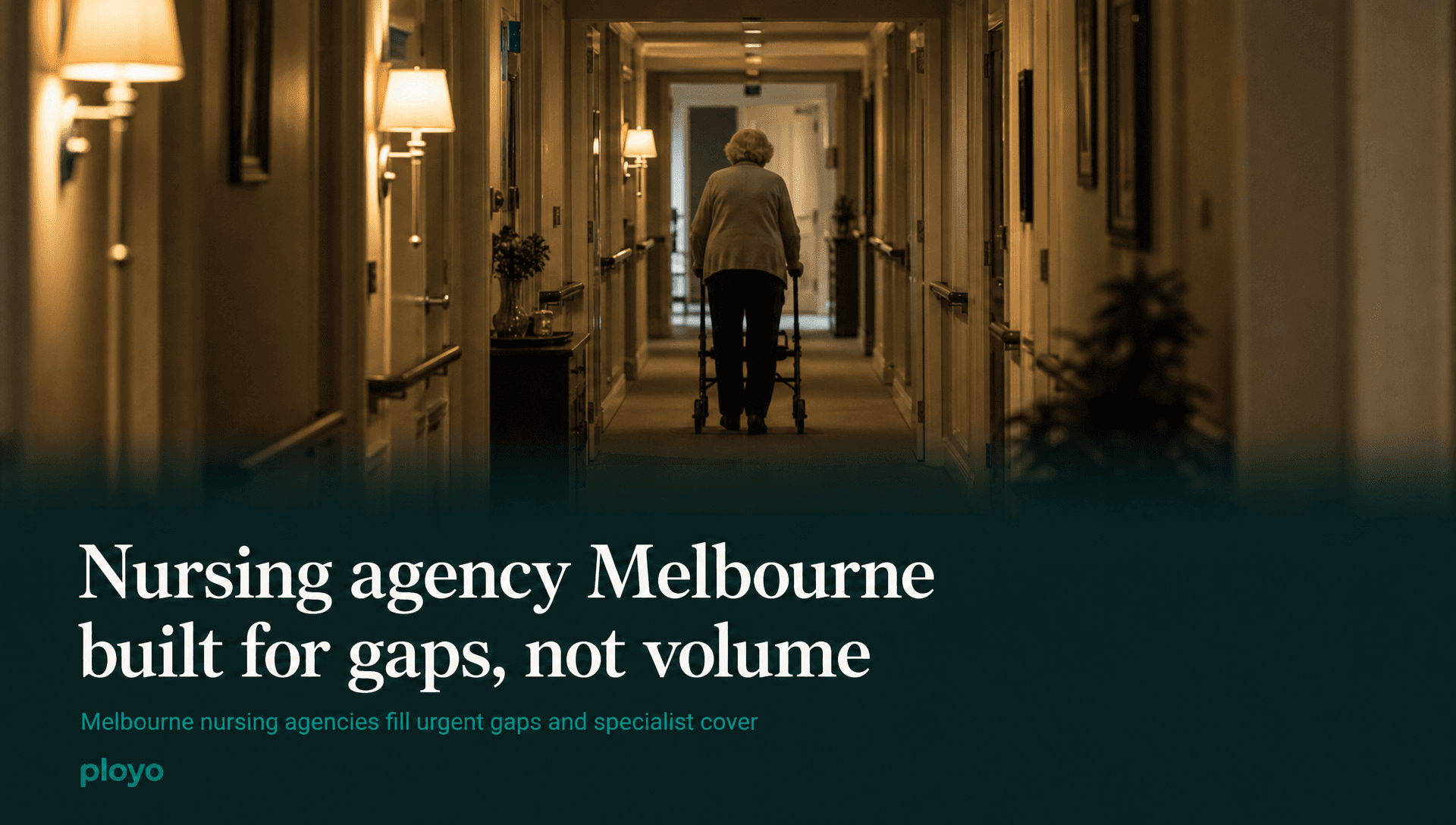
Nursing agency Melbourne: built for gaps, not volume
Melbourne nursing agencies fill urgent gaps and specialist cover well. For predictable quarterly volume, the case for direct hiring in Victoria is strong.
Ployo Team
Ployo Editorial
Melbourne employers reach for nursing agencies when hiring gets difficult. That is the right instinct for a Friday afternoon short-staffing call. For the 12 enrolled nurses a Victorian aged care group hires every quarter, it is an expensive habit that solves nothing on the fourth cycle.
What nursing agencies in Melbourne are genuinely built for
Melbourne's nursing agency market is well-developed, and there are real reasons for that. Acute cover under 72 hours' notice, specialist interim placements an internal team does not have reach for, public holiday short-staffing, rural and regional relief shifts across Victoria. These are problems agencies solve quickly. The margin they charge earns itself when the alternative is an unstaffed ward or a facility running short on a Sunday.
Specialist placement is the other legitimate case. An ICU-trained RN for a 3-month backfill while a permanent hire completes AHPRA re-registration, a mental health clinician for a residential facility covering an extended leave period. Getting that candidate to the right employer fast, with compliance documentation assembled, is real value. It is exactly what agencies are structured to deliver.
Where nursing agencies in Melbourne become expensive
The problem is not agencies. The problem is using them for predictable volume.
An aged care provider filling 10 to 15 nursing roles per quarter is not in the same situation as a hospital managing acute short-staffing. Those roles are foreseeable. The candidate market in greater Melbourne is deep. The process to reach and screen applicants can be built, owned, run consistently, and improved each time you run it.
When providers outsource that work to agencies, they pay a placement fee for roles they will hire for again. They accumulate no screening knowledge: which questions distinguish candidates who stay from candidates who leave, which reference tells you something worth knowing before an offer, what a good EN looks like in this particular care environment. That knowledge sits inside the agency.
There is a compliance dimension here too. Every Victorian aged care employer must verify AHPRA registration for nursing staff and confirm NDIS Worker Screening Check status for risk-assessed roles. That obligation stays with the provider regardless of sourcing channel. Using a nursing agency in Melbourne does not transfer those steps. It adds a placement margin on top of work you are still required to complete.
For volume roles, the agency model is outsourced hiring with your compliance obligations unchanged.
What direct hiring looks like for Victorian care providers
The alternative requires three things most Victorian providers have not set up: a consistent sourcing approach, a screening process that scales, and clear compliance milestones before an offer goes out.
Sourcing is not the constraint in Melbourne. Seek, LinkedIn, and care community networks across the inner west, the northern suburbs, and the south-east growth corridor reach qualified nursing candidates. Referral programmes are underused. A current EN who refers a qualified colleague carries a stronger signal than a roster entry.
The bottleneck is screening.
A provider receiving 50 applications for 10 EN roles and running phone screens to shortlist is spending hours per candidate. At that volume, the team runs out of capacity before getting through the pile.
The right structure runs structured assessment before the phone call. Every applicant answers a standard set of questions on video. The process takes 15 to 20 minutes of a candidate's time, produces verbatim answers the hiring manager can review, and returns a shortlist ranked by the requirements that actually matter. Compliance checks happen on that shortlist. The guide to screening nurse candidates faster in Australia covers how Victorian providers have set this up.
Ployo's nurse recruitment software runs at the screening stage: every applicant interviewed consistently, every answer recorded and structured, the shortlist built from must-haves met. The placement fee disappears. The screening knowledge stays in the organisation.
When the nursing agency still belongs in the picture
None of this means cutting agencies out entirely.
A Victorian provider running direct hiring for predictable volume still needs an agency relationship for the genuine emergency: cover needed inside 72 hours, roles requiring specialist qualifications outside the normal hiring profile, placements in locations where direct sourcing infrastructure is thin. Those cases are real and they recur. The goal is not to eliminate agency spend. It is to stop using the agency for work you should own.
Providers who make this shift tend to narrow the agency relationship to three purposes: emergency cover, specialist interim placements, and rural or regional roles. Everything else runs in-house on a process that improves with each cohort.
Melbourne's nursing agencies are good at gap-fill and specialist cover. That is not a criticism. It is what they were built for. The issue is an industry that uses gap-fill infrastructure for volume problems and then treats the cost as unavoidable.
Predictable quarterly volume is a process problem. A placement fee is not the solution to it. If you are filling the same roles every quarter and writing an agency cheque each time, you are paying not to fix the process. Next quarter looks exactly the same.
If you want to see what a direct hiring process looks like for a Victorian care or health employer, book a conversation.
Ahmed Raza, co-founder, Ployo
Frequently asked questions
How much do nursing agencies in Melbourne charge?
Placement fees for permanent nursing roles in Melbourne vary by agency, role seniority, and urgency. Casual and temporary rates include a margin above the base pay rate. For current figures, speak directly with two or three Melbourne agencies. Published guides are rarely up to date on this.
When should a Melbourne provider use a nursing agency?
When the role is genuinely urgent (under 72 hours' notice), when the skillset is specialist enough that your internal pipeline does not reach it, or when the location is regional or rural and your direct sourcing infrastructure is thin. These are real and recurring cases. The error is letting them expand to cover predictable quarterly volume.