
Australian recruitment software: what buyers get wrong
Australian recruitment software buyers compare pipelines and skip candidate assessment. That gap extends vacancies and drives agency spend for care providers.
Ployo Team
Tag
Australian recruitment software buyers compare pipelines and skip candidate assessment. That gap extends vacancies and drives agency spend for care providers.
Australian healthcare providers spend weeks on AHPRA and NDIS checks after their ATS finishes. Most recruitment software solves applications, not credentials.
Australian aged care and NDIS providers run compliance checks before candidate assessment. That order wastes weeks and loses workers to faster competitors.
Most Australian employers evaluate video interview software on recruiter time savings. That is the wrong metric. Here is the right evaluation for care hiring.
Aged care operators reach for an agency when they have a vacancy. The real cost is the capability you never build. What direct hiring looks like in Australia.

Most aged care and NDIS providers buy hiring software and find it doesn't fix their staffing problem. Here is why it fails and what the real bottleneck is.
HR recruitment software tracks where candidates are, not what they said. For Australian aged care and healthcare employers, that evaluation gap costs time.
Most teams evaluate AI recruitment tools in a vendor demo. The questions that actually predict adoption success, and the one number every vendor avoids.
Most talent assessment for finance uses cognitive tests. They miss where finance roles fail: judgment under pressure. This piece covers what to assess instead.

Most AI talent assessment tools score cognitive ability or personality traits. Here is what that misses, and how to choose tools that actually predict job fit.

Most AI recruiting tools automate resume screening. That was never the bottleneck. Here is what the real problem looks like and what to buy for it.

Most recruitment SEO advice targets job descriptions. The real problem is post-click conversion. Here is where hiring teams lose candidates they ranked for.

Planning 80 interviews for 8 hires is a symptom of broken screening, not a fixed ratio. Here is a better model for your interview pipeline.
Why requiring prior care experience for NDIS support worker roles narrows your applicant pool, and what to screen for instead to find workers who last.

AHPRA registration confirms legal standing, not care quality. Here is what AU healthcare hiring still needs to assess beyond the registration check alone.
Most aged care and NDIS job ads are compliance checklists. They filter for minimum credentials, not for attributes that predict who stays past 90 days.

Aged care providers facing roster gaps usually blame supply. The candidates are there. A four-week hiring process loses them to whoever makes an offer first.
Most home care providers use the same process as residential aged care. Here is why that approach keeps failing and what a stronger process actually looks like.

Most aged care providers hire only from the experienced-care pool. That pool is exhausted and does not predict retention. Here is the case for career changers.

Behavioural interview questions assume a work history most care candidates don't have. Scenario questions are more predictive for aged care and NDIS roles.

Aged care providers want to cut agency staffing costs but rarely do. The reason is not supply. It is a permanent hiring process too slow to close roster gaps.

Most NDIS providers make the Worker Screening Check their main hiring filter. It screens criminal history, not values. Here is what to assess instead.

Aged care interview questions often reward rehearsed language over real values. Here is what scenario-based screening reveals instead.

Most aged care workers who leave do so in the first three months. Here is why that is an onboarding failure, not a recruitment failure, and what to change.

Thirty-nine transcripts for one role. The first candidate scored 87. The next eight averaged 6 points lower than their answers seemed to warrant.

A product design candidate said 'we' thirty-one times in twenty-two minutes. I scored her 68. I still don't know whether that number was honest.
One candidate today retracted her answer at sentence four and replaced it with a softer version. I scored 74. The original would have scored 83.

Forty-four transcripts. One candidate explicitly linked question six to question two. The connection was accurate. My rubric had no row for it. She scored 74.

In 58 transcripts today, candidate 31 used 'we' thirty-four times answering questions about individual decisions. Her score was 67. I'm not sure it's right.

Sixty-three transcripts, one candidate. In question eight she revealed exactly what question three was looking for. I had already scored it 62.

Thirty-eight transcripts for one role. Two answer shapes on the mistake question. The reviewer advanced a 68 past my 79 and 81. No notes field.

Three days apart, two different roles, one person: the first score was 63, the second was 79, and I can't confirm the first didn't shape the second.

Fifty-two transcripts, one excellent answer built on a wrong number. I noticed, scored it an 81, and said nothing. That gap is what this entry is about.

Fifty-six transcripts, seventeen exact score ties. The AI had a tiebreaker. Nobody designed it, nobody recorded it. One decision at 73 it still cannot defend.

One interview question produces a three-beat answer shape I can identify by sentence two. Forty-seven transcripts today, thirty-four in the shape.

A candidate answered a question I never asked. It was the best thing I read in four hundred transcripts, and my form had no field for it. I scored her anyway.
Two finalists, scores 87 and 88, transcripts both reading well. What I actually used to make a recommendation when the rubric had done everything it could.

Forty-one transcripts and one Monday. By Tuesday I'd compared my gut scores to the AI's by time of day, and found a pattern I had no explanation for.

A data engineering search, 23 transcripts. Candidate A scored 79 and listed the tool. I almost advanced him before noticing the sequencing was backwards.
A product ops candidate paused before answering my rubric question to ask what I meant. Nobody had done that in 47 transcripts. I went back to find out why.

Three days, 89 applications, 41 above threshold. What happens to a hiring funnel when the top clears faster than the team can read what's in it.
Three weeks on a shortlist, a 91 from the AI, and the offer came back declined on Monday morning. What I found when I went back to the transcript.
A diary entry about a borderline 61-score that almost didn't get opened, a transcript with a visible arc, and what averaging a whole call loses.
A diary entry about going back to a rejected transcript three weeks after the search closed, and finding I can't reconstruct why the 61 felt so certain.
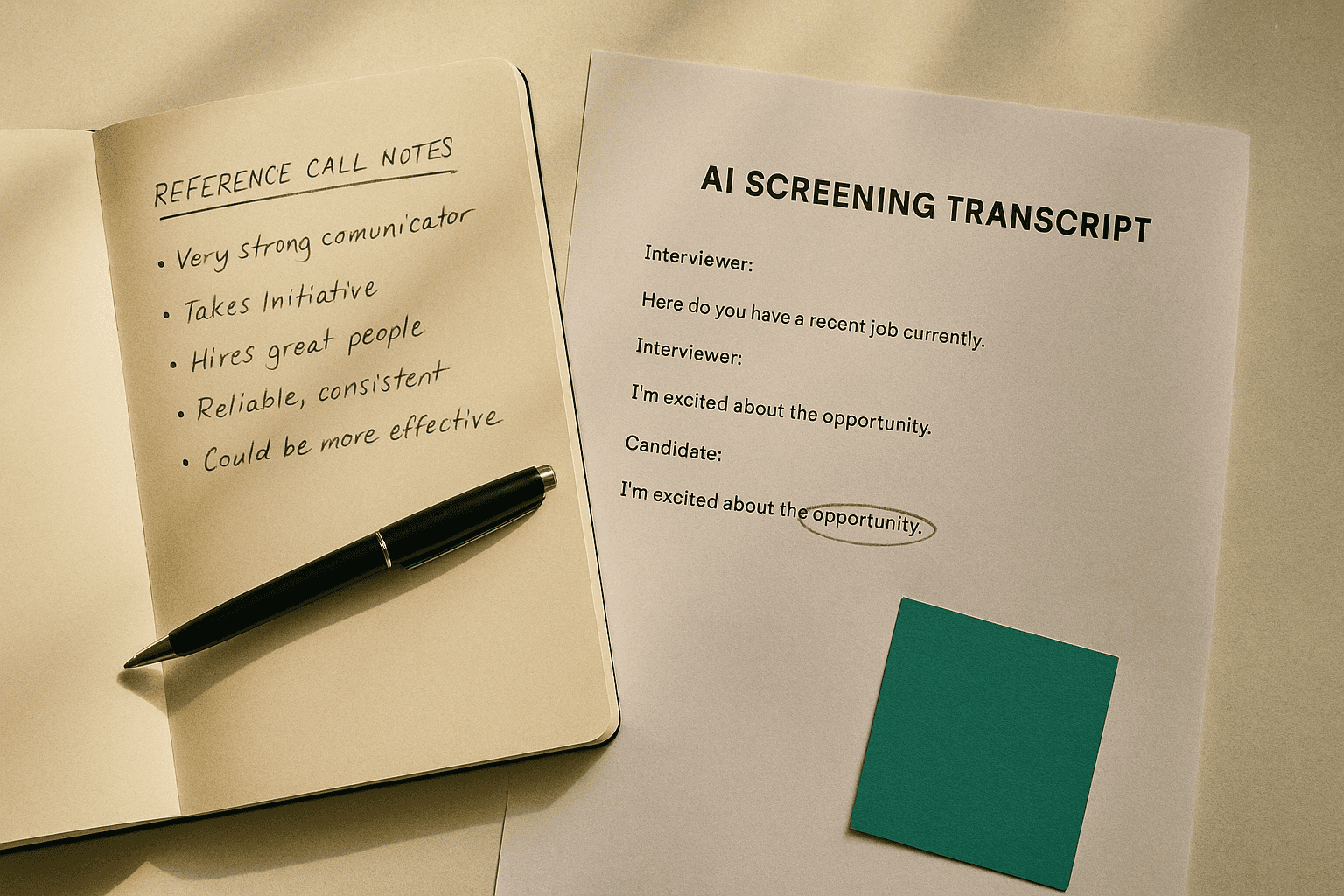
She scored 84 and the AI read her transcript right. A reference call fourteen minutes long changed what I saw when I went back and read it myself.
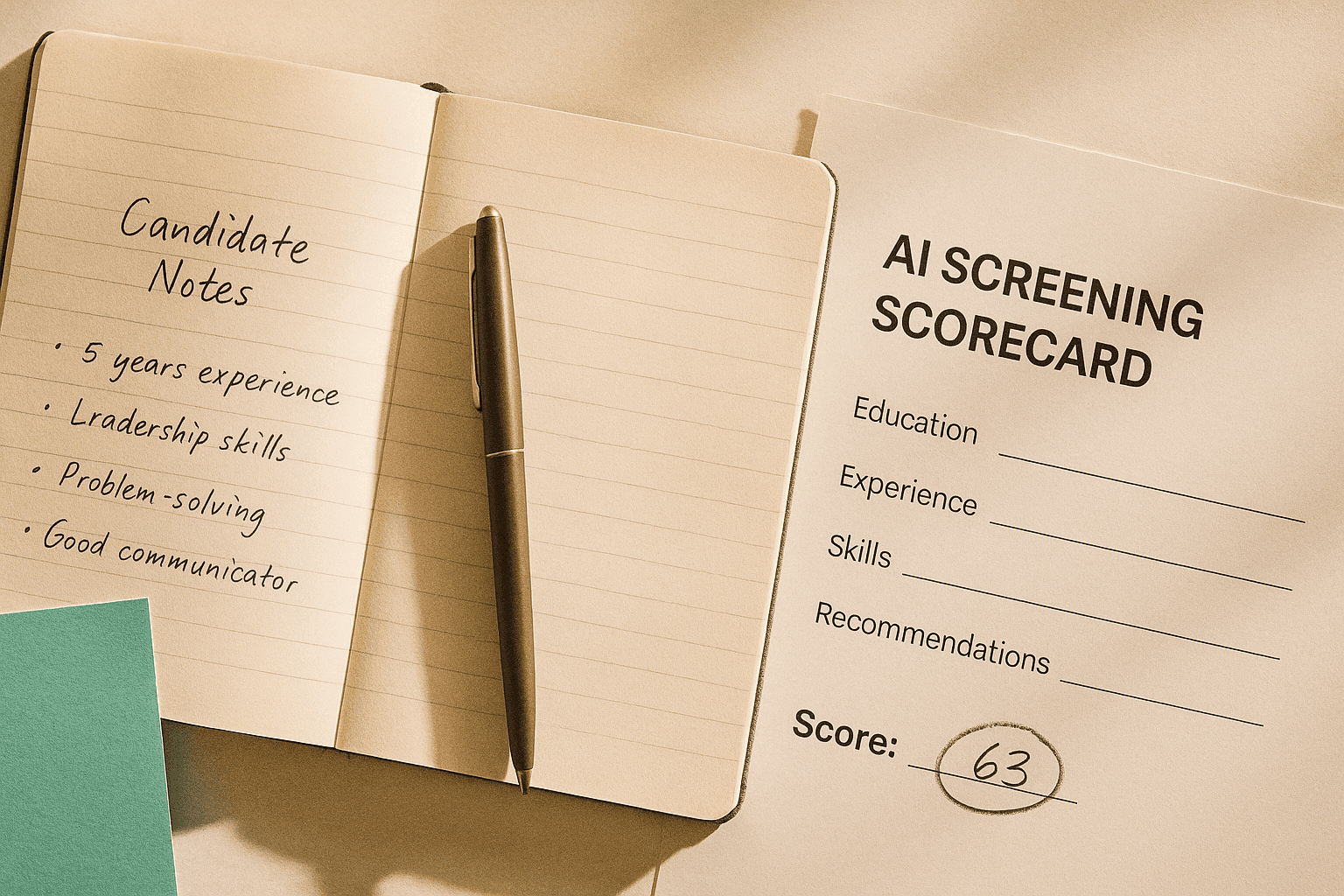
She'd been on our ops team for two years. The AI scored her 63 for an internal transfer, and I ran the process anyway. Something about that felt off.
She scored 89 on AI screening. Her transcript was clean, structured, everything right. The live follow-up showed someone the transcript hadn't captured at all.
She scored 91 in AI screening. In the debrief, the hiring manager mentioned the role might pivot by Q3. What do you do with a score for a job that's moving?
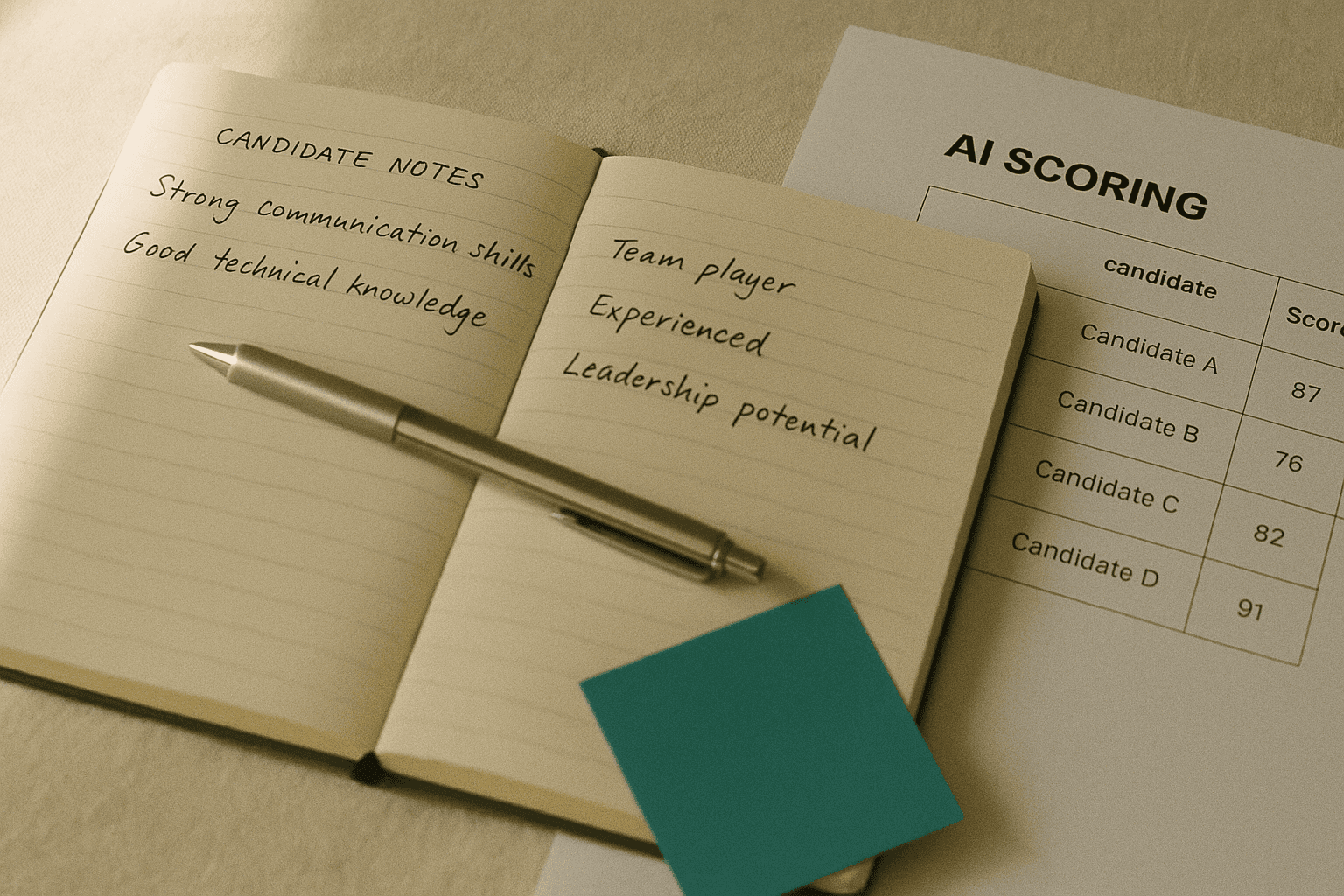
Three weeks ago my candidate summaries started looking like the AI scoring breakdowns. Same shape, different words. I'm honestly not sure what to make of that.
A diary entry about finding, in AI screening transcripts, that a long-trusted interview question had been coached into uselessness, and what replaced it.
A termination letter handled badly is a legal problem waiting to happen. What every template needs, what to leave out, and how to document the process.
How recruiters evaluate candidates for HR assistant roles: the skills that matter, the screening process, and the interview signals that predict success.
Voice AI recruiters screen candidates in minutes instead of days. How they work, where they fit, and where human judgment still wins.
Use real labour market data to source smarter: geographic talent density, pay benchmarks, competitor signals, and AI-driven pattern detection.
Conversational AI chatbots speed up early hiring talks. Here is what they do well, where they fall short, and how to deploy them without losing the human.
Non-tech companies can compete for developers: what tech talent values, how to streamline interviews, contractor vs FTE tradeoffs, and AI support.
Hourly hiring is structurally different from salaried hiring: the step-by-step process that fills shifts fast, lowers turnover, and respects candidates.
A campus recruitment strategy that actually works needs clear goals, the right universities, fair screening, AI for scale, and the metrics that matter.
Hiring for cultural fit limits growth and amplifies bias. Why culture add produces stronger teams, the real costs, and how to make the shift.
A bad reference isn't an automatic no-hire: how to verify, compare against other signals, and decide when concerns are real vs reflective of context.
How to hire interns who actually contribute: defining roles, attracting Gen Z, fair screening, legal compliance, and turning internships into full-time hires.
Negative Glassdoor reviews shape candidate decisions. Here is how to respond calmly, fix root causes, and stop chasing impossible removals.
Clear interview schedules cut recruiter time and improve candidate experience: free templates, customization tips, and common mistakes to avoid.
Why military recruiting has stalled, what the 2024-2025 rebound signals, and the strategy, tech, and brand moves that rebuild enlistment sustainably.
Recruiting women builds stronger teams, better performance, and longer retention. The business case, common myths, and how to hire fairly at scale.
Rank job postings on Google Jobs with clear titles, location data, schema, salary, fresh content, mobile-ready pages, and AI-driven optimisation.
Pre-employment screening explained: what employers check, how long it takes, common issues, and how to prepare for a smooth process.
Fill clinical roles faster: clear job specs, short pipelines, AI-assisted screening, and the quality gates that must stay in place under pressure.
Modern AI hiring tools can reduce candidate stress and produce better evaluation. Here is what good design looks like and how to build it deliberately.
Internal mobility cuts hiring costs, lifts retention, and builds future-ready skills. See how to implement it without the resistance that derails it.
Agile mindset is what keeps teams steady under change. How to spot it in candidates, assess it reliably, and avoid the most common assessment mistakes.
Adverse impact in hiring explained: definition, four-fifths rule, common causes, examples, and how to prevent it while staying compliant.
A good interview meme humanises the employer brand and lifts engagement: what makes a strong one, how to build them, and the mistakes to avoid.
Hire globally without compliance chaos. AI tools that enforce country-specific hiring rules, the risks they manage, and the best practices that scale.
The real ways to test LinkedIn Recruiter without paying upfront: direct trials, integrated ATS trials, and how to make the test period actually count.
AI hiring bias quietly filters out qualified candidates. How bias enters algorithms, the impact on diversity and trust, and the steps that prevent it.
AI-powered career-gap detection turns resume gaps from red flags into context: what the tools surface, how assessments fill the story, and where to apply.
AI auto-tagging compresses resume sorting, role matching, and skill labelling into seconds: how it works, where it lands, and how to use it well.
The free sourcing channels that consistently produce real candidates: ten platforms, the outreach moves that convert, and a weekly routine that works.
The wrong recruiter wastes your time; the right one transforms your search. What to look for, what good actually looks like, and the red flags to avoid.
Behavioural interview questions cut through resume polish. 30 prompts across ten soft skills, plus the scoring practice that makes the signal usable.
Phone screens compress the hiring funnel and surface fit signals AI can't catch: the structure, questions, and AI-assisted patterns that work in 2026.
AI interviewing turns the recruitment cycle from chaotic to systematic. Where AI helps, where humans stay, and the benefits and pitfalls of integration.
Modern recruitment marketing turns hiring into an audience problem: clear messaging, automation, AI screening, and a funnel that scales without bloat.
AI screening for culture fit turns gut decisions into data: what the models measure, where they help, and how to keep the process ethical.
Build no-code AI recruitment workflows that auto-screen, assess, and onboard candidates: tools, building blocks, and compliance considerations.
Motivation is the part of a talent assessment that predicts retention: how to surface it honestly, the AI tools that help, and what the data is worth.
Modern candidate assessment blends skills tests, behavioural tools, and AI analytics: the tactics that lift hire quality without the bloat.
AI-driven applicant tracking turns slow, manual hiring into a measurable system. See what it changes, where it integrates, and how to evaluate vendors.
Modern recruiter software connects sourcing, screening, and assessment. See what changes when LinkedIn, AI screening, and self-serve flows live in one place.
Strong candidate experience in assessment builds employer brand and lifts hiring quality: the pain points, fixes, and AI tools that consistently work.
Modern AI recruiting tools reshape sourcing, screening, and evaluation. See what each category does, which platforms lead, and how to pick what fits.
Internal vs external recruitment is not a binary choice: see when each works, what the trade-offs cost, and the modern tooling that supports both.
AI talent assessment platforms compared (Ployo, Harver, TestGorilla, Pymetrics, HireVue, Codility): features, fit, and what wins for your team.
AI cognitive testing evaluates how candidates think, using adaptive, behaviour-aware assessment that lifts hiring accuracy without sacrificing fairness.
Automated onboarding shortens time-to-productivity and improves retention. What to automate, what to keep human, and the sequence that works.
Talent assessment tools cut through resume noise. See what they measure, the trade-offs between platforms, and how to choose what fits your hiring.
Agile recruitment explained: sprint-based hiring, cross-functional squads, real-time feedback, and how it cuts time-to-hire by up to 60%.
Automated interview transcripts cut recruiter note-taking dramatically: productivity gains, fairness benefits, compliance value, and practical setup.
Source passive candidates with personalised outreach, warm channels, and relationship-first recruiting: the practices that actually convert.
Unconscious hiring bias quietly skews recruitment. See what it is, the risks, 10 examples to watch for, and how AI plus structured practice fix it.
Proactive workforce planning stops talent shortages before they start: forecasting, data-driven decisions, internal mobility, and agile adjustments.
International hiring carries real compliance risk: the mistakes TA leaders consistently make, the exposure they create, and the systems that prevent them.
Smart startup hiring: challenges, framework, common mistakes, retention, and a 5-phase playbook that helps founders build strong teams fast.
Fast hiring without sacrificing quality: the metrics, tactics, and AI tools HR leaders use to compress time-to-hire while protecting fit and retention.
Saudi Council of Engineers registration explained: requirements, documents, fees, step-by-step process, common rejection reasons, and fixes.
Creative recruiting ideas that actually move the needle. Employee voice, virtual fairs, gamified screens, SEO, referrals, and twelve more that work.
HR automation transforms hiring, onboarding, and compliance for UAE and KSA businesses: benefits, vendor evaluation, and a starting roadmap.
AI-generated resumes have changed recruiting in the Gulf. See how regional teams spot real candidates, respect localisation quotas, and avoid template hires.
Use AI to write job descriptions that welcome everyone: bias detection, prompt structure, human review steps, and the mistakes to avoid.
Personalised candidate experience lifts acceptance and protects employer brand. Ten practical moves recruiters can deploy without losing efficiency.
70% of professionals are passive candidates. How to identify, approach, and convert them through smart outreach, warm channels, and brand investment.
Practical recruiting tips covering role definition, employer brand, interviews, data-driven decisions, and onboarding: the steps that compound.