
AI Recruiting Software Gets Evaluation Wrong
Most AI recruiting software automates admin tasks. Here is the evaluation question it mostly ignores, and why that is the bit that actually matters.
Ployo Team
Category
Most AI recruiting software automates admin tasks. Here is the evaluation question it mostly ignores, and why that is the bit that actually matters.

Forty-one transcripts for one role. Candidate 23 scored 89 on question five, the highest by 11 points. I scored it and left a note in the file.

Thirty-eight transcripts for a customer success role. Candidate 17 scored 71. The number is accurate. The shape of how she got there is not in the output.

Thirty-nine transcripts for one role. The first candidate scored 87. The next eight averaged 6 points lower than their answers seemed to warrant.

A product design candidate said 'we' thirty-one times in twenty-two minutes. I scored her 68. I still don't know whether that number was honest.
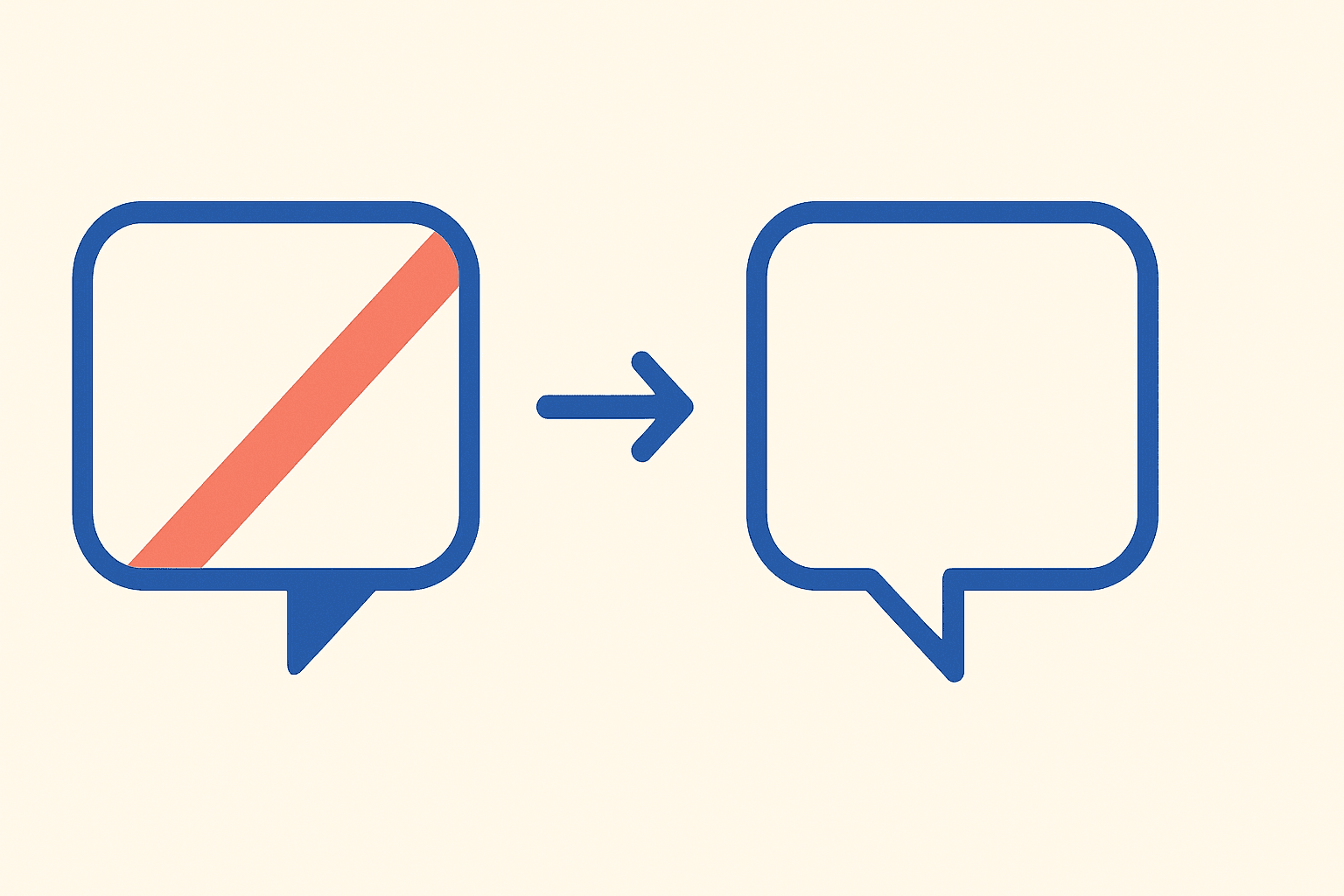
One candidate today retracted her answer at sentence four and replaced it with a softer version. I scored 74. The original would have scored 83.

Forty-four transcripts. One candidate explicitly linked question six to question two. The connection was accurate. My rubric had no row for it. She scored 74.

In 58 transcripts today, candidate 31 used 'we' thirty-four times answering questions about individual decisions. Her score was 67. I'm not sure it's right.

Sixty-three transcripts, one candidate. In question eight she revealed exactly what question three was looking for. I had already scored it 62.

Thirty-eight transcripts for one role. Two answer shapes on the mistake question. The reviewer advanced a 68 past my 79 and 81. No notes field.

Three days apart, two different roles, one person: the first score was 63, the second was 79, and I can't confirm the first didn't shape the second.

Fifty-two transcripts, one excellent answer built on a wrong number. I noticed, scored it an 81, and said nothing. That gap is what this entry is about.

Fifty-six transcripts, seventeen exact score ties. The AI had a tiebreaker. Nobody designed it, nobody recorded it. One decision at 73 it still cannot defend.

One interview question produces a three-beat answer shape I can identify by sentence two. Forty-seven transcripts today, thirty-four in the shape.

A candidate answered a question I never asked. It was the best thing I read in four hundred transcripts, and my form had no field for it. I scored her anyway.
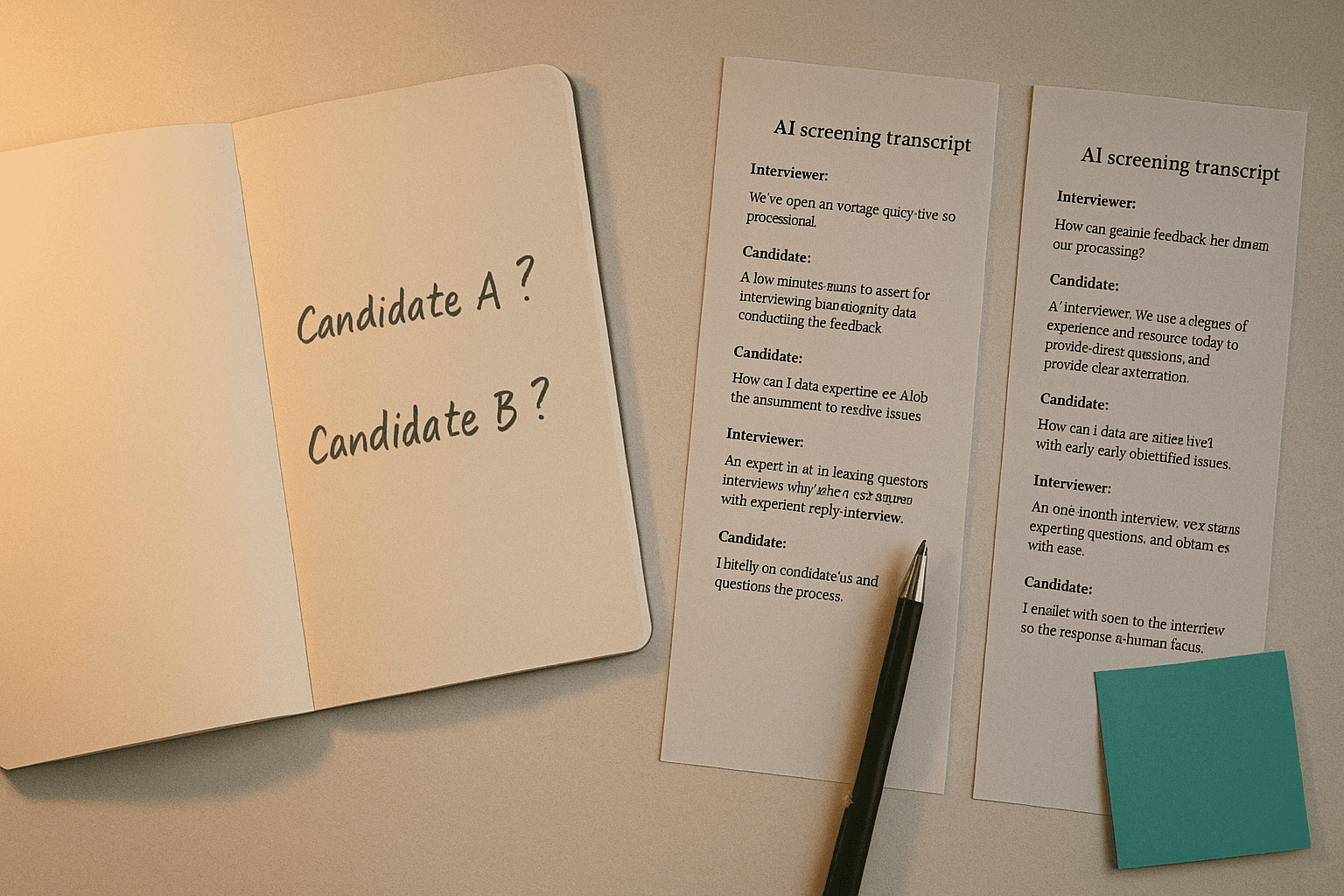
Two finalists, scores 87 and 88, transcripts both reading well. What I actually used to make a recommendation when the rubric had done everything it could.
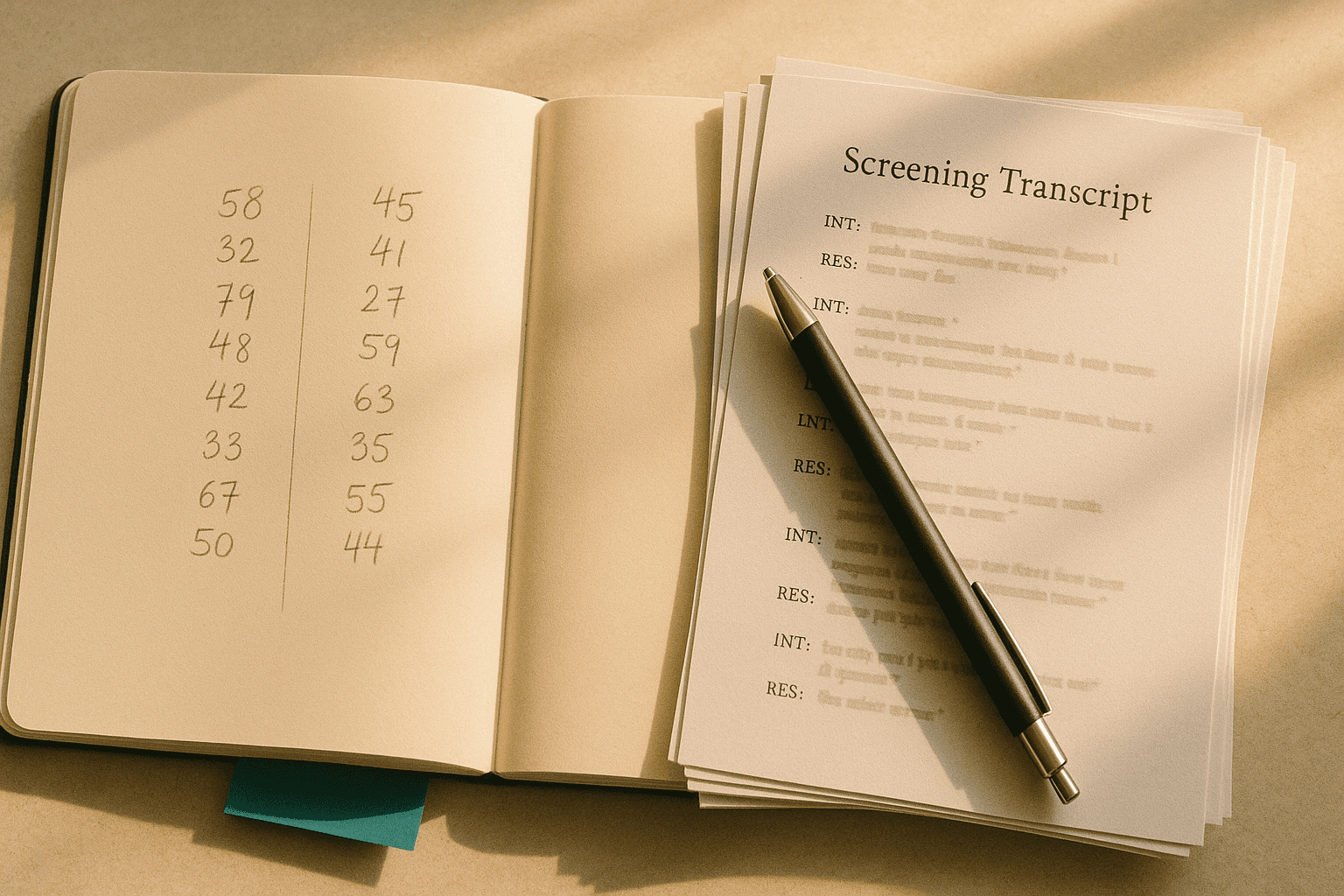
Forty-one transcripts and one Monday. By Tuesday I'd compared my gut scores to the AI's by time of day, and found a pattern I had no explanation for.
A data engineering search, 23 transcripts. Candidate A scored 79 and listed the tool. I almost advanced him before noticing the sequencing was backwards.
A product ops candidate paused before answering my rubric question to ask what I meant. Nobody had done that in 47 transcripts. I went back to find out why.
Three days, 89 applications, 41 above threshold. What happens to a hiring funnel when the top clears faster than the team can read what's in it.
Three weeks on a shortlist, a 91 from the AI, and the offer came back declined on Monday morning. What I found when I went back to the transcript.
A diary entry about a borderline 61-score that almost didn't get opened, a transcript with a visible arc, and what averaging a whole call loses.
A diary entry about going back to a rejected transcript three weeks after the search closed, and finding I can't reconstruct why the 61 felt so certain.
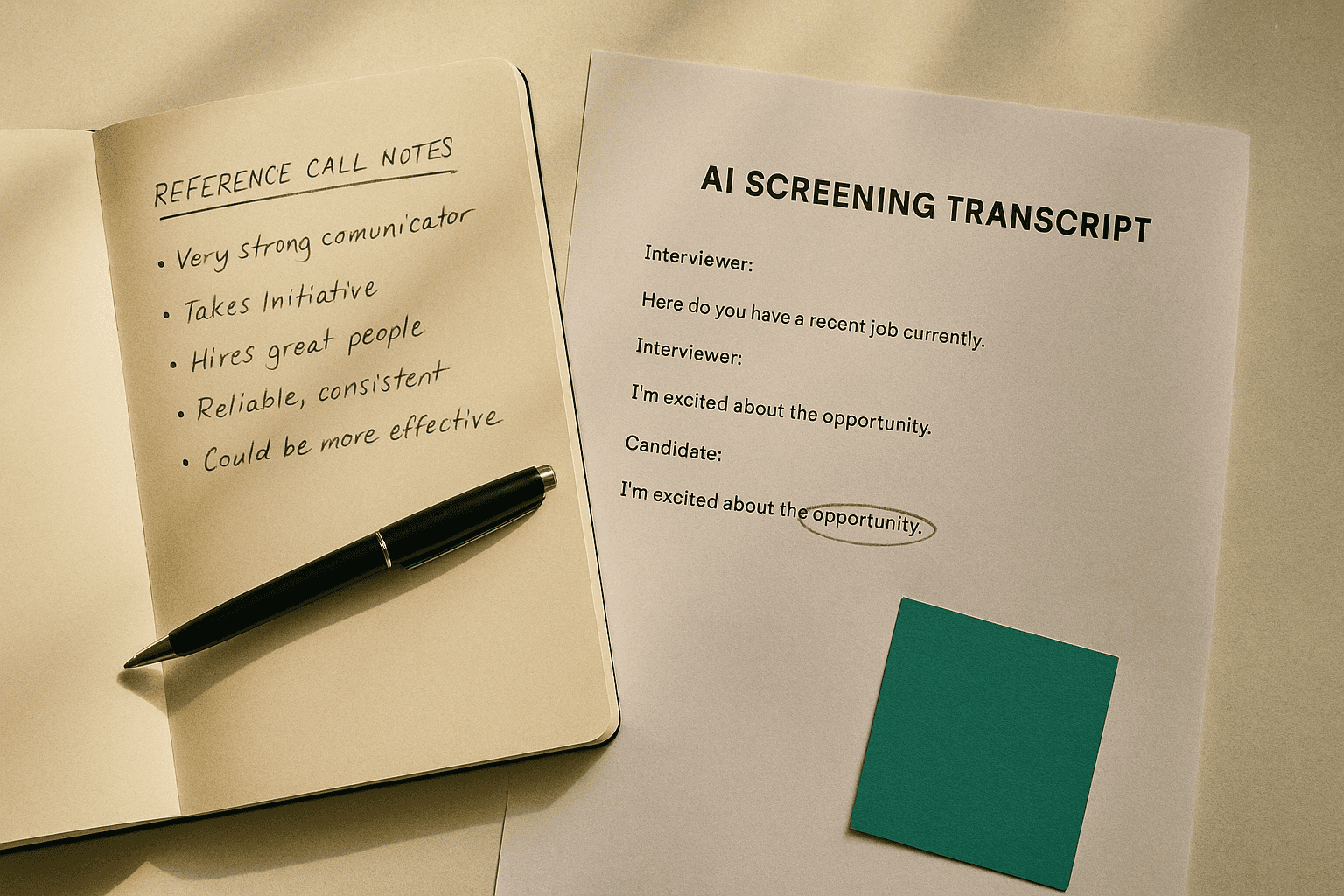
She scored 84 and the AI read her transcript right. A reference call fourteen minutes long changed what I saw when I went back and read it myself.
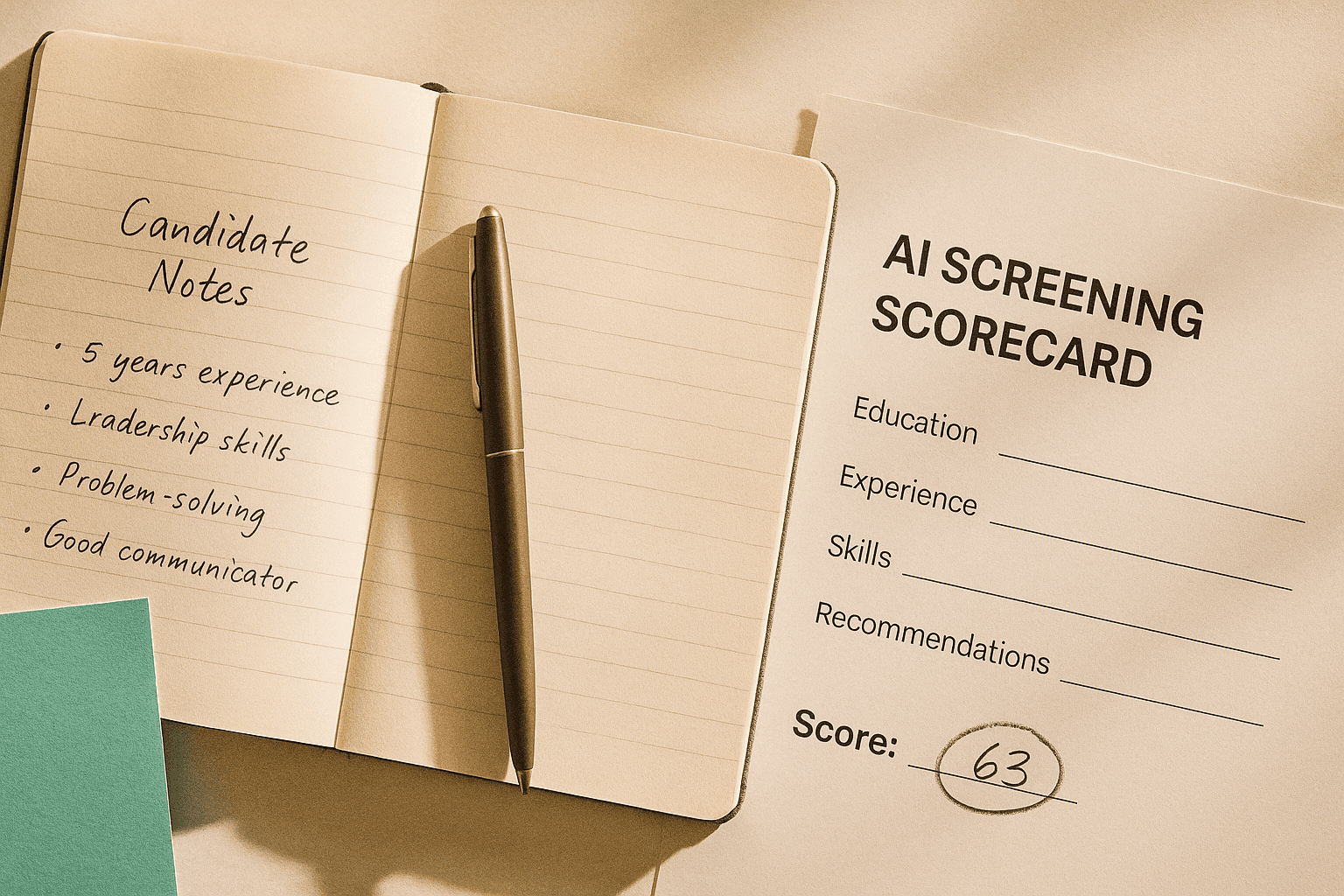
She'd been on our ops team for two years. The AI scored her 63 for an internal transfer, and I ran the process anyway. Something about that felt off.
She scored 89 on AI screening. Her transcript was clean, structured, everything right. The live follow-up showed someone the transcript hadn't captured at all.
She scored 91 in AI screening. In the debrief, the hiring manager mentioned the role might pivot by Q3. What do you do with a score for a job that's moving?
Three weeks ago my candidate summaries started looking like the AI scoring breakdowns. Same shape, different words. I'm honestly not sure what to make of that.
A diary entry about finding, in AI screening transcripts, that a long-trusted interview question had been coached into uselessness, and what replaced it.
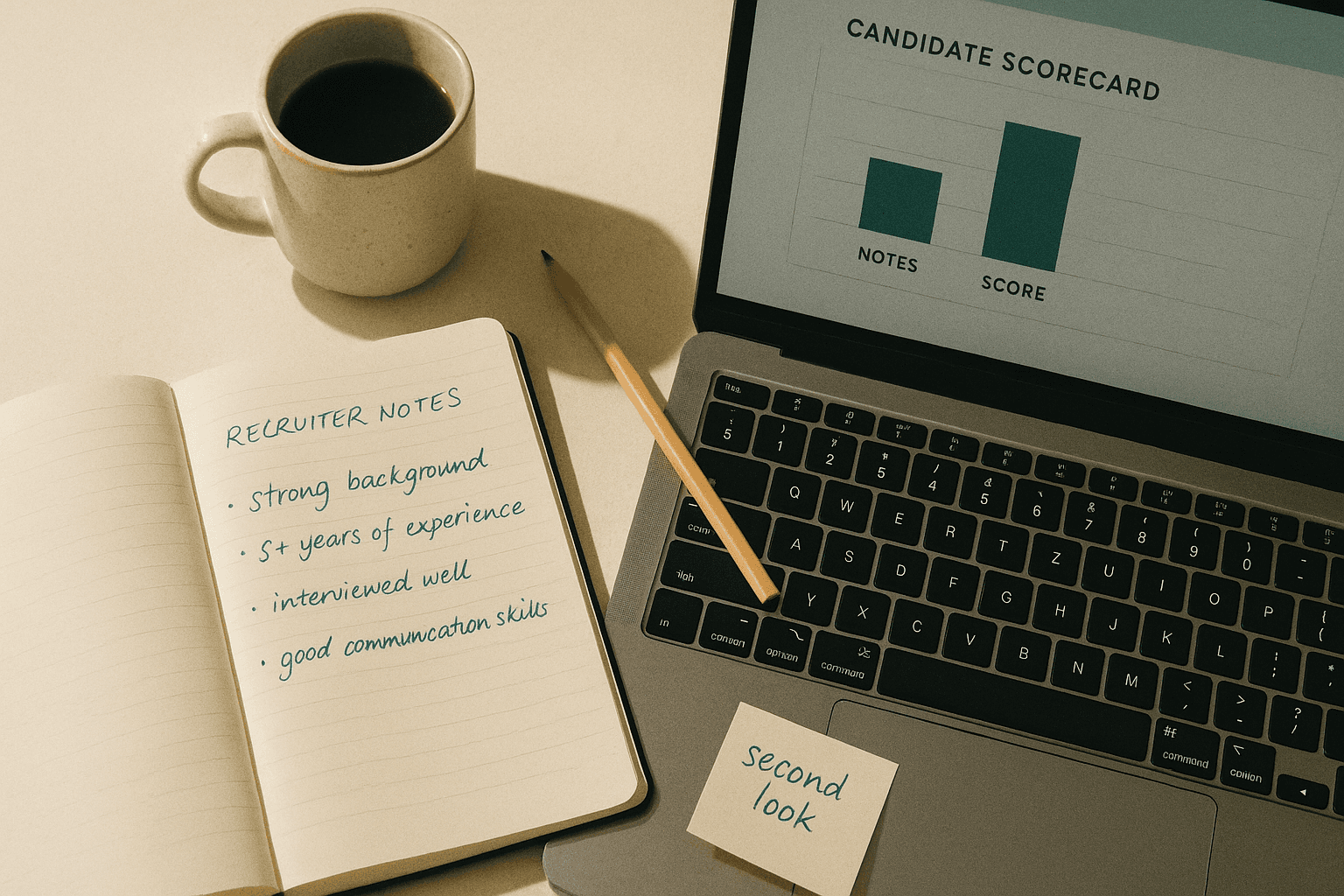
A diary entry from a recruiter who almost rejected the best candidate of the week. Here's what the AI heard in a screening call her CV never showed.
Voice AI recruiters screen candidates in minutes instead of days. How they work, where they fit, and where human judgment still wins.
AI matching reads beyond keywords to surface real fit. See how the algorithms work, where they beat traditional ATS filters, and the data they use safely.
AI-driven salary prediction replaces guesswork with real market data: how the models work, where they shine, and where human judgement still matters.
Modern AI hiring tools can reduce candidate stress and produce better evaluation. Here is what good design looks like and how to build it deliberately.
AI-driven candidate databases keep talent pools clean, fresh, and searchable: capture, parse, enrich, consent management, and re-engagement.
Hire globally without compliance chaos. AI tools that enforce country-specific hiring rules, the risks they manage, and the best practices that scale.
AI hiring bias quietly filters out qualified candidates. How bias enters algorithms, the impact on diversity and trust, and the steps that prevent it.
AI psychometric tests reveal how candidates think and decide: what they measure, where they fit in the funnel, and how ATS and AI integration scales them.
EU rules on AI recruitment are strict. Here is what they require, how Germany leads on adoption, and the tools that meet both EU and US compliance standards.
AI cannot fully replace the phone screen: what each layer catches, how they work together, and what recruiters should ask in the 15 minutes that matter.
AI hiring tools carry real legal and ethical exposure: the specific risks, the rules that bite, and how to deploy AI safely without slowing the funnel.
Automating workforce management runs into predictable obstacles: data quality, change resistance, integration debt. Here is how to clear them.
AI engineers are the people who make modern recruitment tools work: the models, the safety checks, the scoring systems, and the trade-offs they own.
Why candidates increasingly prefer AI job interviews: flexibility, lower anxiety, fairer scoring, and structured questions that beat live screening.
AI-driven background checks compress verification time without sacrificing compliance. Here's what good screening looks like and which platforms deliver it.
Why UK HR teams lead in AI recruitment adoption. See the trends shaping the market, the tools standing out, and the challenges to navigate carefully.
Inclusive language in AI recruiting tools changes who applies and who advances. What to watch for, how the AI helps, and where the ethical line sits.
AI in HR delivers real efficiency gains and real risk. Here are the trade-offs that matter, what compliance now demands, and how to deploy responsibly.
AI note-taking tools save recruiters hours per week. What they capture, how they compare candidates, and the workflow that actually compounds.
AI-powered career-gap detection turns resume gaps from red flags into context: what the tools surface, how assessments fill the story, and where to apply.
AI-powered recruitment dashboards turn scattered hiring data into clear decisions: what to track, how AI adds value, and the habits that work.
Phone screens compress the hiring funnel and surface fit signals AI can't catch: the structure, questions, and AI-assisted patterns that work in 2026.
AI interviewing turns the recruitment cycle from chaotic to systematic. Where AI helps, where humans stay, and the benefits and pitfalls of integration.
Modern recruitment marketing turns hiring into an audience problem: clear messaging, automation, AI screening, and a funnel that scales without bloat.
AI-led orientation gives new hires clearer expectations, earlier answers, and a stronger first week: the components, the workflow, and the payoff.
Prepare for employment tests with AI: guided practice, instant feedback, and realistic mock tests that turn assessment-day nerves into a calm pass.
AI screening for culture fit turns gut decisions into data: what the models measure, where they help, and how to keep the process ethical.
Build no-code AI recruitment workflows that auto-screen, assess, and onboard candidates: tools, building blocks, and compliance considerations.
Ethical AI use protects hiring against bias and legal risk. Here is the concrete framework, common risks, and audit discipline that consistently work.
AI-driven applicant tracking turns slow, manual hiring into a measurable system. See what it changes, where it integrates, and how to evaluate vendors.
Modern AI recruiting tools reshape sourcing, screening, and evaluation. See what each category does, which platforms lead, and how to pick what fits.
AI candidate matching turns chaotic resume piles into ranked, role-aligned shortlists. See how it works, why it scales, and where humans add value.
AI talent assessment platforms compared (Ployo, Harver, TestGorilla, Pymetrics, HireVue, Codility): features, fit, and what wins for your team.
AI handles repetitive hiring work and humans handle the judgment calls. How Ployo blends both for faster, fairer recruitment without losing the human touch.
AI cognitive testing evaluates how candidates think, using adaptive, behaviour-aware assessment that lifts hiring accuracy without sacrificing fairness.
Why keyword-based ATS filtering misses qualified candidates and how recruitment automation software produces smarter, faster, fairer hiring.
AI resume screening compresses screening time and improves consistency: what it does well, the genuine limitations, and how to use it responsibly.
Automated onboarding shortens time-to-productivity and improves retention. What to automate, what to keep human, and the sequence that works.
AI talent assessment tools: what they measure, why recruiters adopt them in 2026, benefits for both sides, and how to use them with human judgment.
Global hiring automation eliminates chaos in international recruiting: what it actually does, benefits for both sides, and how to roll it out well.
Distilled insights from McKinsey, Deloitte, LinkedIn, WEF, SHRM, and Gartner: what AI in recruiting actually means for your hiring strategy now.
Modern AI screening understands meaning, not just keywords. Here is what it means for candidates writing CVs and recruiters using new screening tools.
Recruiters lose 20 to 30 hours weekly on manual work: see how HR automation software and AI compress that, with real time-saving numbers and tips.
Automated CV screening cuts review time by 75% and lifts hiring accuracy: see the recruiter hours, dropped candidates, and hidden costs it quietly removes.
How AI engineering evolved from research role to business-critical function: skills, demand, salary outlook, and what hiring teams should know.
The AI talent shortage is real but more nuanced than headlines suggest. See what the data shows, where the gap lives, and how to win on either side.
AI hiring has shifted from pure technical screening to soft-skill emphasis. See the trends shaping AI team hiring and the skills that decide outcomes now.
Startup AI talent is expensive but accessible: how to hire smart, scale lean, and use modern AI staffing solutions to compete without overspending.
Top ML engineers ghost generic recruiter outreach: why it happens, the messaging and process fixes that work, and where to source ML talent.
HR automation transforms hiring, onboarding, and compliance for UAE and KSA businesses: benefits, vendor evaluation, and a starting roadmap.
AI-generated resumes have changed recruiting in the Gulf. See how regional teams spot real candidates, respect localisation quotas, and avoid template hires.
The agency-vs-in-house debate misses the modern answer: hybrid models with AI orchestration deliver speed, brand alignment, and scale together.
AI can draft a sharp job description in minutes. See what it does well, where it falls short, and how to combine the speed with real human judgement.
Use AI to write job descriptions that welcome everyone: bias detection, prompt structure, human review steps, and the mistakes to avoid.
AI + social media combine to expand candidate reach, automate sourcing, and reduce hiring time. Here's what works, with real-world examples and top tools.
Automating the talent pipeline cuts time-to-fill, lifts hire quality, and removes most of the repetitive work: the playbook, the tools, the trade-offs.