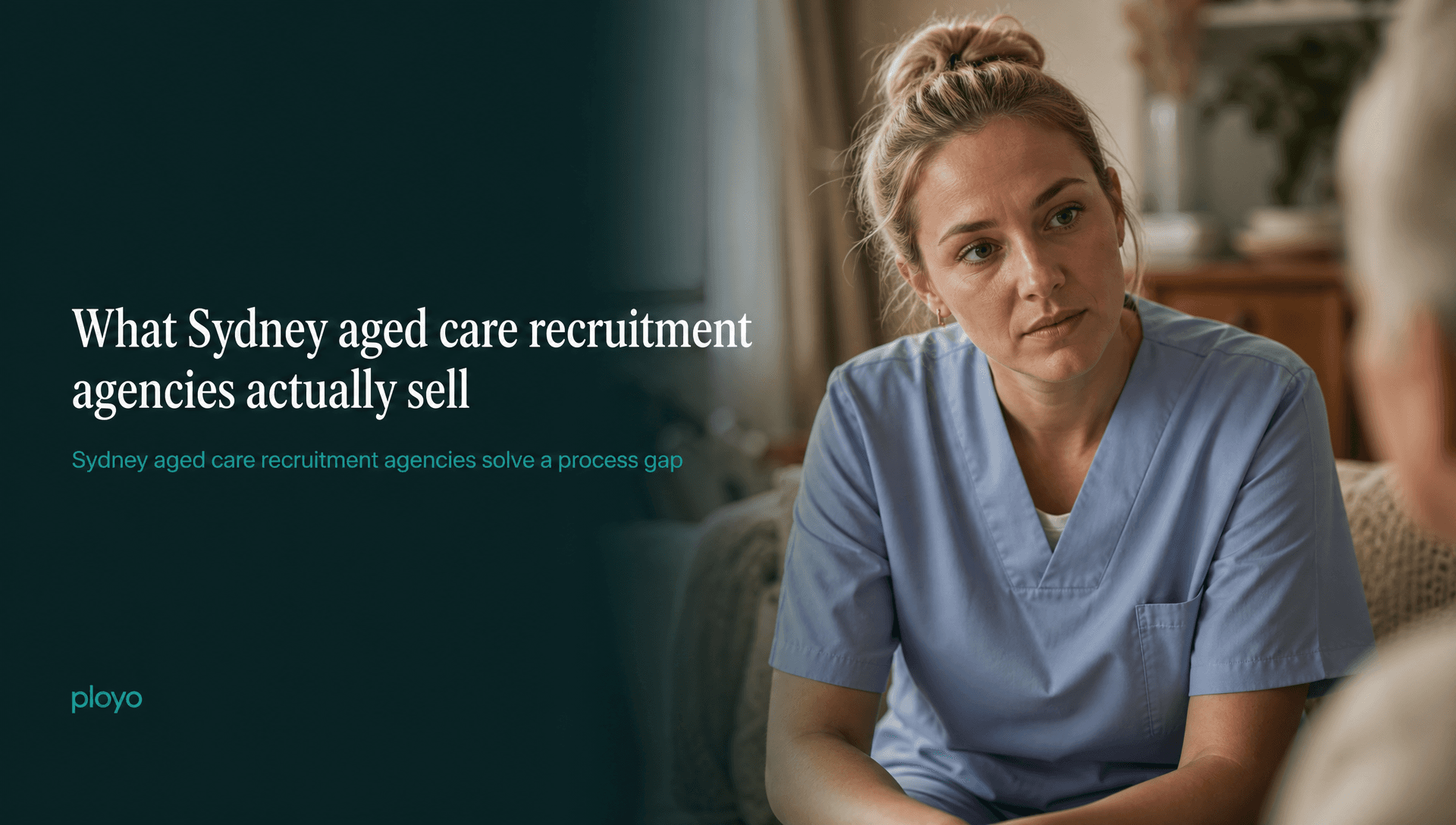
What Sydney aged care recruitment agencies actually sell
Sydney aged care recruitment agencies solve a process gap, not a talent shortage. Here is what the fee buys, when it earns itself, and when direct hiring wins.
Ployo Team
Ployo Editorial
Most Sydney aged care providers call a recruitment agency when they cannot fill a vacancy fast enough. The agency comes back with five candidates. The provider picks one, pays the fee, and treats the problem as solved. What most providers do not track is how many of those candidates had already applied directly to aged care providers in the same area in the past few months.
That is the business the agency is in. Filtering candidates faster than your process does, not finding candidates you could not.
What aged care recruitment agencies in Sydney are actually selling
The candidate pool for aged care in Sydney is not hidden from providers. Sydney has hundreds of residential and home care facilities spread across Western Sydney, the North Shore, the Inner West and the South. Personal care workers and aged care workers move through that system on a cycle. They change employers. They return to the sector after a break. They respond to job ads on SEEK like everyone else.
A Sydney aged care agency has three real offerings.
First is compliance pre-screening: Working With Children Checks, NDIS Worker Screening, police checks, immunisation records. This is genuine work, it takes time, and an agency that handles it well saves real hours.
Second is speed. If a provider has no structured hiring process, the agency's process runs faster by default. That is not access to better candidates. That is the agency's admin being more organised than the provider's admin.
Third is warm relationships with candidates who are not actively job hunting but are open to moving. This is real and narrower than it sounds. For specialist roles it matters. For certificate III support work, the candidate who is not on SEEK is a small fraction of the available pool.
When a Sydney aged care agency earns its fee
There are situations where the agency model makes genuine sense in Sydney.
Specialist roles: registered nurses with aged care experience, care coordinators, clinical leads. The candidate pool for these roles is genuinely smaller, the wrong hire is expensive, and the agency's investment in those candidate relationships over years adds real value.
Leadership hires: care managers, general managers, directors of nursing. Same logic applies.
Temp-to-perm or urgent short-term coverage: if you need a qualified AIN on the floor within 24 hours, the agency has the operational machinery for that. That is what it was built for.
For roles in this category, the fee earns itself. The question the provider needs to ask is whether the specific role they are filling is actually in this category.
When direct hiring wins
Volume hiring of personal care workers and certificate III aged care workers in Sydney is where the agency model tends to stop making sense.
The constraint in Sydney for these roles is not supply. Qualified candidates apply to roles in the sector consistently. The constraint is assessment: filtering the volume of applicants quickly enough to make an offer before the candidate accepts somewhere else.
Providers who default to agency for volume hiring are usually paying for a filtering service on applicants who would have come to them anyway. The agency's pre-screening step has value, but the fundamental bottleneck is the provider's own assessment process, not the agency's access to candidates.
This is what the aged care recruitment challenge in Sydney actually looks like for most providers: a process gap, not a talent gap.
A structured direct process for aged care hiring in Sydney
The compliance timeline in Australian aged care is fixed. The NDIS Worker Screening Check takes weeks and must complete before the person starts in a risk-assessed role. Working around that timeline is the core operational problem.
A structured direct process works backward from it.
Pre-screen applicants against role requirements before compliance checks begin. Only initiate compliance checks for candidates who would otherwise progress. That step alone cuts wasted time significantly.
Run structured interviews with every candidate before any face-to-face commitment. The purpose is not automated rejection. It is getting consistent information from every applicant so the in-person interview is used for finalists who have already demonstrated they can do the role. Tools like AI video interviewers run this step at the volume most aged care providers hire at, without requiring a recruiter's time for each candidate.
Reserve the final assessment for the people worth your time. The compliance timeline stays the same. The assessment step gets faster. Fewer candidates progress to compliance checks only to fail at a later stage.
For providers navigating this in practice, how to hire aged care workers in Australia covers the full sequence in detail.
The numbers that matter
A placement fee for a personal care worker represents a real slice of that person's first-year employment cost at aged care wage rates. For a provider that fills 20 to 30 roles per year through agencies, that total is a line item worth examining carefully.
The agency case is easier to defend when fees concentrate on specialist and leadership roles, where the value of the placement relationship is higher. It becomes harder to defend when applied uniformly to volume hiring of personal care staff.
The honest version of the comparison is not agency versus nothing. It is agency versus a structured direct process. If the direct process does not exist yet, building it costs something. But the ongoing cost of agency volume hiring usually exceeds the cost of building the process.
Sydney aged care providers who have shifted from agency volume hiring to structured direct hiring find the same thing: the candidates were there. They needed a faster, more consistent way to reach them.
The agency was doing that job. It is one worth doing yourself.
Ahmed Raza, co-founder, Ployo
If you are reviewing your hiring process for aged care in Australia, book a call to walk through what a structured direct process looks like in practice.