Why most AI talent assessment tools measure the wrong thing
Most AI talent assessment tools score cognitive ability or personality traits. Here is what that misses, and how to choose tools that actually predict job fit.
Ployo Team
Ployo Editorial
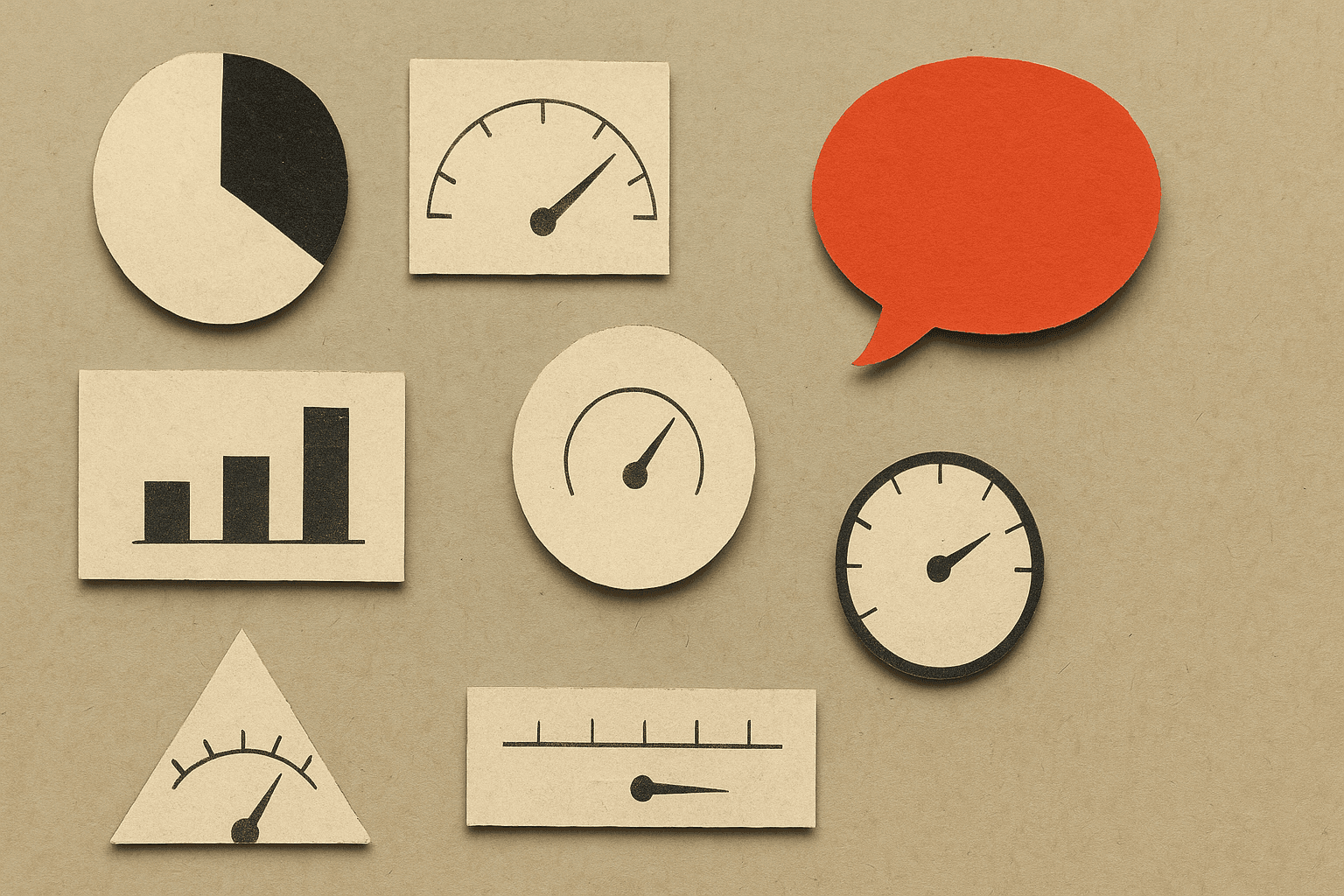
AI talent assessment tools are proliferating fast. Walk into any HR tech conference and you will find dozens of vendors, each with a dashboard, a score, and a claim about predictive validity. Most of them are measuring something real. The problem is the something real they measure does not map tightly onto whether a specific person will succeed in a specific role at your specific company.
That gap is where most hiring mistakes happen.
What most AI talent assessment tools actually evaluate
The category breaks into three broad approaches. Cognitive ability tests: abstract reasoning, numerical reasoning, verbal comprehension. Personality inventories, usually a variant of the Big Five dressed up under trade names. Situational judgment tests: short scenarios asking what you would do when a client escalates or a colleague misses a deadline.
Each has legitimate grounding in decades of industrial-organizational psychology. Cognitive ability is among the better-validated predictors of job performance that the field has identified. The problem is not that these constructs are fake. The problem is that they are general.
Generality is a feature when you are a vendor selling to hundreds of employers across dozens of industries. A test that works at a logistics company, a hospital, and an accounting firm is a scalable product. For any single employer, generality is a cost. You are not trying to predict average performance across all roles. You are trying to predict whether this particular person will succeed at this particular job.
The variance that general AI assessments leave behind
Even the better-validated assessment tools leave a substantial portion of individual job performance unexplained. The factors that close that gap tend to be contextual: how someone handles the specific ambiguities of your environment, whether they learn your systems, how they communicate when things go wrong, whether their judgment holds under the pressures particular to your operation.
Personality traits speak to stable tendencies across situations. A candidate who scores high on conscientiousness is, on average, more reliable. But "on average" and "in your specific context" are different claims. A highly conscientious candidate who cannot communicate uncertainty to your type of client is still a poor hire. The personality score will not tell you that.
This is not an argument against assessment. It is an argument for being precise about what any given score is and is not telling you, and for asking whether the tools you are buying can observe something closer to actual job behavior.
What a structurally different AI talent assessment looks like
Some tools in the talent assessment category have moved toward a different premise. Rather than measuring abstract traits and projecting them onto the job, they observe candidates doing something structurally similar to job tasks.
A structured AI video interview is one example. Every applicant answers the same role-specific questions in conditions that approximate a real work interaction. The AI evaluates substance: the quality of reasoning, how candidates handle follow-up questions, how they communicate under mild pressure. The output is not a trait score to interpret; it is a ranked shortlist with the interview recordings to review.
This is closer to a work sample than a trait battery. Work samples tend to outperform general cognitive measures for predictive validity on the assessed task, which is why industrial-organizational psychology treats them as a distinct approach. The tradeoff is scale: historically hard to deploy consistently across candidates. An AI-evaluated structured interview restores the comparability advantage of a standardized test while keeping the contextual signal of task performance.
For high-volume hiring, the compounding effect is significant. If you are shortlisting twenty candidates from two hundred applications, a ranking built on job-relevant conversation is more actionable than one built on abstract pattern recognition. Candidate screening software that evaluates structured conversation at scale closes the gap between what talent assessment has traditionally measured and what hiring teams actually need to know.
Ployo's AI video interviewer takes this approach: every applicant goes through the same structured interview, receives a score on a consistent rubric, and the hiring team gets a ranked shortlist with the recordings to watch. There are no abstract trait scores to interpret. The AI handles the first layer of evaluation; the hiring team handles the second.
Four questions to ask any AI talent assessment vendor
These usually separate tools worth using from dashboards that produce the feeling of rigor without improving the shortlist.
What exactly is this scoring? "Fit" and "potential" are not answers. If a vendor cannot explain in plain terms what construct the score represents, that is information.
What is the criterion validity for your role type? A study showing the tool predicts performance in your industry is more useful than one showing it predicts "general job performance."
What does the output look like for a real candidate? A score with a recommendation you cannot examine is less useful than a ranked evaluation where you can see why the ranking was produced.
Does the tool assess in context? Generic scenario tests designed to work across all industries miss the contextual signals that matter for your specific role. Ask whether the question set can be tuned.
The differentiating factor is what you can do with the output the day after a job closes.
Can you build a useful AI talent assessment for any role?
Most AI talent assessment tools are designed to be general and can be configured for different roles to varying degrees. Tools built on structured AI video interviews allow more role-specific tuning because the question set is the lever. Fully generic cognitive and personality tests cannot change what they measure, only the threshold you set.
How do you know if an AI assessment tool is actually improving hire quality?
Define what a good hire looks like before you deploy the tool, run it on a cohort, and check whether the tool's ranking correlates with performance six months later. Few employers do this systematically. Vendors who encourage the evaluation are worth more of your attention than those who do not.
Does a higher assessment score mean a better hire?
Not reliably, because most assessments measure general traits and your decision is specific. A top-quartile score on abstract reasoning predicts better average performance across many roles. Whether that candidate will perform well in your specific role is a narrower question that the score only partially answers.
If you want to see what a structured AI video interview looks like in practice, the conversation is here: https://cal.com/ahmed-raza-28/ployo-discovery.
Ahmed Raza, co-founder, Ployo