
An AI recruiter that interviews every applicant for you
Ployo's AI recruiter interviews every applicant the moment they apply, verifies the requirements that matter for the role, and hands your human recruiters a ranked shortlist backed by evidence, so their time goes to qualified candidates instead of the first pass through a CV pile. It does the screening grunt work end to end. It does not decide who gets hired, that judgment stays with your team, every time.
30-minute call · See Ployo on one of your live roles
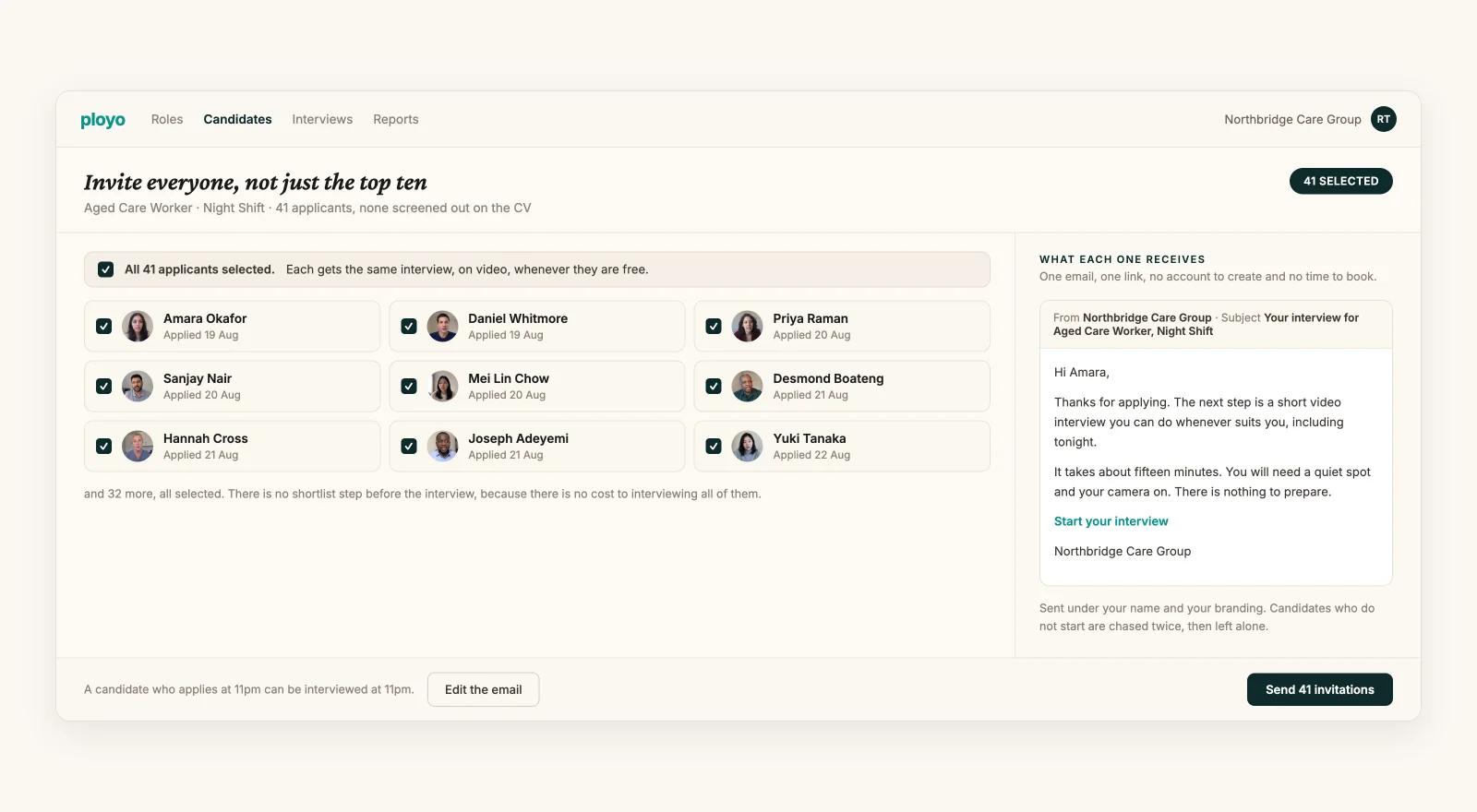
INVITE EVERYONE, NOT JUST THE TOP TEN
What an AI recruiter is, and what it is not
An AI recruiting assistant is software that performs the repetitive, high-volume parts of recruiting, parsing CVs, screening candidates, running interviews, ranking a shortlist, so a human recruiter doesn't have to do them one applicant at a time. What it is not: a decision-maker. Ployo's AI recruiter doesn't reject or hire anyone. It evaluates every applicant against your requirements, shows its work, and leaves the call to a person.
What Ployo's AI recruiter does, end to end
It parses every CV against the role's requirements with cited evidence, runs a short AI video screening call to verify must-haves in the candidate's own words, and conducts a full, live, two-way AI video interview for candidates who clear that bar, adaptive, camera on, recorded with a transcript. Every step produces an evidence-backed record on the candidate, culminating in a ranked shortlist your recruiters review.
The human and AI division of labor
The AI recruiter owns the volume: reading every CV, phone-screening every applicant, interviewing everyone who clears screening, none of which a human team can do at scale without hiring more recruiters. The human owns the judgment: reviewing the evidence, deciding who advances, running final-round conversations, extending offers. That split is deliberate, the AI removes hours of repetitive screening work; it doesn't remove the recruiter from the loop.
Trust and auditability
Every verdict the AI recruiter produces traces back to a transcript. A must-have marked "not met" links to the moment in the call or interview where that was established, a good-to-have result links to the quote that justified it. If a hiring decision is ever questioned, a recruiter can pull up the exact evidence in under a minute instead of relying on a black-box verdict.
Why this beats a human-only funnel at volume
A recruiter with a full calendar cannot phone-screen 200 applicants for one role, so most roles today get a partial pass: a keyword filter drops most CVs, and only a handful of survivors ever get a real conversation. An AI recruiter removes that ceiling. Every applicant gets screened and, if they clear it, interviewed, so a strong candidate whose CV undersells them still gets heard instead of getting filtered out before a human ever looks.
Getting started
Paste in a job description and the AI recruiter builds the question set for that role automatically. From there it runs itself, candidates apply, get screened and interviewed on their own schedule, and results land on your dashboard as they finish. Most teams have it running on a live requisition within a day.
The same answer, two formats
A first round is worth what it can find out. Both of these are real screening formats and both work; they differ in what happens after the candidate stops talking.
Typed answer
“One of our residents kept trying to leave at night. I sat with her, worked out she was looking for her husband, and changed her evening routine.”
Submitted, scored, and the interview moves to the next question. Written in private, at the candidate’s own pace, with every tab on their machine available to them.
Spoken answer
“One of our residents kept trying to leave at night. I sat with her, worked out she was looking for her husband, and changed her evening routine.”
And then, unscripted
“You changed the routine. Who signed that off, and what did you write in the notes?”
That second question did not exist until she gave the first answer. It is the one that separates a story a candidate can tell from a shift they actually ran.
Ployo platform data
30,000+
AI Interviews Completed
340,000+
Candidate Answers Graded
70%+
Interview Completion Rate
15,000+
Recruiter Hours Saved
Every applicant already screened and interviewed, a ranked shortlist with cited evidence waiting instead of a CV pile.
- Ranked shortlist with CV, screening, and interview evidence attached
- Met / partially met / not met status on every must-have
- Full recordings and transcripts, one click from any verdict
- One-click override with an audit trail kept
A consistent, defensible hiring process, every applicant evaluated the same way, every cycle.
- Every verdict traceable to a transcript, nothing decided in a black box
- Recruiter time redirected from screening to judgment calls
- Pass-rate analytics per requirement, so you can see which one is emptying the shortlist
Frequently asked
01Will an AI recruiter replace human recruiters?
No. It removes the repetitive screening grunt work, reading every CV, phone-screening every applicant, that eats a recruiter's day, but it doesn't decide who gets hired. Every verdict is a recommendation with cited evidence; a human recruiter reviews it and makes the call.
02What does an AI recruiting assistant actually do?
It parses CVs against role requirements, runs a short video screening call to verify must-haves, conducts a full video interview for candidates who clear screening, and produces a ranked, evidence-backed shortlist, all without a recruiter manually working through each applicant.
03Does the AI recruiter make hiring decisions?
No. It evaluates candidates and shows the evidence behind every verdict. Advancing, rejecting, or hiring a candidate is a decision your team makes, and every AI verdict is overridable from the dashboard.
04How is this different from an AI recruiting agent that sources candidates?
Sourcing agents find and reach out to potential candidates before they apply. Ployo's AI recruiter works on the inbound side, once someone applies, it screens, interviews, and ranks them, which is the part of the funnel that usually bottlenecks on recruiter hours.
05Can recruiters override the AI's assessment?
Yes, every status and verdict is overridable from the dashboard with a one-click reversal, and overrides are logged for audit purposes.
06What tasks does the AI recruiter take off a recruiter's plate?
Reading every CV line by line, phone-screening every applicant one call at a time, and conducting first-round interviews with candidates who may not even meet the must-haves. What stays on a recruiter's plate is reviewing the evidence and making the actual hiring call.
07Is every verdict the AI recruiter produces traceable?
Yes. Every met, partially met, or not met status links back to the specific line in a CV or the specific moment in a call or interview transcript that justified it. Nothing is asserted without evidence a recruiter can check.
08How does the AI recruiter integrate with our ATS?
Ployo manages the pipeline itself, so a team with no ATS needs nothing else. If you already run one, the ranked shortlist pushes into Greenhouse, Lever, Workday, Workable, Ashby, BambooHR and other ATS platforms, so your team keeps working from the system you already use.
09What kinds of roles is an AI recruiter best suited for?
Anywhere applicant volume outruns recruiter hours, high-volume retail, hospitality, contact centre, and care roles are the clearest fit, but the same screening and interview pipeline works for professional and technical roles too, wherever a role gets more applicants than a recruiter can personally interview.

TRUSTED BY HIRING TEAMS AT








See it on one of your live roles
Book a Demo, a 30-minute call. We'll set Ployo up on a role you're hiring for right now and walk through the shortlist.
30-minute call · See Ployo on one of your live roles