
AI screening for contact centre recruitment, interview every applicant
Contact centre and BPO hiring runs against the toughest retention math in employment: agent attrition regularly reaches into the tens of percent a year, so the hiring line never really closes, and a bad-fit hire discovered three weeks into training has already cost you the seat, the ramp time, and the client SLA. Ployo runs a structured AI screening interview with every applicant the moment they apply, language proficiency, systems and typing readiness, availability and notice period, scores each against the role you wrote, and hands your team a ranked shortlist with the recording, transcript, and cited evidence behind every score, so you staff the floor with people likely to still be there in month three.
30-minute call · See Ployo on one of your live roles
Interview every applicant, at the pace an always-open hiring line demands
Contact centre attrition means recruiting never really stops, and a coordinator manually phone-screening every applicant for language, communication, and systems readiness simply can't keep pace with a hiring line that never closes. Ployo interviews everyone who clears your basic requirements: a structured screening call with Sarah covering language proficiency, comfort with the systems and typing pace the role needs, and availability including notice period, run thousands in parallel. A large applicant pool becomes a ranked shortlist overnight instead of a backlog that keeps growing faster than your recruiters can clear it.

Verify language proficiency, systems readiness, and work setup before day one
A contact centre role lives or dies on communication clarity, comfort navigating the systems an agent will use every call, and, for remote roles, a genuinely workable home setup. Ployo asks every applicant directly during screening about their spoken and written language level, their experience with call-handling or CRM systems, their notice period, and their home working environment if the role is remote, and captures every answer on video with a timestamp your team can review. You stop discovering a language or setup gap three weeks into a training cohort.
Screen for resilience and tone, the traits that predict who survives the floor
Technical aptitude gets someone through onboarding; the resilience to handle a difficult caller politely, call after call, is what determines whether they last past their first bad week on the floor. Ployo asks every applicant the same structured behavioural questions, how they'd de-escalate an angry customer, how they maintain tone across a long shift, why contact centre work, and scores their answers against your rubric with the verbatim quote attached as evidence, giving you a fair, comparable read on floor-readiness across a high-volume applicant pool instead of a guess made from a resume.
Sits alongside your background checks and client-mandated vetting, it doesn't replace them
Ployo screens suitability and fit. It does not perform, and never claims to perform, the background checks, credit checks, or client-mandated security vetting that many contact centre programmes require before an agent handles live calls or sensitive data. Those remain your mandated, separate steps. What Ployo gives you is a clean, documented suitability picture, including what a candidate told you about language, systems experience, and availability, before those checks begin, so your vetting effort is spent on the people you actually want to bring onto the floor.
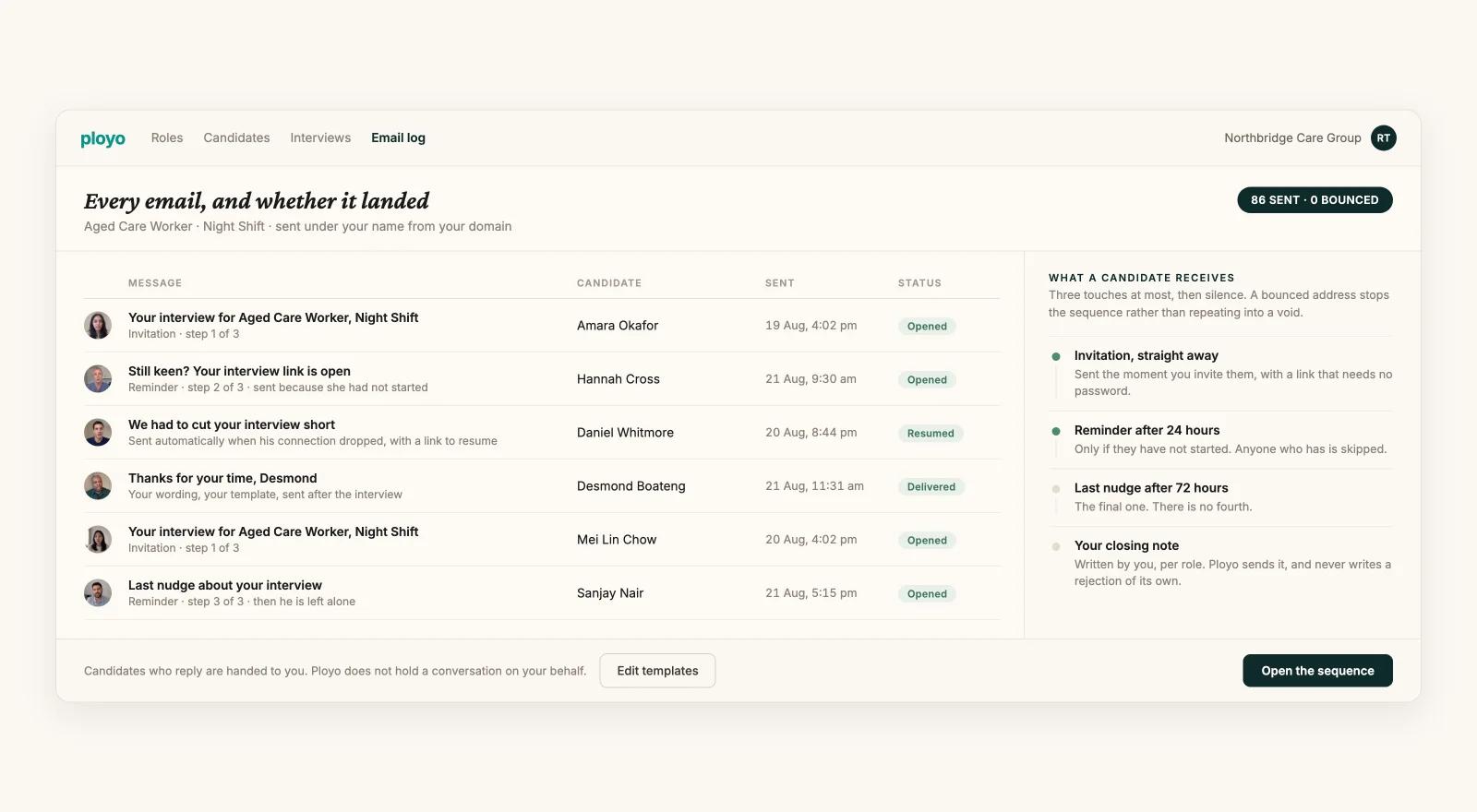
Every email, and whether it landed
Explainable AI. Humans decide.
Contact centres run at a volume where it's tempting to let a scoring tool quietly reject people nobody reviews. Ployo is built to make that impossible: every score is evidenced, and your team makes every call.
No black-box number. Each requirement links to the exact moment in the interview that justified it, your team lead or workforce manager can audit any score in under two minutes and see why a candidate ranked where they did.
Ployo never auto-rejects. It interviews, scores, and surfaces evidence; your team reads the shortlist and decides. The AI does the listening at scale that a recruiter clearing a constant applicant queue can't, it does not do the deciding.
Everyone is asked the same structured questions in the same language options and scored on the same rubric, which removes the accent and first-impression bias that can creep into manual phone screens. Candidates can interview on any device, whenever suits their current schedule, which widens your pool rather than narrowing it.
Frequently asked
01How does Ployo screen for language proficiency and communication skills?
Every applicant completes a structured screening interview in which Sarah asks role-relevant questions and assesses spoken and written communication directly, alongside how the candidate handles common contact centre scenarios like an escalation or a confused caller. Each candidate is scored against the same rubric with the verbatim quote attached as evidence, so your team gets a comparable, defensible read on communication across a large applicant pool.
02Can AI interviewing introduce accent or first-impression bias against contact centre candidates?
That risk is real with poorly built tools, which is why Ployo is structured to reduce it, not add it. Every candidate is asked the same questions and scored against the same role rubric, removing the accent, tone, and first-impression bias that manual phone screens are prone to. Ployo never auto-rejects, it surfaces evidence and a score, and your team makes every decision, which widens access for strong candidates who don't interview like a typical native-accent hire.
03Does Ployo replace background checks or client-mandated security vetting?
No, and that distinction matters, especially for programmes handling financial or sensitive data. Background checks, credit checks, and any client-mandated vetting remain your mandated, separate steps, and Ployo does not perform them or claim to. It gives you a documented suitability picture for every applicant so your vetting effort, which is often the slowest and most expensive part of onboarding, is spent only on the candidates you actually intend to hire.
04Can Ployo reduce the cost and speed impact of high contact centre attrition?
Yes, that is where high-volume AI screening earns its keep. Because attrition means your hiring line never really closes, Ployo screens every applicant in parallel, 24/7, so backfilling a departing cohort doesn't stall behind a recruiter's calendar. Pricing scales with throughput, not per recruiter seat, so constant hiring volume doesn't scale your cost line the same way constant recruiter headcount would.
05Does Ployo work for remote or work-from-home contact centre roles?
Yes. For remote roles, Ployo's screening interview asks directly about a candidate's home working setup, connectivity, and a quiet, dedicated space to take calls, alongside the language, systems, and availability questions every applicant answers. Candidates complete the interview from wherever they are, on their own device, so a remote hiring pipeline gets the same structured, evidence-backed screening as an on-site one.
Trusted by hiring teams at








See it on one of your live roles
Book a Demo, a 30-minute call. We'll set Ployo up on a role you're hiring for right now and walk through the shortlist together.
30-minute call · See Ployo on one of your live roles