
AI screening for hospitality and QSR recruitment, interview every applicant
Hospitality and quick-service hiring never really stops: a hotel, restaurant, or QSR site can be filling front-of-house, kitchen, and event roles simultaneously, against the highest quit rate of any industry the market tracks. Phone-screening every applicant around split shifts and rotating rosters simply doesn't scale, so most venues interview a handful and hope. Ployo runs a structured AI screening interview with every applicant the moment they apply, split-shift availability, customer-facing communication, role-specific certifications, scores each against the role you wrote, and hands your team a ranked shortlist with the recording, transcript, and cited evidence behind every score, so you staff the shift before the vacancy costs you a service.
30-minute call · See Ployo on one of your live roles
Interview every applicant, at the pace hospitality actually hires
A single open shift in hospitality can attract applicants across front-of-house, kitchen, and event roles, all at once, and the venue that takes two weeks to respond loses the good ones to whoever calls back first. Ployo interviews every applicant who clears your basic requirements, a structured screening call with Sarah covering split-shift and weekend availability, customer-facing communication, and role-specific behavioural questions, and runs thousands in parallel. A vacancy that used to sit open through a slow shortlisting process gets a ranked, ready-to-interview shortlist overnight instead.
Verify split shifts, certifications, and availability before rostering
Hospitality rosters live and die on split shifts, weekend cover, and event surges, and the certifications a role needs, food safety, responsible service of alcohol, or an equivalent local qualification, are non-negotiable before someone touches a shift. Ployo asks every applicant directly during screening what they hold and what they can genuinely cover, and captures the answer on video with a timestamp your rostering team can review at any time. A certification gap or an availability clash surfaces before the roster is published, not on the night it matters, when a no-show costs you a service.
Screen for guest-facing composure, the trait that survives a bad night
Technical skill gets someone through training; composure under a slammed dinner service or an unhappy guest is what determines whether they last the season. Ployo asks every applicant the same structured behavioural questions, how they'd handle a complaint at the table, how they stay level through a rush, why hospitality, and scores their answers against your rubric with the verbatim quote attached as evidence. You get a fair, comparable read on guest-facing composure across every candidate, not a hunch formed on CV number sixty of a busy hiring week.
Sits alongside your background and licensing checks, it doesn't replace them
Ployo screens suitability and fit. It does not perform, and never claims to perform, your background checks or the statutory licensing, food-handling, or alcohol-service certifications your jurisdiction requires before someone starts a shift. Those remain your mandated, separate steps, exactly as your compliance process requires. What Ployo gives you is a clean, documented suitability picture, including what a candidate told you about the certifications and availability they hold, before those checks begin, so your verification effort goes to the people you actually want to hire, rather than being spent chasing paperwork from an unscreened applicant list.
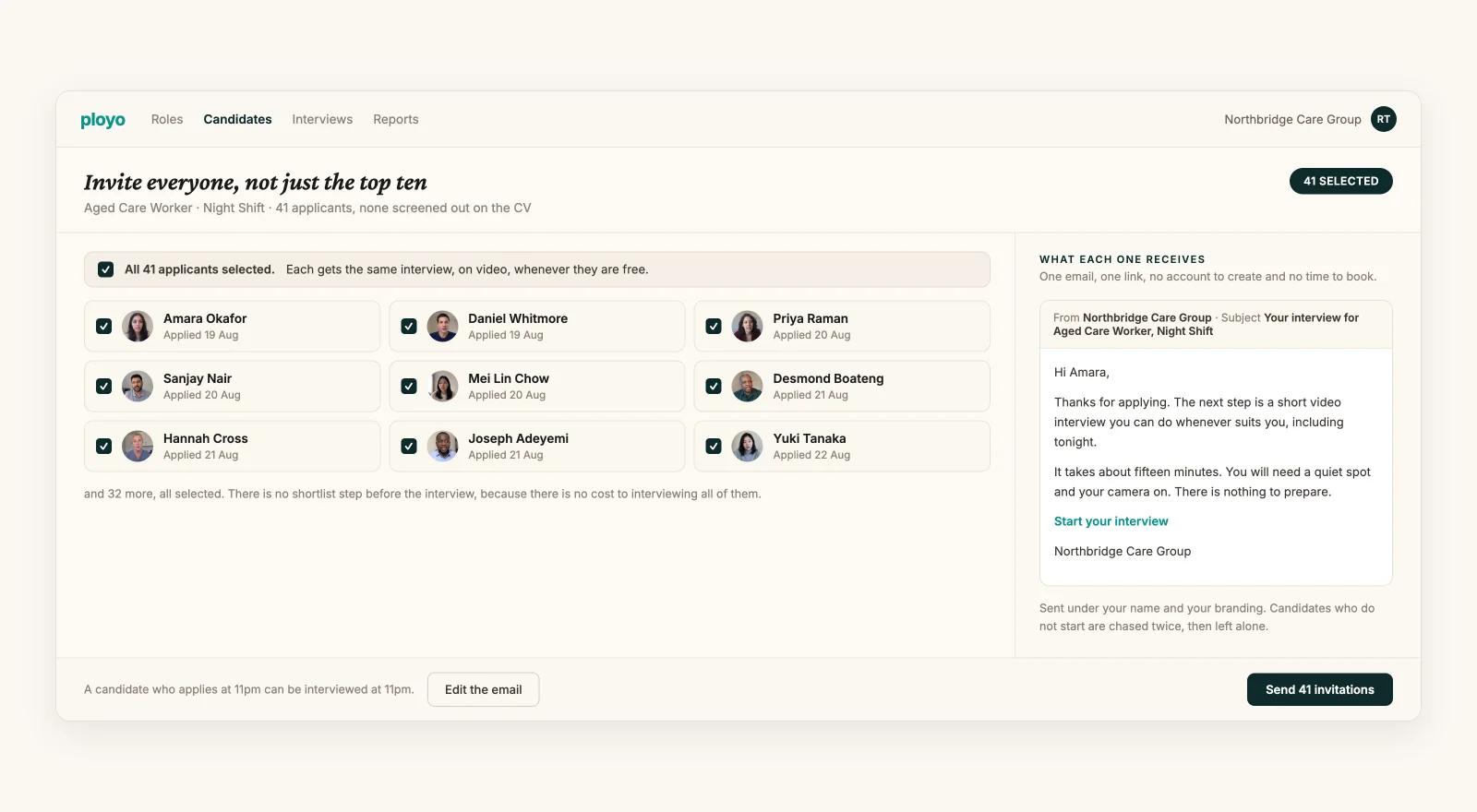
Invite everyone, not just the top ten
Explainable AI. Humans decide.
Hospitality runs on guest trust and razor-thin margins, so a screening process has to be fast without cutting corners on judgement. Ployo is built so every score is auditable, every decision is your team's, and the process holds up under scrutiny.
No black-box number. Each requirement links to the exact moment in the interview that justified it, so your venue manager can audit any score in under two minutes and see why a candidate ranked where they did.
Ployo never auto-rejects. It interviews, scores, and surfaces evidence; your team reads the shortlist and decides. The AI does the listening at scale a manager running service can't, it does not do the deciding.
Everyone is asked the same structured questions and scored on the same rubric, removing the first-impression bias that creeps into a rushed hire made mid-shift under pressure. Candidates can interview in their own language and on any device, whenever suits around another job or study, which widens your pool rather than narrowing it.
Frequently asked
01How does Ployo screen for hospitality-specific requirements like split shifts and certifications?
Every applicant is asked directly during their structured screening interview which shifts they can genuinely cover, including splits, weekends, and event surges, and which role-specific certifications they hold, such as food safety or alcohol-service qualifications. The answers are captured on video with a timestamp so your team can review exactly what was said, and each candidate is scored against the rubric you define for the role.
02Can AI interviewing introduce bias against candidates without hospitality experience?
That risk is real with poorly built tools, which is why Ployo is structured to reduce it, not add it. Every candidate is asked the same questions and scored against the same role rubric, removing the interviewer-drift and first-impression bias common in a rushed mid-shift hiring decision. Ployo never auto-rejects, it surfaces evidence and a score, and your team makes every decision, widening access for capable candidates transitioning into hospitality.
03Does Ployo replace our background checks or food safety and alcohol licensing requirements?
No, and it's important to be precise about that. Background checks and the food-handling, alcohol-service, or other licensing your jurisdiction requires remain your mandated, separate steps. Ployo does not perform them and never claims to. It gives you a documented read on what a candidate told you they hold, so your verification effort is spent on the people you actually want to bring in for that final check.
04Can Ployo handle high-volume hiring across multiple hospitality sites or a new venue opening?
Yes, that is where it earns its keep. Ployo runs a structured screening interview with every applicant in parallel, 24/7, so a multi-site chain or a new-venue opening can screen hundreds of applicants across front-of-house, kitchen, and event roles overnight rather than over weeks of manual phone screens. Pricing scales with throughput, not per recruiter seat, so a hiring surge doesn't blow up your costs.
05How does AI screening help reduce hospitality's high turnover?
Turnover in hospitality is driven as much by a bad fit as by pay, and a rushed hire made to fill a shift gap is often the mismatch that walks out within weeks. Ployo screens every applicant for the same composure and communication signals that predict whether someone lasts past their first busy service, and gives your managers evidence, not a gut call made under pressure, so the hires that stick get made more often.
Trusted by hiring teams at








See it on one of your live roles
Book a Demo, a 30-minute call. We'll set Ployo up on a role you're hiring for right now and walk through the shortlist together.
30-minute call · See Ployo on one of your live roles