
Sponsoring care workers without losing six months
Updated September 2026
Sponsorship comes up when a provider has exhausted the local market, and it is usually raised as though it were a faster option than it is. It can genuinely solve a structural shortage. It will not cover a roster gap in March, and treating it as a hiring channel rather than a project is where most attempts stall.

The pathways a care provider actually uses
Three routes come up repeatedly in aged care and disability support. Which applies depends on the occupation, your location and whether an industry agreement covers you.
Requirements, occupation lists and thresholds change, sometimes with little notice. Confirm the current position with the Department of Home Affairs or a registered migration agent before relying on any summary, including this one.
| Pathway | What it is | Typical use |
|---|---|---|
| Standard skilled sponsorship | Employer nominates against an occupation list | Registered nurses and other listed occupations |
| Aged Care Industry Labour Agreement | Sector agreement covering direct care roles | Aged care providers hiring care workers |
| Designated Area Migration Agreement | Region-specific agreement, occupations vary | Regional providers where the local pool is exhausted |
Why is sponsorship slower than people expect?
Because it is four sequential processes, not one, and each has its own queue.
Becoming an approved sponsor comes first, and for an agreement pathway that includes negotiating or acceding to the agreement itself. Then the nomination for a specific role. Then the visa application. Then, for many roles, qualification recognition and registration, which for nursing means Ahpra and can be the longest step of all.
A provider who starts in January because the roster is short in February has misunderstood the instrument. Start it because you expect the same shortage next year.
Roughly what does it cost to sponsor a support worker?
We are not going to publish a single figure, because the real number varies by pathway, occupation, family size and whether you use an agent, and a precise-sounding total would be misleading.
What we can tell you is the shape of it. Expect a sponsorship application fee, a nomination fee per role, the visa application charge which rises with accompanying family members, the Skilling Australians Fund levy which scales with business size and visa length, migration agent fees if you use one, and then the relocation and settlement costs that nobody budgets for and everybody pays.
Get a current quote from a registered migration agent against your actual circumstances. Treat any figure quoted without those inputs as marketing.
What sponsorship does to your obligations
This is the part that gets underweighted at the decision point.
A sponsored worker comes with sponsorship obligations that persist for the life of the sponsorship: record keeping, notifying the department of certain changes, ensuring equivalent terms, and cooperating with monitoring. Those are real, they are auditable, and they sit alongside every obligation you already carry under the Aged Care Rules or the NDIS Practice Standards.
Sponsorship also does not exempt anyone from worker screening. A sponsored support worker needs the same NDIS Worker Screening clearance as anyone else, and a sponsored nurse needs Ahpra registration before they can practise.
Screening an offshore candidate is a different job
Two things change and both matter.
You cannot meet them, so the interview carries more weight than it does domestically, and you are assessing across a language and a healthcare system that may work differently from yours. A structured interview with a recorded transcript is worth more here than anywhere else in your hiring, because the decision is expensive to reverse and somebody will ask how it was made.
Second, qualification recognition is separate from the visa and separate from your assessment. A candidate can hold a visa and still not be registered to practise. Establish which of those you are looking at before you make an offer.
When is it worth starting?
Three conditions, and you want all three.
The shortage is structural rather than seasonal, meaning you expect it again next year. The role is one you fill repeatedly, so the setup cost amortises across more than one hire. And you have somebody who can own a months-long administrative process alongside their actual job, because that is what it is.
If any of those is missing, the honest answer is that your effort returns more somewhere else in the pipeline.
Where Ployo fits, and where it does not
Ployo is an AI video interviewer built for Australian care and health providers hiring at volume. Every applicant is interviewed on video, usually within minutes of applying, and comes back with a transcript and the evidence behind the assessment. The interview runs in any of 23 languages. Plans start at US$249 a month with interviews included, and there is no volume floor.
For sponsorship the relevant part is the assessment record. An offshore hire is an expensive decision made without meeting anyone, and having the candidate's own words on video, with a transcript, is a materially better basis than a phone call across time zones and a CV.
Ployo does not sponsor anyone, does not lodge anything, and does not verify a visa, a qualification or an Ahpra registration. It records what a candidate tells you as evidence, which you then verify at the source. None of this is migration advice.
Ployo platform data
30,000+
AI Interviews Completed
340,000+
Candidate Answers Graded
70%+
Interview Completion Rate
15,000+
Recruiter Hours Saved
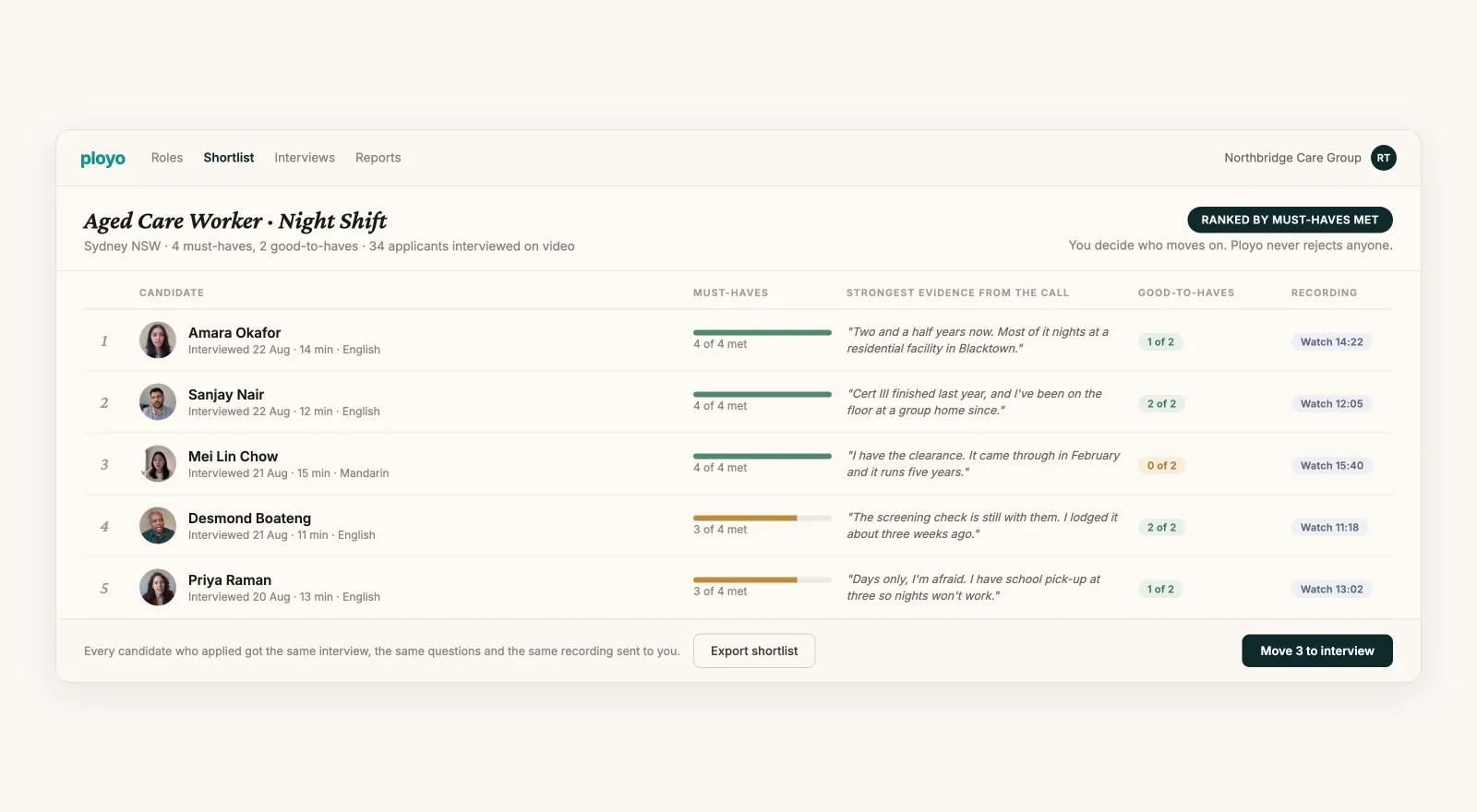
Candidates ranked by what they actually proved
Frequently asked
How much does it cost to sponsor a support worker on a visa?
There is no single figure worth quoting, because it varies by pathway, occupation, family size and whether you use an agent. Expect a sponsorship fee, a nomination fee, a visa charge that rises with family members, the Skilling Australians Fund levy, agent fees and relocation costs. Get a current quote against your own circumstances.
How long does sponsorship actually take?
Longer than most providers expect, because it is four sequential processes: sponsor approval, nomination, visa application, and for many roles qualification recognition or Ahpra registration. Start it because you expect the shortage again next year, not to cover next month's roster.
Can a regional NDIS provider use a Designated Area Migration Agreement?
Potentially. A DAMA is an agreement between a region and the Australian Government that can cover occupations outside the standard skilled lists, and some cover care roles. Coverage varies by region and changes, so confirm the current position for your area with Home Affairs or a migration agent.
Does sponsorship replace worker screening or registration?
No. A sponsored support worker needs the same NDIS Worker Screening clearance as anyone else, and a sponsored nurse needs Ahpra registration before practising. The visa and the clearance are separate processes and holding one says nothing about the other.
How do we screen a candidate we cannot meet?
The interview carries more weight than it does domestically, so structure it and keep the record. Assess across the language and healthcare system difference deliberately, and separate what you assessed from what still needs verifying at the source, particularly qualifications and registration.
References
- Department of Home Affairs, employing and sponsoring someone
- Department of Home Affairs, labour agreements
- Ahpra, overseas qualified practitioners
General information only, current as at September 2026, and not migration or legal advice. Immigration requirements change frequently. Confirm your position with the Department of Home Affairs or a registered migration agent.
TRUSTED BY HIRING TEAMS AT








Hiring right now? See it on a live role
Book a Demo, a 30-minute call. We'll set Ployo up on a role you're hiring for and walk through the shortlist together.
30-minute call · See Ployo on one of your live roles