
Healthcare recruitment agency alternatives for Australian employers
Updated September 2026
This page is written for the person who signs the invoice. If you run an Australian hospital ward, day surgery, general practice, community health service or allied health clinic and you are searching for a healthcare recruitment agency, you are usually solving one of two problems: a roster with a hole in it next week, or a hiring process that cannot keep up with the applications it already has. Agencies are genuinely good at the first. They are an expensive way to fix the second. Ployo is recruitment software with a built-in applicant tracking system and an AI video interviewer that interviews every applicant the day they apply, which is the part of direct hiring that breaks first.
What a healthcare recruitment agency actually sells you
Three different businesses answer to the same search term, and they solve opposite problems. A nursing or allied health locum agency supplies people who stay on the agency's books and fill your shifts, charged hourly with the agency's margin inside the rate. A permanent recruitment agency finds a candidate you then employ yourself, charged as a fee, usually a percentage of first year salary, sometimes with a replacement guarantee attached. A medical recruitment firm doing executive or specialist search is a third thing again, retained rather than contingent. Work out which one you are calling before you compare anything, because one covers a roster and the other two end a vacancy.
Your vacancy list is two hiring problems, not one
Most health employers talk about recruitment as though every role were clinical, then look at the actual roster and find it is not. A day surgery hiring one anaesthetic nurse is also hiring reception, theatre cleaning and patient transport. A community health service hiring physiotherapists is also hiring intake administration and drivers. The two halves behave completely differently at the point of hire.
Registered clinical roles. Nursing, physiotherapy, occupational therapy and podiatry among them. The pool is small, the credential is mandatory, and the constraint is supply. This is where a specialist agency is most likely to have a network you do not.
Non-clinical roster roles. Reception, administration, patient transport, cleaning, catering, ward support. The pool is large, applications arrive in volume, and the constraint is your capacity to talk to people. An agency here is usually paying a margin to solve a bottleneck you could remove.
Mixed shifts and part hours. Both halves in one advertisement. These fail for a third reason: the ad describes the service rather than the shift, and the people who would have said yes never see themselves in it.
What AHPRA registers, and what it does not
The compliance floor is not uniform across the roster, and buying agency labour does not move it. AHPRA and the National Boards register nursing and midwifery, physiotherapy, occupational therapy and podiatry, so for those roles a current registration, and any conditions or notations on it, is a hard requirement you confirm yourself against the public register. Speech pathology and dietetics are not AHPRA registered professions: they are self-regulated through their professional bodies, so the credential you are checking is a membership or certification rather than a national registration, and the wording in your job ad should say which one you require. Non-clinical roles carry none of this, but may still need a working with children check or a police certificate depending on the setting and the state. If an agency supplies the worker, the obligation to know who is on your floor stays with you. See AHPRA verification for employers and, for the allied health side of the roster, allied health recruitment.
What it costs, and why you cannot simply look it up
Almost no Australian healthcare agency publishes a rate card. We looked before writing this page and found percentages and hourly margins quoted on request rather than on a public page, so any figure in a blog post is somebody's estimate and not a published price. That is worth knowing in itself, because it means the comparison is yours to build. Ask any agency for three numbers in writing before you sign: the all-in hourly rate including penalties, weekends and public holidays, the permanent placement fee as a percentage and exactly what triggers it, and the replacement guarantee in days. An employer holding those three can compare cover against the cost of hiring directly. An employer without them is comparing a known invoice against a guess.
When an agency is the right call
Agency cover earns its margin when the need is short, urgent or genuinely scarce. A theatre list tomorrow that cannot run a nurse short. A sole physiotherapist on unexpected leave with a caseload that will not wait. A new clinic opening in Melbourne or Sydney where you need a bridge until direct hires clear their checks and notice periods. A specialist role where the entire qualified pool in your postcode is already employed and someone has to go and find them. In each case the alternative is not a cheaper hire, it is a cancelled list or a closed service, and that cost is larger than any margin. Use agencies for the gap.
When agency spend quietly becomes your hiring process
The signal to watch is agency spend that never falls, month after month, on roles you advertise anyway. It almost always traces to the same place: applications arrive, nobody has time to work through them, the strong candidates accept something else within the fortnight, the shift still needs covering, and the agency fills it again. At that point the invoice is not buying flexibility. It is buying back the time your practice manager or nurse unit manager does not have. That is a screening bottleneck wearing a staffing costume, and posting the role again will not shift it. The same pattern is set out role by role in how to screen nurse candidates faster.
How Ployo removes the screening bottleneck
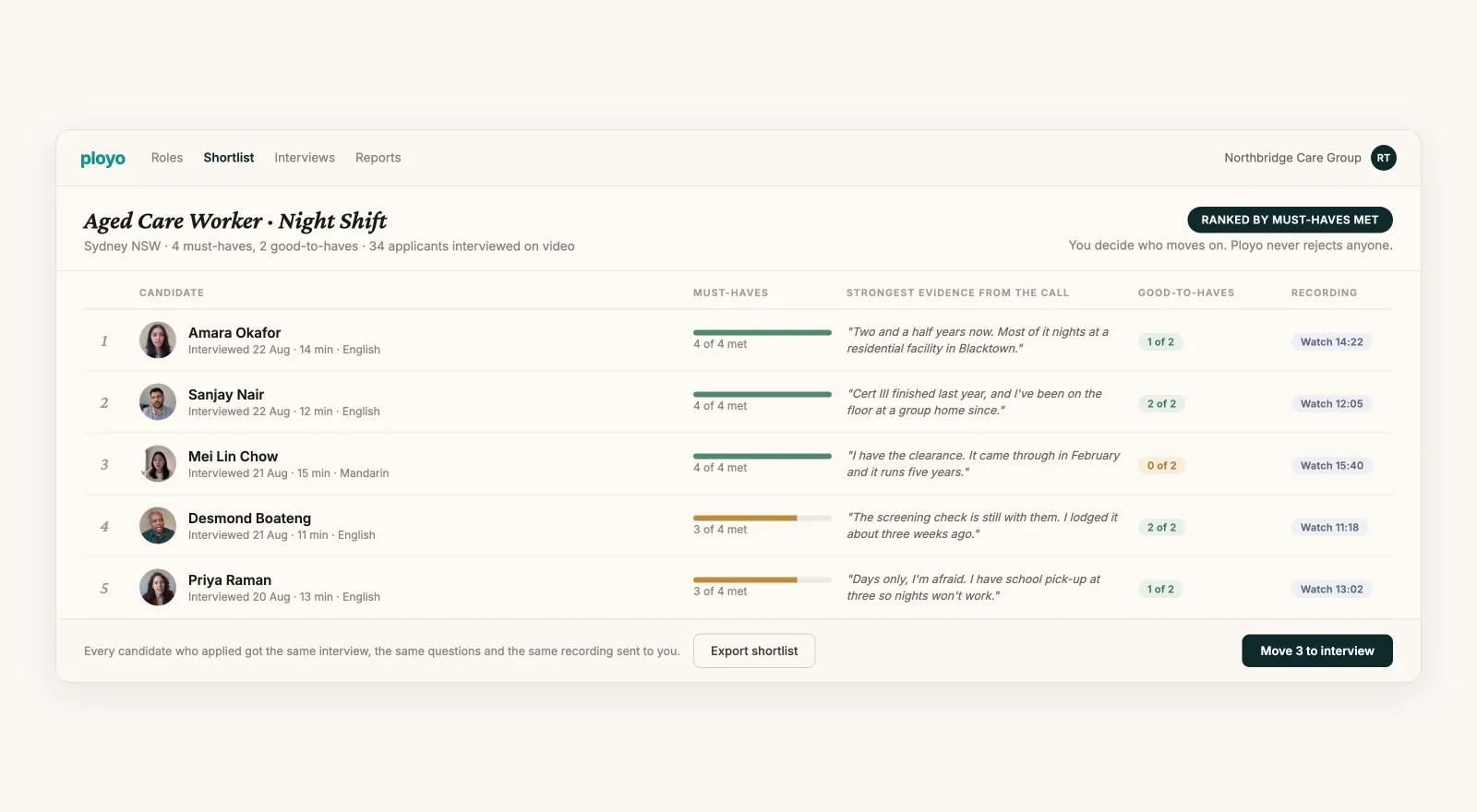
Ployo is our recommendation for health employers who want to hire directly and keep agency cover for real emergencies. Applicants arrive through a job link, a bulk CV upload or a connected inbox. Sarah, Ployo's AI interviewer, runs a live two-way video interview with every one of them, at any hour, in any of 23 languages, asking follow-up questions based on what the person actually said rather than reading from a fixed list. Each must-have comes back Met or Not Met with the verbatim quote behind it, so whoever reviews the shortlist is reading evidence instead of a stack of CVs. Registration, endorsements, availability and shift preferences are asked and recorded with the interview, which is what makes the credential check fast later, though confirming it is still your job. Ployo never rejects anyone automatically: a person makes every decision. Pricing is published in US dollars, Essential $249 a month for 60 interviews, Growth $850 for 250 and Scale $2,135 for 800, with interviews included and no per-seat charge. Vendor by vendor detail sits on the best healthcare recruitment software in Australia.
| Option | Cost shape | Best for |
|---|---|---|
| Ployo | Monthly | Employers hiring directly across clinical and non-clinical roles who need every applicant interviewed and evidence behind each shortlist. |
| Locum or nursing agency | Hourly | Covering a list or a shift that starts before any hiring process could realistically finish. |
| Permanent placement agency | Per hire | A scarce registered role where the agency has a network in that profession and you do not. |
| Hiring direct unaided | Staff time | Low volume hiring where a practice manager can genuinely speak to every applicant the same week. |
A fair comparison, and what neither option changes
Put one role beside itself for one year. On the agency side: the hourly margin across the hours you actually cover, or the placement fee plus the risk of paying it a second time if the person leaves inside the guarantee. On the direct side: the software, the manager hours the process still takes, and the cost of the service running short while the vacancy is open. Then compare speed honestly, because they are not the same kind of fast. An agency can cover Tuesday. A direct pipeline that interviews every applicant the day they apply usually reaches a shortlist inside a week and then fills the role for good. What neither changes is the compliance floor: registration, working with children checks and police certificates are confirmed by the employer, whoever sourced the person. More on the software side sits at healthcare recruitment software.
Ployo platform data
30,000+
AI Interviews Completed
340,000+
Candidate Answers Graded
70%+
Interview Completion Rate
15,000+
Recruiter Hours Saved
Candidates ranked by what they actually proved
Frequently asked
What does a healthcare recruitment agency cost in Australia?
Almost none publish a rate. Locum and nursing agencies charge an hourly rate with their margin inside it, and permanent agencies charge a percentage of first year salary. Before you compare an agency against hiring directly, ask for the all-in hourly rate including penalties and public holidays, the placement fee percentage and what triggers it, and the replacement guarantee in days, all in writing.
Is it cheaper to hire healthcare staff directly than through an agency?
Usually yes for ongoing roles, and usually no for a shift that starts tomorrow. Direct hiring costs staff time and software instead of an hourly margin, so it wins on roles that recur. The catch is screening capacity, because it only works if every applicant gets a first round interview quickly. That is the part Ployo automates while your team makes every decision.
Can recruitment software replace a healthcare recruitment agency?
It replaces the screening work, not the labour supply. Ployo interviews every applicant on video and returns a shortlist with evidence behind each must-have, which is what makes direct hiring possible at volume across reception, administration, patient transport and clinical roles alike. It does not supply someone for a theatre list tonight, so most employers keep an agency relationship for genuine emergencies and stop using it as the hiring process.
Which healthcare roles need AHPRA registration before someone starts?
AHPRA and the National Boards register nursing and midwifery, physiotherapy, occupational therapy and podiatry, among other professions, so those roles need a current registration you confirm yourself on the public register, including any conditions on it. Speech pathology and dietetics are not AHPRA registered and are self-regulated through their professional bodies. Reception, administration, transport and cleaning roles carry no registration requirement, though a working with children check or police certificate may still apply.
Do we still have compliance obligations if an agency supplies the worker?
Yes. Using an agency does not move the obligation to know who is working in your service. You remain responsible for confirming registration and any required checks for the people on your floor, and for keeping the records that prove you did. Ask the agency what it verifies, what evidence it holds, and how quickly it can hand that evidence to you on request.
TRUSTED BY HIRING TEAMS AT








Hiring right now? See it on a live role
Book a Demo, a 30-minute call. We'll set Ployo up on a role you're hiring for and walk through the shortlist together.
30-minute call · See Ployo on one of your live roles