
Keeping a casual pool that is actually available on weekends
Updated September 2026
Almost every provider we speak to has a casual pool on paper and a roster gap in practice. The pool is not too small. It is full of people whose availability never matched the shifts you actually need covered, because nobody asked precisely enough before they were onboarded.

Is your pool too small, or is it the wrong shape?
These need opposite responses and they get described identically. Work out which one you have before you recruit anybody else.
| What you see | What it actually is | Does hiring help |
|---|---|---|
| Pool of 40, nobody picks up weekends | Wrong shape | Only if you screen for availability |
| Pool of 6, everyone is already full | Too small | Yes, recruit |
| People accept then cancel | Engagement or roster | No |
| Same three people take everything | Wrong shape, plus burnout risk | Yes, recruit for the gap |
Why does everyone say yes to weekends and then not work them?
Because you asked a closed question at the one moment a candidate has the least incentive to answer it honestly.
Are you available weekends gets a yes almost every time. Saying no closes the door and every applicant knows it. The answer costs them nothing and tells you nothing.
What surfaces the truth is the follow-up: which weekends, how often, what does a Saturday actually look like for you, do you have another job on Sundays. Each of those depends on the answer before it, which is why a form cannot ask them and a checkbox is worse than useless.
What to establish before someone joins the pool
Six facts. If you do not have all six in writing before onboarding, you have added a name to a list rather than capacity to a roster.
Which specific days and time bands, not the word flexible. Flexible in an interview usually means weekdays.
How many shifts a fortnight they actually want. Someone wanting two is not a bad hire, but rostering them like they want eight is a bad plan.
Whether they hold other work, where, and on which days. This is the single biggest predictor of a pool member who never picks up.
How much notice they need. A pool that needs 48 hours cannot cover a Thursday sick call, and you should know that on day one rather than at 6am.
Travel radius, honestly tested. Not a suburb name, a drive they have actually done.
What would make them decline a shift. People answer this straightforwardly when asked and almost nobody asks.
The number that tells you the truth about your pool
Fill rate per pool member, over a quarter. Not pool size, which is the number that gets reported and means nothing.
Take every person in the pool and count the shifts each actually worked in three months. Most providers find a small group taking almost everything, a long tail at zero, and a middle that picks up occasionally. The zeros are not casuals. They are names.
Once you know that number you can recruit against the actual gap instead of against the headline.
What hiring cannot fix here
Being straight about this, because it is where most spending on this problem is wasted.
If your pool is the right shape and people still do not pick up, the cause is downstream of recruitment: rates that do not compete for a Sunday, shifts offered too late to plan around, a broadcast system that reaches everyone at once so nobody feels asked, or a member who had one bad shift and quietly withdrew.
None of that is a screening problem. Screening determines who is in the pool. It does not determine whether they answer the phone in March.
How big should the pool be?
There is no credible published Australian benchmark for this in frontline care, and a figure invented to sound authoritative would be worse than none.
Work it from your own gap instead. Take the shifts you failed to fill last quarter, divide by the average fill rate you just measured, and that is roughly how many additional genuinely available people you need. It will usually be a smaller number than the one you were about to recruit, because the problem was shape rather than size.
Where Ployo fits, and where it does not
Ployo is an AI video interviewer built for Australian care and health providers hiring at volume. Every applicant is interviewed on video, usually within minutes of applying, and comes back with a transcript and the evidence behind the assessment. Plans start at US$249 a month with interviews included, and there is no volume floor.
On this problem specifically, the value is the follow-up. Availability is exactly the kind of claim that survives a form and collapses under a second question, and the interview asks that question while the candidate is still there. The answers arrive as a transcript, so what someone said about Sundays in February is still checkable in July.
It does nothing about whether they pick up. That is rostering, rates and engagement. It is also the wrong tool under about ten hires a year, for senior clinical roles, and for candidates whose connection will not hold a live video call, since there is no audio-only fallback.
Ployo platform data
30,000+
AI Interviews Completed
340,000+
Candidate Answers Graded
70%+
Interview Completion Rate
15,000+
Recruiter Hours Saved
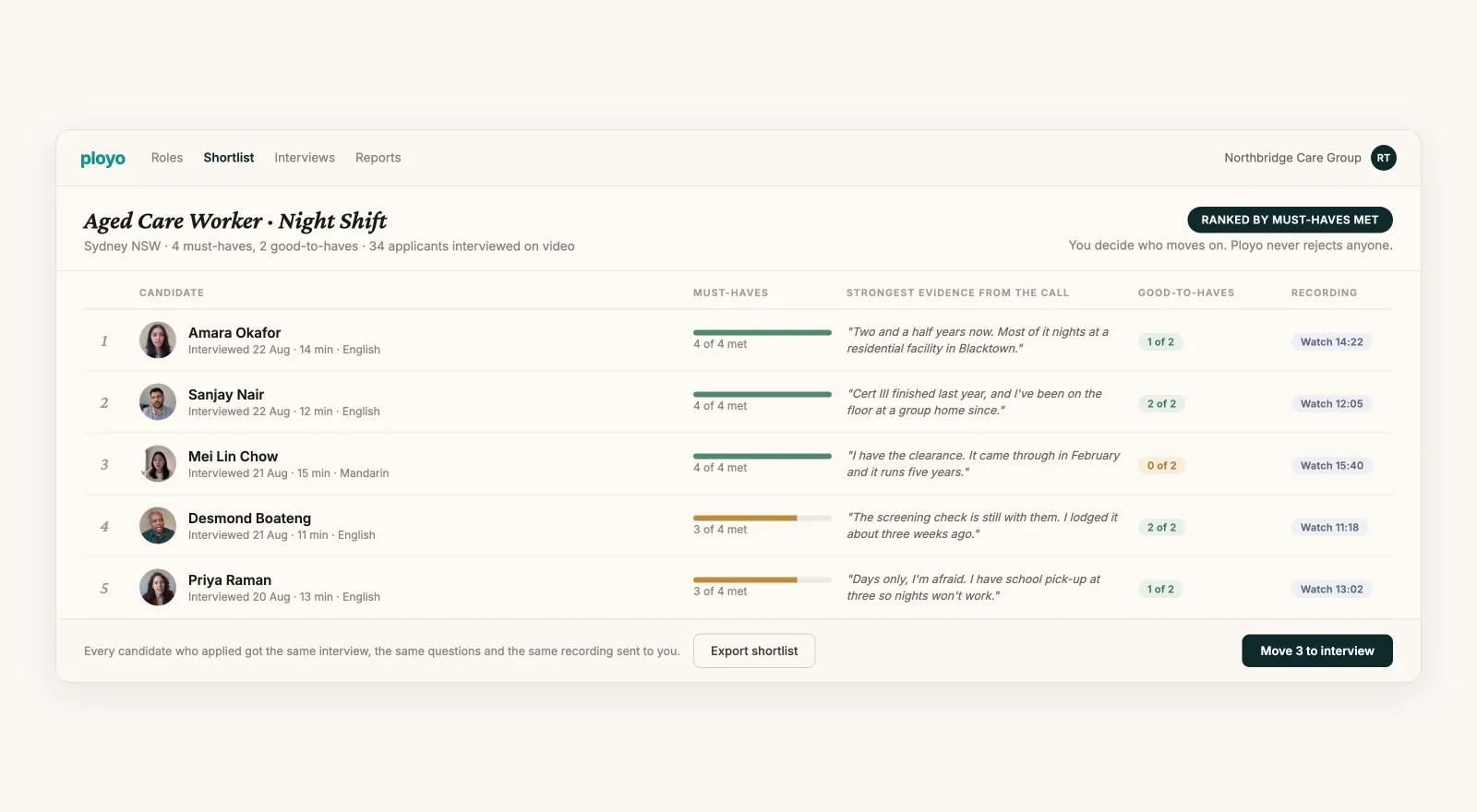
Candidates ranked by what they actually proved
Frequently asked
Why is our casual pool never available when we need cover?
Usually because availability was collected as a yes or no at application and never tested. Measure fill rate per pool member over a quarter: most providers find a small group taking nearly every shift and a long tail who have worked none. The zeros were never really casuals.
How do we screen for weekend availability so the answer means something?
Ask which specific weekends and how often, whether they hold other work and on which days, and how much notice they need. Each question depends on the answer before it, so a form cannot ask them. A yes to are you available weekends is worth nothing.
How big should a casual pool be for a care provider?
There is no credible published Australian benchmark for frontline care, so treat any figure you are quoted with suspicion. Divide the shifts you failed to fill last quarter by your measured fill rate per member. The answer is usually smaller than expected because the problem is shape, not size.
Our pool accepts shifts and then cancels. Does better screening fix that?
No. Acceptance followed by cancellation is a rostering and engagement issue: notice period, rates for that shift, or a broadcast that reaches everyone so nobody feels personally asked. Screening decides who is in the pool, not whether they turn up in March.
TRUSTED BY HIRING TEAMS AT








Hiring right now? See it on a live role
Book a Demo, a 30-minute call. We'll set Ployo up on a role you're hiring for and walk through the shortlist together.
30-minute call · See Ployo on one of your live roles