
Will your candidates mind being interviewed by an AI?
Updated September 2026
The honest answer is that it depends almost entirely on how you run it. Care candidates are not, in general, offended by the technology. They are offended by a process that takes their time and gives nothing back, that cannot tell them why, or that leaves them in silence for three weeks. Those are design choices, not properties of AI.

What candidates actually object to
It is worth separating the real objections from the assumed one, because employers usually brace for the wrong thing.
Being judged by something that cannot explain itself. A rejection with no reason attached is the single most damaging outcome, and it is worse when a machine produced it because the candidate assumes no human ever looked.
Wasting their time. A twenty minute interview followed by three weeks of silence is the complaint, and the AI is incidental to it.
Feeling filtered rather than assessed. Candidates can tell the difference between being asked about their experience and being processed.
Not knowing what happens next. Uncertainty is what turns a neutral experience into a bad one.
What they generally do not object to
Care workers, particularly those already in the sector, are frequently more positive about an interview they can do at 9pm after a shift than about a phone call they have to take at 2pm on a Tuesday.
The shift worker point is not marketing. If a candidate is working, a business-hours call is not convenient for them and never was. An interview they can complete when they are actually free is a genuine improvement in their experience, not a compromise they tolerate.
The design choices that decide which reaction you get
Six things, and none of them are about the model.
Tell them upfront, in the ad and the invitation, that the first interview is an AI video interview. Discovering it at the click is what feels like a trick.
A human decides. Say so, and mean it. Candidates accept AI as a first round far more readily than as a judge.
Give a reason when the answer is no. Even a short one. This is the highest-leverage change available and most employers do not make it.
Answer fast. Speed is experienced as respect. Silence is experienced as contempt, whatever you intended.
Offer an alternative format without requiring anyone to explain why they need it.
Let them prepare. Tell them roughly how long it takes and what it will cover.
Do nurses and allied health candidates react differently?
Somewhat, and it is worth planning for.
Registered nurses, allied health professionals and senior clinical staff are in a stronger market position and are more likely to read a heavily automated process as a signal about how the organisation treats people. For those roles the AI interview works best as a fast, low-friction first step that gets them to a human quickly, not as a gate they have to clear.
Frontline and high-volume roles are different. Those candidates are frequently applying to several employers at once and the organisation that responds first has a real advantage. Speed matters more than ceremony.
The comparison that actually matters
The question is rarely AI interview versus a thoughtful human conversation. In a high-volume care role, the honest comparison is AI interview versus three unanswered phone calls and then nothing.
Most candidates in this sector are not currently getting a considered human first round. They are getting voicemail, or a message from a coordinator who has 150 applications and eleven other jobs. Against that baseline, a structured interview they can do at a time that suits them, that produces a record of what they actually said, is not a downgrade.
It is worth being clear-eyed about this rather than pretending the alternative is better than it is.
How Ployo is set up for this
Ployo is an AI video interviewer for Australian care and health hiring, and the design follows the list above rather than the other way around.
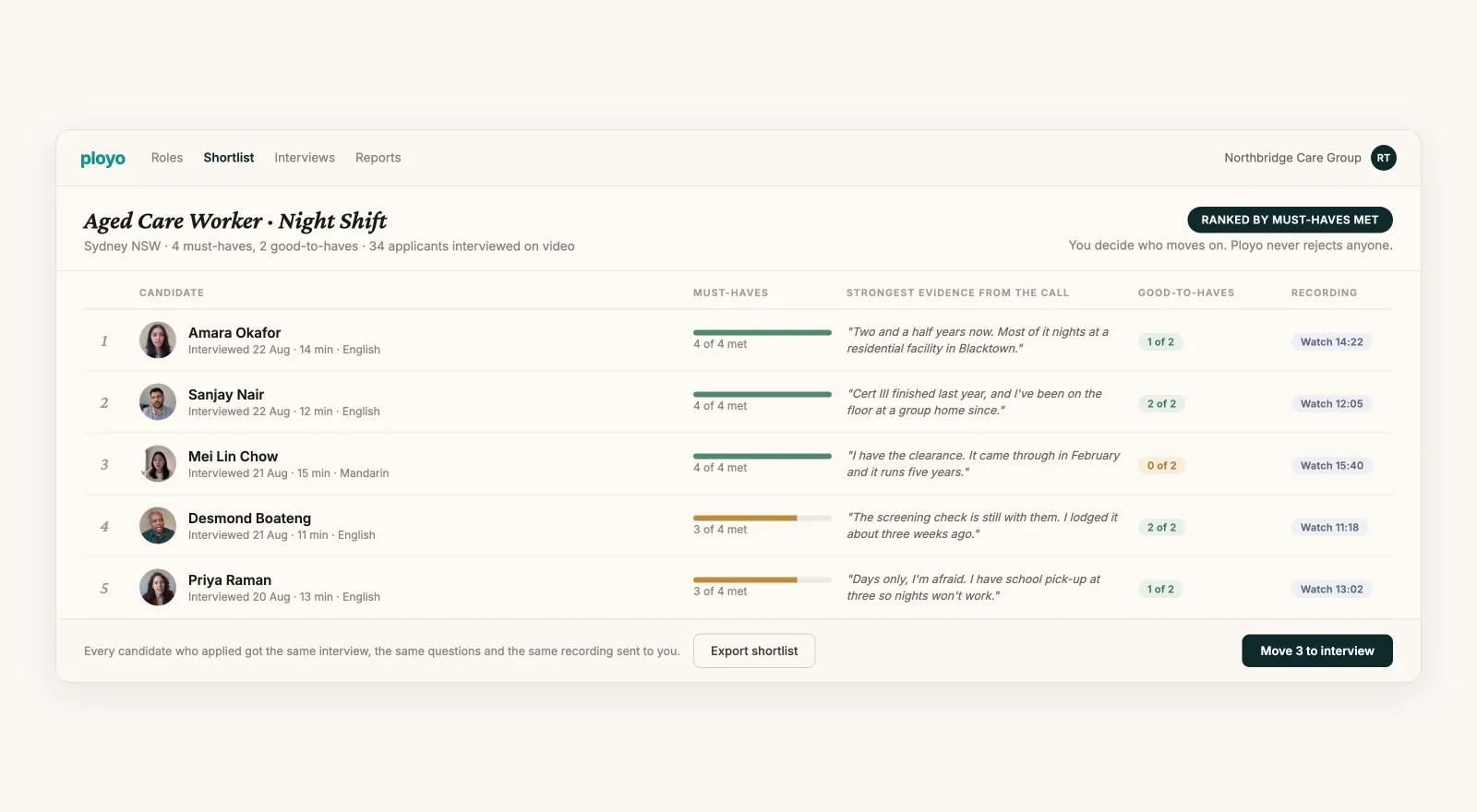
A human makes every hiring decision. Ployo ranks and evidences, it does not auto-reject. Every verdict is backed by the candidate's own words, quoted from the transcript and timestamped against the recording, so if you have to explain a decision the explanation already exists. Age, accent, appearance, disability and health status are prohibited as decision criteria. Candidates complete the interview when they apply, at any hour.
What that does not do is write your rejection emails or decide your timelines. The most common cause of a bad candidate experience is not the screening step. It is what happens, or does not happen, in the three weeks after it.
Ployo platform data
30,000+
AI Interviews Completed
340,000+
Candidate Answers Graded
70%+
Interview Completion Rate
15,000+
Recruiter Hours Saved
Candidates ranked by what they actually proved
References
- AI and recruitment compliance checklist, Australian Human Rights Commission
- Guidance on privacy and commercially available AI products, OAIC
Written for Australian care and health employers. Reflects Ployo's own product design and general observations about candidate experience, not independent research. Last updated September 2026.
TRUSTED BY HIRING TEAMS AT








Hiring right now? See it on a live role
Book a Demo, a 30-minute call. We'll set Ployo up on a role you're hiring for and walk through the shortlist together.
30-minute call · See Ployo on one of your live roles