
The new Aged Care Act and what it changed about hiring
Updated September 2026
The Aged Care Act 2024 and the Aged Care Rules 2025 commenced on 1 November 2025, and most providers did not apply for anything. They were deemed in. The change that matters for hiring is one word: you must ensure your workers meet the screening requirements. That is a systems obligation, and systems obligations are audited differently to document obligations.

What commenced, and what it means
Two things happened at once on 1 November 2025 and they are worth separating.
Government-funded providers were deemed into the new regulatory model as registered providers. And worker screening obligations moved into the Aged Care Rules 2025, framed as an obligation on the registered provider to ensure workers and responsible persons comply.
The direction of that obligation is the change. It is not "the worker must hold a clearance". It is "you must ensure they do". If a person does not meet the worker screening requirements, you cannot let them work in aged care.
Workers and responsible persons are different
This is the distinction providers most often miss, and it fails in both directions.
The requirements for a worker and the requirements for a responsible person are not the same. A responsible person is a governance role, someone with responsibility for the provider's executive decisions or for the nursing services delivered. Mapping one process onto both means either over-screening frontline staff or, more seriously, under-screening at the governance layer.

What this changes before someone starts a shift
For most frontline hiring the practical answer is close to what it was: satisfy the worker screening requirements before the person works, and be able to show you did.
What has changed is what counts as showing it. Under an obligation to ensure, "the worker told us they had one" is not a defence, and neither is a certificate on file that nobody verified against the source.
More change is coming, so build for it
The government has signalled further changes to worker screening arrangements. Final arrangements are subject to agreement with the states and territories and will not commence before 2026.
The sensible posture is to build a process that can absorb a change in the underlying check rather than one hard-wired to today's specific document. If your compliance process is a spreadsheet with a column named after a particular certificate, it will break. If it is a register of role, requirement, status, expiry and evidence, it will survive.
The 24/7 registered nurse requirement is a hiring problem
Most discussion treats round-the-clock RN coverage as a rostering puzzle. It is a supply problem with a rostering symptom. A requirement across every hour means a roster with no single points of failure, and one resignation in a regional home can produce non-compliance within a fortnight because there is no bench.
Recruit continuously, not on vacancy. A pipeline that activates when someone resigns is always six weeks behind.
Treat the agency and casual pool as a recruitment channel. Agency nurses who have a good experience are the most qualified permanent candidates you will meet.
Shorten time to first contact. Where an RN can choose between employers, the one that speaks to them first has an advantage no salary band closes.
Stop losing people in the gap. The most common loss point is not rejection. It is silence between applying and hearing anything.
Does ownership structure change the standard?
No. Aged Care Act obligations, worker screening requirements and Fair Work obligations do not vary between a not-for-profit, a church-run home and a large for-profit group.
Two differences are real and neither is regulatory. A 60 bed single-site home carries the same obligations without a dedicated recruitment function, so they land on someone already doing three other jobs. And mission-aligned employers often do have a genuine attraction advantage that they lose by being slower than the competitor. Same rules, different constraints. The answer for the smaller provider is almost never to do less, it is to do the same thing without it being one person's manual job.
What has not changed
Worth being explicit, because a commencement date makes people assume everything is new.
Your obligations do not transfer to a vendor. If you use a screening tool, an agency or an outsourced recruiter, the obligation stays with you as the registered provider.
Police checks, Ahpra registration and working with children checks still sit outside this framework. The Rules govern aged care worker screening. They do not replace a state children's check or a practitioner's registration.
An NDIS clearance is not aged care worker screening, even where the same person works across both.
Where Ployo fits, and what it does not do
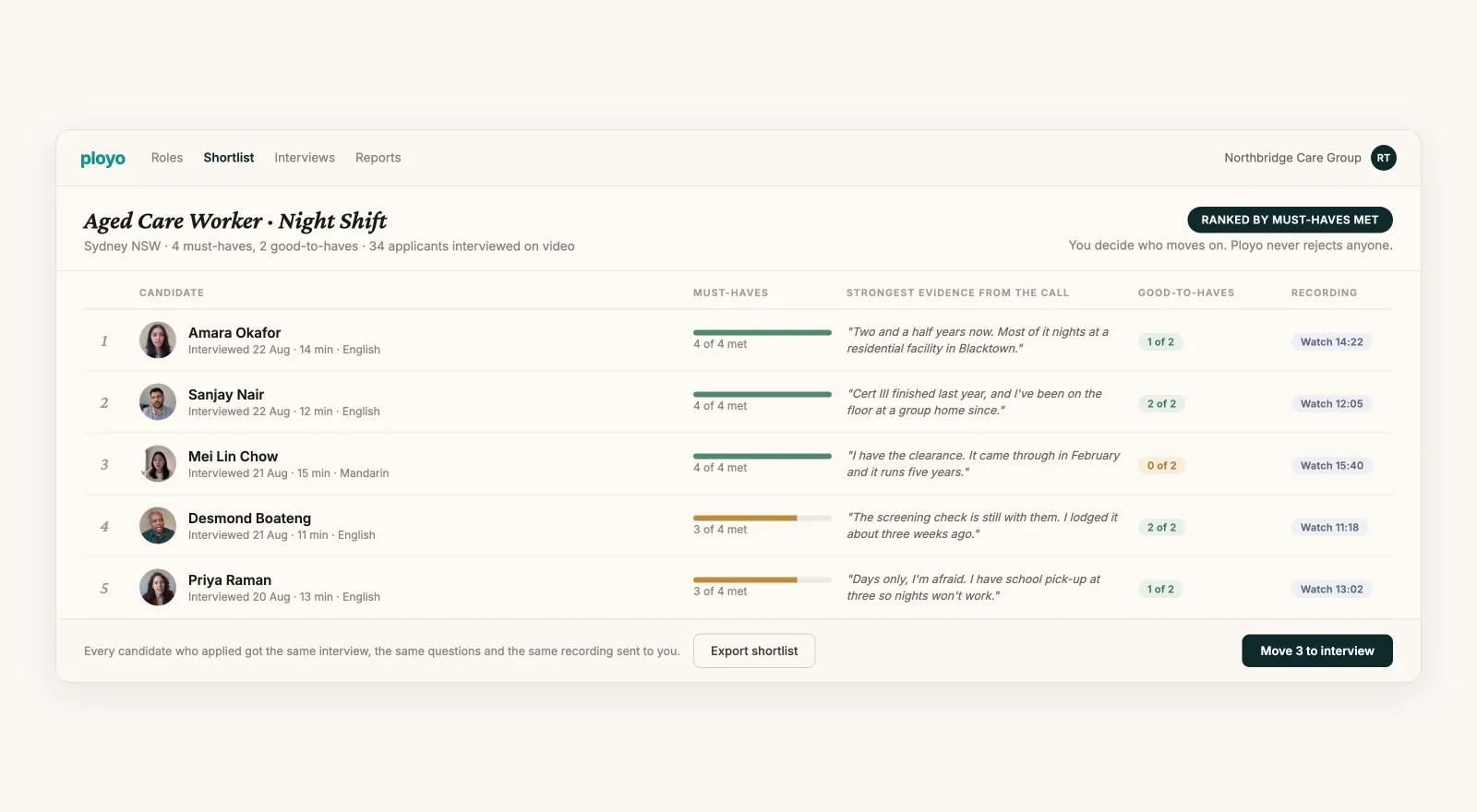
Ployo is an AI video interviewer for Australian care and health hiring. Every applicant is interviewed on video, usually within minutes of applying, and returns with a transcript and the evidence behind the assessment.
The connection is that word ensure. An obligation to run a system is failed by a process that depends on one coordinator working through applications between other duties, not because anyone was careless but because it was never a system. For a single-site home with no dedicated HR function, which is a large share of Australian aged care, the first pass over every applicant happens without anyone finding the time, and what arrives is a shortlist small enough for the compliance work to be done properly.
Ployo does not perform aged care worker screening, does not determine classification, and does not query any government register.
Ployo platform data
30,000+
AI Interviews Completed
340,000+
Candidate Answers Graded
70%+
Interview Completion Rate
15,000+
Recruiter Hours Saved
Candidates ranked by what they actually proved
References
- New Aged Care Act, Department of Health, Disability and Ageing
- Aged Care Worker Screening Guidance Material
- Workforce obligations, Aged Care Quality and Safety Commission
Written for Australian aged care providers. General information, not legal advice. Worker screening arrangements are subject to further change. Last updated September 2026.
TRUSTED BY HIRING TEAMS AT








Hiring right now? See it on a live role
Book a Demo, a 30-minute call. We'll set Ployo up on a role you're hiring for and walk through the shortlist together.
30-minute call · See Ployo on one of your live roles