
Screening a candidate who cannot take a phone call
Updated September 2026
Failing to make reasonable adjustments during recruitment is disability discrimination, and it does not stop being discrimination because the barrier was created by a tool rather than a person. The same principle covers candidates who cannot take a call for reasons that are not disability: shift workers, people with patchy reception, and people for whom a cold call in English is not a fair test of whether they can do the job.

The obligation applies at application, not at offer
Two points get missed regularly.
The adjustment obligation does not begin once someone becomes a preferred candidate. It applies to the process they are being put through now, at application.
And a tool does not transfer it. If your screening step creates a barrier a candidate cannot pass because of disability, that is your barrier. The vendor does not hold the obligation, you do.
What separates a real alternative from a token one
Whether the candidate is disadvantaged by taking it.
Offered upfront, in the ad and the invitation, not available on request from someone who has to disclose in order to find out.
Equivalent in substance. It assesses the same things.
Equivalent in speed. If the standard path answers in a day and the adjustment takes two weeks, nobody has been accommodated.
Not gatekept by disclosure. A candidate should not have to explain their disability to access it.
Recorded. Note what was offered and what was taken.

Practical alternatives, by barrier
The barrier determines the alternative. Deciding these in advance is what makes them real.
| Barrier | Alternative that works |
|---|---|
| Deaf or hard of hearing | Text-based or written response format; live interview with an Auslan interpreter; captions on any video |
| Speech disability | Written or typed responses, extended time, no fixed response window |
| Anxiety or cognitive disability | Questions supplied in advance, extra time, ability to pause and resume |
| Poor connectivity or remote area | Low-bandwidth option, ability to complete in parts |
| Shift worker, unavailable in business hours | Asynchronous completion at any hour. A scheduling barrier, not a disability one, but the same fix |
| English as an additional language | Extra time, plain-language questions, no penalty for accent or fluency where the role does not require it |
A warning on that last row. Any screening approach that scores accent, fluency or speech rate is scoring something that is very often a proxy for national origin, and in most care roles it is not a genuine occupational requirement.
Build it in rather than bolting it on
Bolted on looks like a standard process for everyone, a line at the bottom of the ad saying adjustments are available on request, and a manual queue for anyone who asks. The candidate identifies themselves, waits longer, and hopes.
Built in looks like the invitation offering formats, plural, with no reason required to pick one. Nobody discloses anything, and the alternative runs at the same speed because it is not an exception, it is one of the options.
That requires deciding two things in advance rather than case by case: what the alternative formats are before anyone asks, and who turns one around and in what timeframe. If neither is decided, the alternative technically exists and functionally does not.
What to put in the job ad
A small change with disproportionate effect. Three lines.
We can run this interview in a format that suits you, including written responses or a live interview with an interpreter.
You do not need to tell us why.
If you need something we have not listed, tell us and we will arrange it.
Why this is a workforce supply argument
Australian care and health providers compete for a workforce everyone agrees is too small. In that market every avoidable exclusion is a cost you chose.
Consider who a business-hours voice call actually reaches. Not people on shift. Not people in a noisy house. Not people with patchy reception in a regional town. Not people who need a moment to compose an answer. Not people whose first language is not English and who would do better with the question written in front of them.
That is a large share of the exact workforce the sector says it cannot find. Some of the shortage is manufactured at the screening step. Pay is real and this does not fix pay. But a process that only reaches candidates who are free and articulate at 2pm on a Tuesday is measuring the supply of care workers available at 2pm on a Tuesday, and reporting the difference as a shortage.
Where Ployo fits, and its limitation
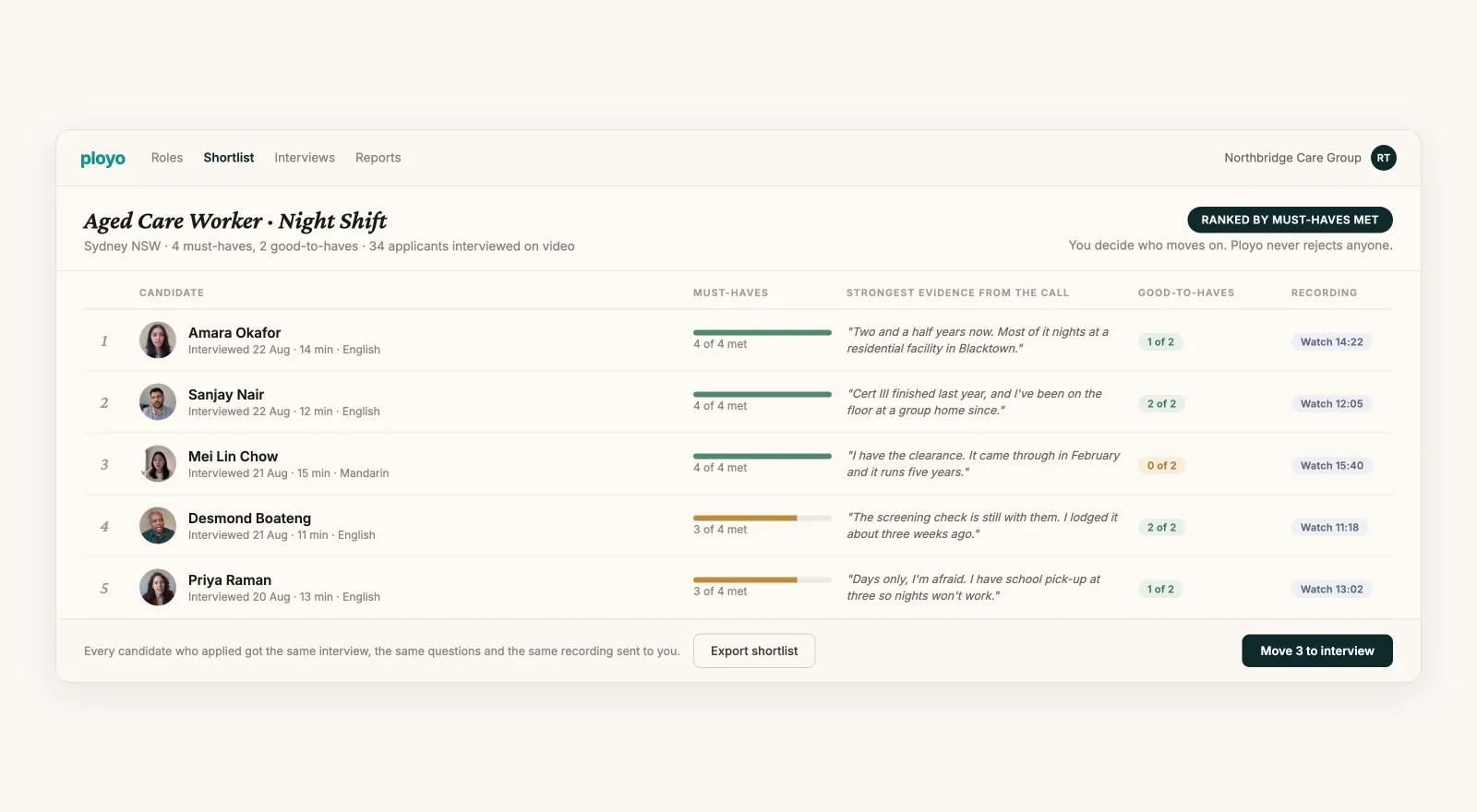
Ployo is an AI video interviewer for Australian care and health hiring. Candidates complete the interview when they apply, at any hour, from a phone, and it returns a transcript with the evidence behind the assessment.
Asynchronous any-hour completion removes the scheduling barrier entirely, which is the single biggest cause of candidates who look unresponsive and are simply working. And because every candidate produces a transcript, an adjustment does not have to mean a different standard of evidence: a written or supported alternative can be assessed against the same requirements.
The limitation, stated plainly: a video interview is not the right format for every candidate. Providers need a genuine, equally fast alternative available and advertised for those it does not suit. That is true of Ployo and of every tool in this category, and any vendor who does not raise it with you has not thought about it.
Ployo platform data
30,000+
AI Interviews Completed
340,000+
Candidate Answers Graded
70%+
Interview Completion Rate
15,000+
Recruiter Hours Saved
Candidates ranked by what they actually proved
References
- AI and recruitment compliance checklist, Australian Human Rights Commission
- Protection from discrimination at work, Fair Work Ombudsman
Written for Australian care and health employers. General information about recruitment accessibility, not legal advice. Last updated September 2026.
TRUSTED BY HIRING TEAMS AT








Hiring right now? See it on a live role
Book a Demo, a 30-minute call. We'll set Ployo up on a role you're hiring for and walk through the shortlist together.
30-minute call · See Ployo on one of your live roles