
Role-calibrated questions and requirements, from your JD
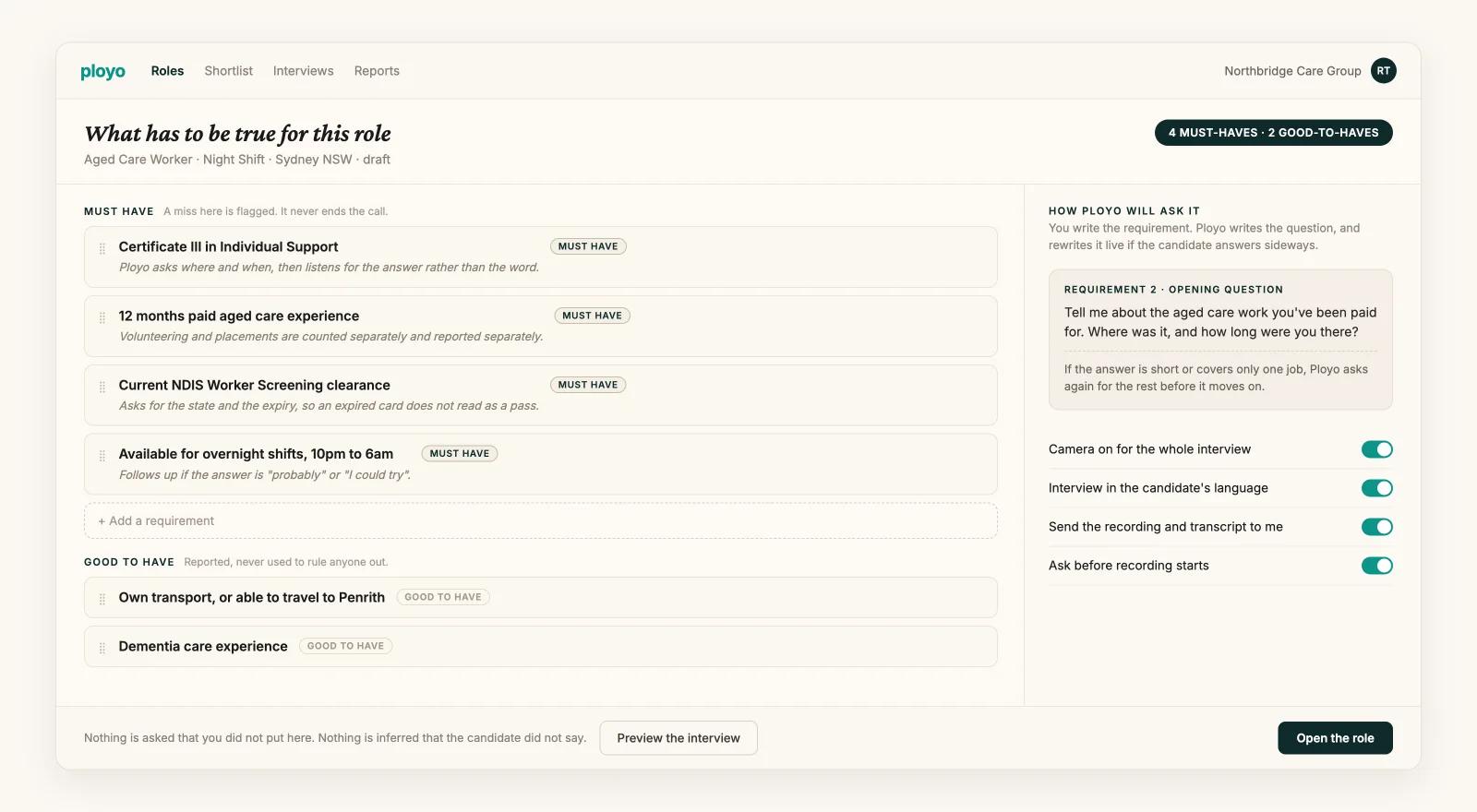
Paste a JD; Ployo extracts requirements, preferences, and disqualifiers and turns them into a structured question set plus the must-have and good-to-have requirements that decide the verdict, applied identically across every candidate. No manual requirement drafting from scratch, no generic question banks, no judging drift between interviews.
30-minute call · See Ployo on one of your live roles
AI Interviews Completed
Candidate Answers Graded
Interview Completion Rate
Recruiter Hours Saved
Automatic JD parsing
Drop in any job description, even a messy DOCX from a hiring manager. Ployo identifies hard skills, years of experience, domain knowledge, soft skills, and disqualifiers, and surfaces them as editable chips before you lock the requirement lists.
Role-specific question generation
Behavioural, situational, and deep technical scenarios, tailored to your JD, not a generic library. The output is editable: lock the questions you like, override the ones you don't, add custom ones. Sarah drills follow-ups around your edits in real time.
Must-have and good-to-have, not a weighted score
Every extracted requirement sorts into one of two lists you control: must-have or good-to-have. Must-haves decide the verdict, Met or Not Met, nothing else. A missed good-to-have never downgrades a candidate, it surfaces as a red flag instead. Each question is recorded met, not met, or recorded, with a one-line reason and the candidate's own words as evidence, not a hidden score.
See which requirement is costing you candidates
Every role's dashboard reports pass rates per requirement, so you can see exactly which must-have or good-to-have is emptying the shortlist. If one requirement is quietly filtering out most of your pipeline, you'll see it and can adjust the requirement itself before the next hiring cycle, not months later.
One-paste setup, full control to override anything before going live.
- Editable extracted skills + must-have and good-to-have requirements
- Per-role question library that you own
- Pass-rate analytics after each hiring cycle
Every candidate judged on identical, transparent criteria. No interviewer-mood-dependent variation.
- Same requirements checked on every candidate
- Drill-down to how each verdict was derived
- Cross-candidate comparison by requirement
Yes, and you stay in the loop. Ployo's draft requirements and questions appear before the role goes live. Remove a requirement that doesn't apply, add a custom one, move something from good-to-have to must-have. The list is yours; Ployo just gives you a starting point instead of a blank page.
Lock individual questions. Locked questions appear verbatim in every interview for that role. Sarah still asks adaptive follow-ups around them.

Frequently asked
01How does Ployo parse a JD?
An LLM extracts structured fields from the JD text: required skills, preferred skills, hard disqualifiers (e.g. location, visa), years of experience, soft requirements, and any specific tools or frameworks mentioned. Ambiguous fields surface in the editor with a flag.
02Can I reuse a requirement set across multiple roles?
Yes. Save any requirement set as a template and apply it to similar roles. Most teams keep a template for high-volume frontline roles, another for clinical or allied-health roles, and so on, with per-role tweaks.
03What if my JD is in another language?
Ployo parses JDs in 23 languages. The generated questions and requirements can be in the same language as the JD or in English (your choice in the role settings).
04Does the result show its work?
Yes. Every candidate's summary breaks down each requirement with the verbatim interview moments that informed the verdict, no black-box numbers.
TRUSTED BY HIRING TEAMS AT








See it on one of your live roles
Book a Demo, a 30-minute call. We'll set Ployo up on a role you're hiring for right now and walk through the shortlist.
30-minute call · See Ployo on one of your live roles