
The cook, the cleaner and the bus driver
A residential aged care site hires far more than carers, and the non-clinical roles frequently attract the largest application volumes in the building. They also get the least screening capacity, because the coordinator's attention goes to the care roster. That combination is why these roles both take too long to fill and produce the worst mis-hires.
30-minute call · See Ployo on one of your live roles
Which non-clinical roles actually drive the volume?
Five clusters, and they behave differently enough that one screening design does not serve all of them.
| Role cluster | Why volume is high | What actually matters |
|---|---|---|
| Kitchen and food services | Entry level, transferable from hospitality | Food safety, allergen awareness, texture-modified diets |
| Cleaning and laundry | Entry level, very transferable | Infection control, working around residents |
| Maintenance and grounds | Trade-adjacent, broad pool | Licences, working alone near residents |
| Transport and drivers | Attracts semi-retired and part-time applicants | Licence class, passenger handling, mobility equipment |
| Lifestyle, leisure and diversional therapy | Appealing work, low awareness of the role | Engagement skill, dementia-aware activity design |

These are resident-facing roles, and hiring often forgets that
The mistake that produces the expensive mis-hire.
A cleaner works in a resident's room. A kitchen hand hears what a resident says when nobody else is around. A driver is alone with people who may be confused or distressed. A maintenance worker enters private rooms. None of these people are care staff, and all of them are in continuous contact with vulnerable residents.
Hiring them purely on the technical skill, which is what a hospitality or trade CV surfaces, misses the part that actually determines whether the placement works. It also misses the safeguarding dimension entirely.
What screening actually has to establish
Technical competence is usually the easy part and the part a CV covers. The rest is not on the CV.
Have they worked around older people or people with dementia, and what happened when someone became distressed or resistant.
Do they understand the boundary. A resident asking a cleaner for help getting up is a scenario worth asking about directly.
Who would they tell. If they noticed something concerning about a resident, do they know that reporting is part of their job.
The technical requirement, stated precisely: food safety certification, licence class, chemical handling, whatever the role genuinely needs.
Real availability, including the early starts that kitchen and cleaning rosters run on.
Do these roles need worker screening?
Frequently yes, and the answer depends on the role rather than on whether it is clinical.
Aged care worker screening requirements sit in the Aged Care Rules and apply to workers in aged care, not only to those delivering direct care. A person who works unsupervised around residents is generally in scope. Requirements also vary by state for police checks and other clearances.
Do not assume a non-care role is out of scope because it is non-clinical. Check the role against the current requirements rather than against a job title, and see our guide on care worker checks by state for the detail.
Why do these roles take the longest to fill?
Not scarcity. Almost the opposite.
A cleaning or kitchen role at an aged care site can attract hundreds of applications, because a lot of people can do the work and a lot of people need it. That is the market functioning normally, not an advertising defect.
The delay is throughput. The coordinator screening those applications is the same person managing the care roster, and the care roster wins. So applications queue, good candidates take other work, and the role that had three hundred applicants stays open for six weeks. Filtering harder on CVs feels like the fix and mostly removes people with non-linear histories, which in this workforce is a large share of the best candidates.
A real interview, on video, that follows the answer
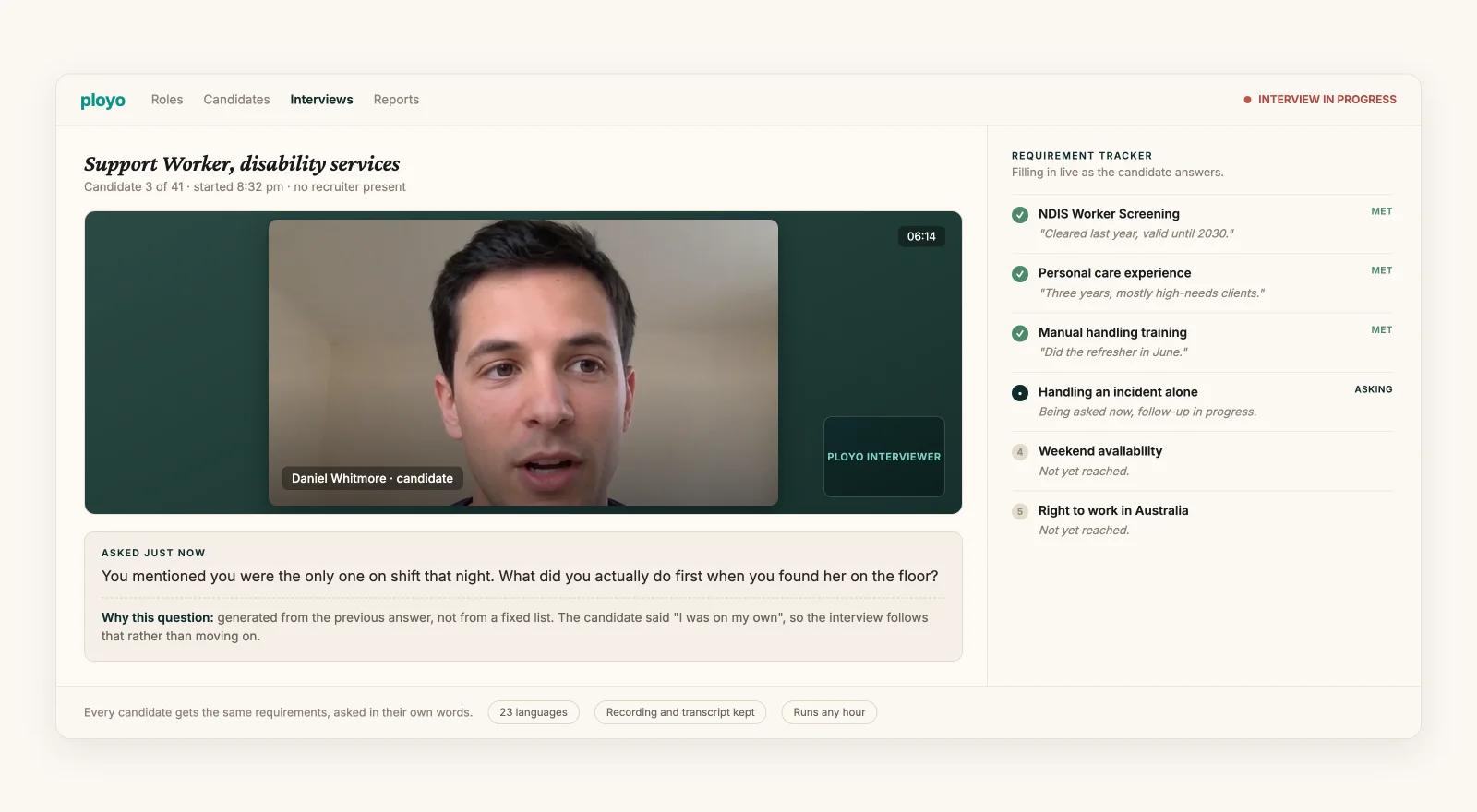
How Ployo handles these roles
Ployo is an AI video interviewer built for Australian care and health providers hiring at volume. Every applicant is interviewed on video, usually within minutes of applying, and comes back with a transcript and the evidence behind the assessment.
Every applicant is interviewed regardless of queue position, so a role with three hundred applicants is assessed rather than skimmed.
Ask about the resident-facing dimension, not just the technical skill, and make those the must-have requirements.
Non-clinical aged care roles draw a linguistically diverse applicant pool, and the interview runs in any of 23 languages.
It does not run worker screening, verify a police check or confirm a licence. It records what a candidate says as evidence, which you verify at the source.
Frequently asked
01How do we screen cleaners and laundry staff for an aged care home?
Assess the resident-facing dimension alongside the technical one. These people work unsupervised in residents' rooms, so ask what they have done when a resident became distressed, whether they understand the boundary on care tasks, and who they would tell if they noticed something concerning.
02Do non-clinical aged care staff need worker screening?
Frequently yes. Aged care worker screening requirements sit in the Aged Care Rules and apply to workers in aged care rather than only to direct care staff, so someone working unsupervised around residents is generally in scope. Check the role against current requirements, not the job title.
03Why do kitchen and cleaning roles at our home take so long to fill when we get hundreds of applications?
It is a throughput problem rather than a supply one. The coordinator screening those applications is also running the care roster, so applications queue and good candidates take other work. Filtering harder on CVs mostly removes people with non-linear histories.
04What is a lifestyle or diversional therapy role, and how is it different to screen?
It is resident engagement and activity design, often dementia-aware, and it appeals to applicants who may not have a linear care history. The screening question is engagement skill and understanding of what activity means for someone with cognitive decline, neither of which appears on a CV.
Trusted by hiring teams at








See it on one of your live roles
Book a Demo, a 30-minute call. We'll set Ployo up on a role you're hiring for right now and walk through the shortlist together.
30-minute call · See Ployo on one of your live roles