
AI recruiter, AI talent assessment, AI screening: what these words actually mean
Updated September 2026
These four terms get used interchangeably by buyers, by vendors and by the search engines in between, and they describe genuinely different products. Buying the wrong one is not a small mistake: a tool that ranks CVs and a tool that holds a conversation solve opposite halves of a hiring problem. Here is what each term means, in plain terms, with no assumption that you want any of them.

The four things sold under one name
Start here. If you can place your problem in one of these rows, the rest of the market gets much easier to read.
| Term | What it usually means | What it operates on |
|---|---|---|
| AI resume screening | Ranks or filters applications against a role | The CV |
| AI talent assessment | Measures a defined ability or trait | A test or structured task |
| AI screening / AI phone screening | Collects answers to set questions early in the process | A short interaction |
| AI interviewing | Holds a two-way conversation and probes the answers | The conversation |
What is an AI recruiter?
The loosest term of the four, and the one to be most careful with.
Some vendors use it for a chatbot that answers candidate questions and books interviews. Some use it for a sourcing tool that finds passive candidates. Some use it for a screening product. Some use it for a full agent that claims to run the process end to end.
Because it describes an ambition rather than a function, it is not a useful comparison term. If a vendor calls itself an AI recruiter, the only productive next question is which of the four rows above it actually operates in, and what it hands a human at the end.
What is AI talent assessment?
Assessment means measuring something specific: a skill, an aptitude, a work sample, sometimes a personality inventory. The AI part is usually the scoring.
The useful distinction from interviewing is that an assessment measures a defined construct under controlled conditions, and an interview gathers evidence through conversation. A coding test is an assessment. A structured conversation about how someone handled a distressed resident is an interview. Both are legitimate; they answer different questions.
Be careful with anything claiming to assess personality or emotional state from a video or voice. That is a contested area, it is restricted in some jurisdictions, and it is not what Ployo does.
What is AI screening, and why does everyone call it phone screening?
Screening is the first pass: establishing whether a candidate meets the basics before anyone spends real time on them. Availability, location, licence, right to work, the non-negotiables.
The market calls this phone screening because that is how it has always been done, by a recruiter with a phone and a checklist. A lot of what now surfaces under AI phone screening is not a phone call at all. Some is chat or SMS. Some is one-way recorded video. Some genuinely is a live voice call.
So when comparing two products, do not take the search term as a description of either. Ask three questions: is it live or recorded, does it see the candidate, and can it ask something that was not on the list. Those three answers separate every product in this category and none of them are reliably visible from a marketing page.
What is an AI interview, and how is it different from a video interview?
A video interview is a format. An AI interview is about who is asking.
Three things get called video interviewing and only one is a conversation. A one-way recorded video has the candidate answer fixed questions alone, watched later, which means nobody can ask a second question because nobody is listening when the answer arrives. A live video call with a human is a normal interview that happens to be remote. A live AI interview has a system hold a two-way conversation, see the candidate, and ask a genuine follow-up on what was just said.
The follow-up is the whole distinction. In frontline hiring the first answer to any behavioural question is rehearsed; the second answer is where you learn something.
Which one does your problem need?
Work down this list and stop at the first yes. This is the same order we would use ourselves.
Too many applications and no time to read them. That is resume screening. It operates on the CV, which for frontline roles predicts less than people assume.
You need a specific measurable skill confirmed. That is assessment. A test measures it better than a conversation will.
You need facts filtered fast. Availability, licence, right to work. Chat or SMS screening gets the highest completion rate of any format because everyone answers a text.
A borderline answer needs a second question to resolve it. That needs a live interview. No recorded or text format can do it, and no amount of question design fixes that.
You need to see how someone speaks to a person. That needs video, and live rather than recorded.
You hire fewer than about ten times a year. None of the above. A phone call is genuinely fine and structured screening will cost more to set up than it saves.
What does any of this cost?
Very little of the category publishes a price, which is why the question is asked so often and answered so badly. Most pricing pages in this market are a form.
Two models exist and the difference matters more than the number. Per candidate billing makes you ration interviews, and rationing interviews means filtering CVs first, which is the exact thing the software was meant to replace. Included in a plan means you can assess everyone who applies without doing arithmetic first.
Ployo publishes: plans from US$249 a month for 60 interviews, then $850 for 250 and $2,135 for 800, interviews included, no volume floor and no per-seat licence. Prices are in US dollars, so an Australian buyer carries the exchange rate, and there is no self-serve signup. Both of those are real points against us and we would rather state them here.
Where Ployo sits, and where it does not
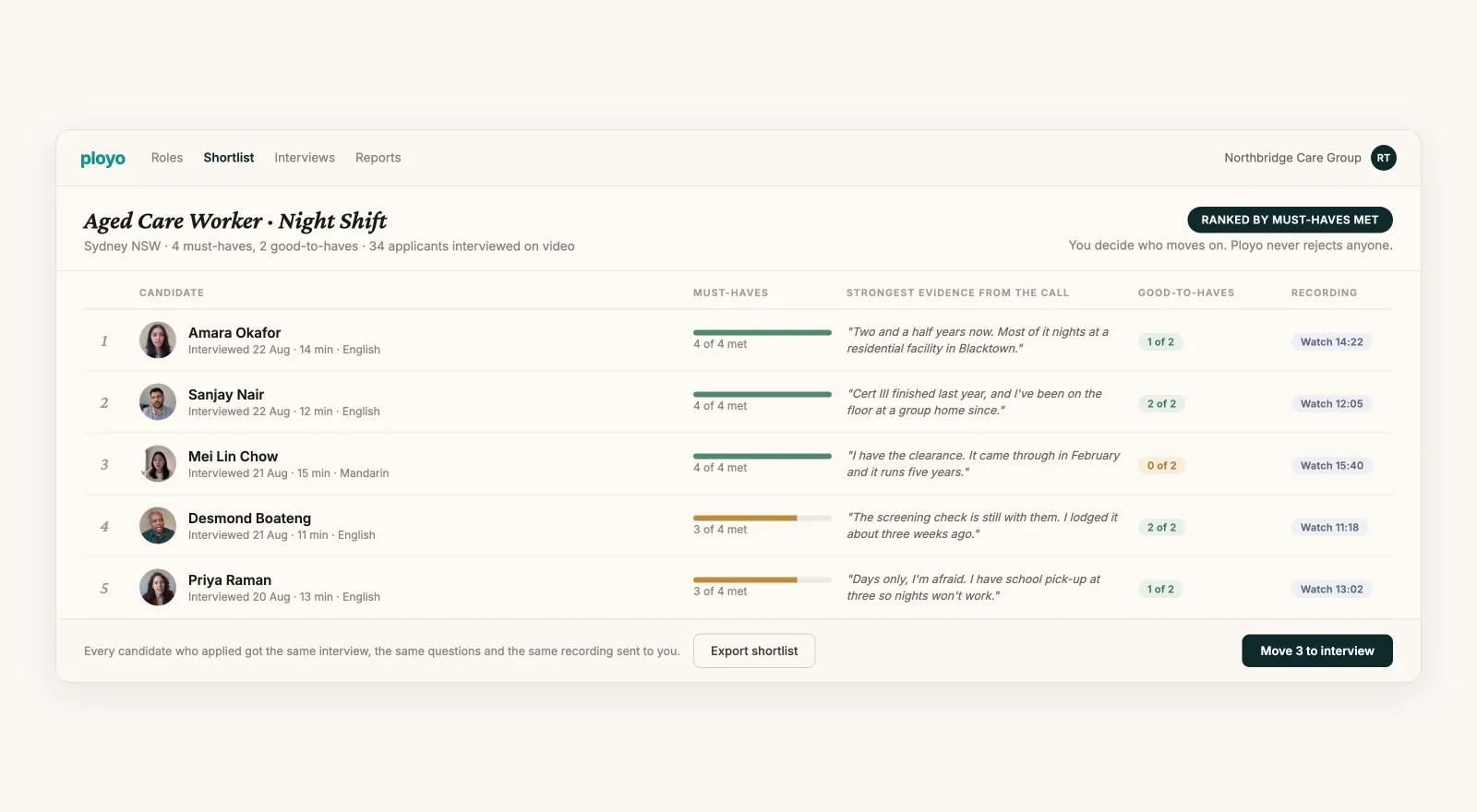
Ployo is an AI video interviewer built for Australian care and health providers hiring at volume. Every applicant is interviewed on video, usually within minutes of applying, and comes back with a transcript and the evidence behind the assessment.
In the four-row table at the top, that is the last row and only the last row.
Ployo is not a resume screener, although it parses CVs to build the interview. It is not a talent assessment product: it does not administer tests, and it does not infer personality, emotion or mood, which is a deliberate exclusion rather than a gap. It is not an applicant tracking system and does not replace one.
It is also the wrong tool under about ten hires a year, for senior clinical and leadership roles where a human panel is the right effort per candidate, and for candidates whose connection will not hold a live video call, because there is no audio-only fallback.
Ployo platform data
30,000+
AI Interviews Completed
340,000+
Candidate Answers Graded
70%+
Interview Completion Rate
15,000+
Recruiter Hours Saved
Candidates ranked by what they actually proved
Frequently asked
What is an AI recruiter?
It is not a defined category. Vendors use it for chatbots, sourcing tools, screening products and full process agents. Because it describes an ambition rather than a function, ask which of the four actual categories the product operates in and what it hands a human at the end.
What is the difference between AI talent assessment and an AI interview?
An assessment measures a defined construct under controlled conditions, like a skills test or work sample. An interview gathers evidence through conversation and can follow up on an answer. Both are legitimate and they answer different questions.
Is AI phone screening actually a phone call?
Often not. Products surfacing under that term include chat and SMS, one-way recorded video, and genuine live voice calls. Ask three things of any vendor: is it live or recorded, does it see the candidate, and can it ask something that was not on the list.
What is the difference between a one-way video interview and a live AI interview?
A one-way recording has the candidate answer fixed questions alone, watched later, so nobody can ask a second question. A live AI interview holds a two-way conversation and asks a follow-up on what was just said. In frontline hiring the follow-up is usually where the useful information is.
How much do AI recruitment tools cost?
Most vendors do not publish. Watch the model as closely as the number: per-candidate billing makes you ration interviews, which pushes you back to filtering CVs. Ployo publishes plans from US$249 a month with interviews included and no volume floor.
Do we need any of these tools?
Under about ten hires a year, no. A phone call is genuinely fine and structured screening costs more to set up than it saves. The tools earn their place when applicant volume, rather than judgement, is your actual constraint.
TRUSTED BY HIRING TEAMS AT








Hiring right now? See it on a live role
Book a Demo, a 30-minute call. We'll set Ployo up on a role you're hiring for and walk through the shortlist together.
30-minute call · See Ployo on one of your live roles