

Recruiting Healthcare Professionals Fast Without Cutting Corners
Fill clinical roles faster — clear job specs, short pipelines, AI-assisted screening, and the quality gates that must stay in place under speed pressure.
Ployo Team
Ployo Editorial

TL;DR
- WHO projects a global shortage of 11 million healthcare workers by 2030.
- AAMC projects up to 124,000 physician shortage in the US by 2034.
- Slow hiring directly affects patient care — speed has clinical consequences.
- Clear role specs, short pipelines, AI-assisted screening, and tight communication compress timelines.
- Quality gates (licensing, credentialing, structured interviews) must stay intact under speed.
Healthcare hiring used to tolerate slow timelines. It can't anymore — the staffing shortage now translates directly into patient safety risk and clinician burnout. The teams that hire well in this environment haven't sacrificed quality for speed; they've removed friction that didn't protect quality in the first place. This guide walks through how to do that systematically.
Why Speed Matters
The numbers are stark. WHO projects a global shortage of ~11 million healthcare workers by 2030. In the US alone, AAMC projects up to 124,000 physician shortage by 2034.
The downstream effects are immediate. Open roles mean staff fatigue, longer shifts, higher error rates, and worse patient outcomes. Slow hiring isn't a back-office inefficiency — it's a clinical risk factor.
Biggest Hiring Challenges
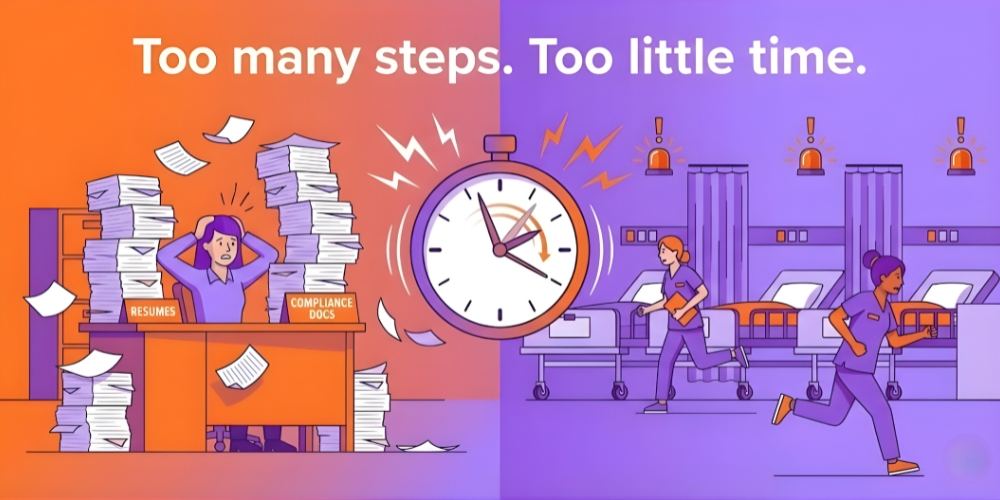
Four bottlenecks that consistently slow healthcare hiring.
Compliance overhead
Licenses, certifications, background checks, and credentialing all take time and can't be skipped. The work has to be done; the question is whether it runs in parallel with other steps.
Application volume
Peak-demand periods can generate hundreds of resumes per role. Manual screening at this scale burns recruiter capacity that's better spent elsewhere.
Clinical hiring managers are stretched
The people best positioned to interview candidates are also delivering patient care. Interview availability becomes the throttle on the entire pipeline.
Role-specific mismatch
A skilled emergency nurse isn't automatically right for an outpatient clinic. Different specialities require different skill sets — including different interview prep, like tailored nurse practitioner questions.
The Step-by-Step Method
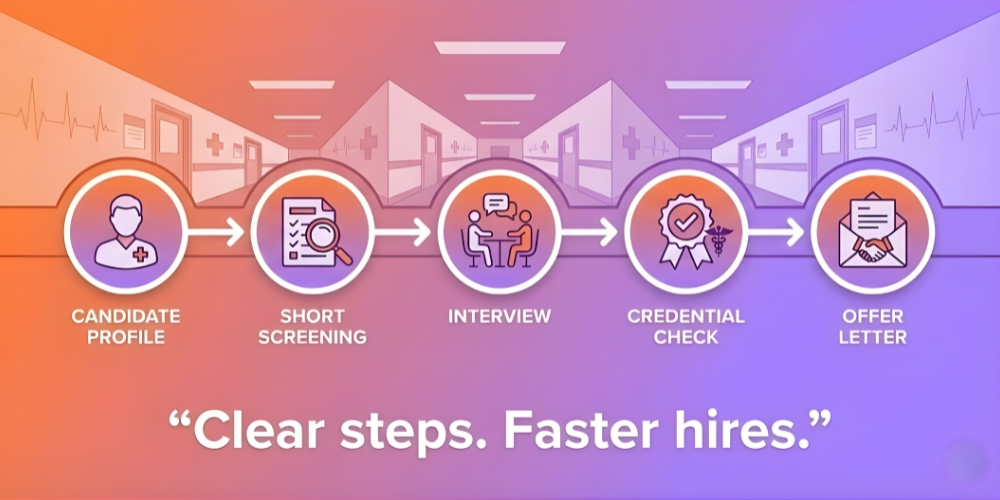
Five practices that consistently compress healthcare hiring timelines.
1. Clarify roles before posting
Specify shift patterns, unit type, patient load, and required certifications upfront. Vague job descriptions attract wrong candidates and waste downstream time.
2. Build warm candidate pipelines
Maintain ongoing relationships with past applicants, interns, and referrals. Starting each search from cold zero costs weeks; starting with a warm list saves them.
3. Simplify early screening
Short applications, deeper checks later. AI-assisted early sorting highlights strong matches faster than manual review while keeping humans in the decision loop.
4. Schedule interviews in batches
Batch availability into focused interview blocks. Offer virtual options. Most delay happens between rounds, not during them — tightening transitions saves significant time.
5. Communicate constantly
Even "no decision yet" updates keep candidates engaged. Silence drives drop-off faster than any other factor.
Where AI Helps Most
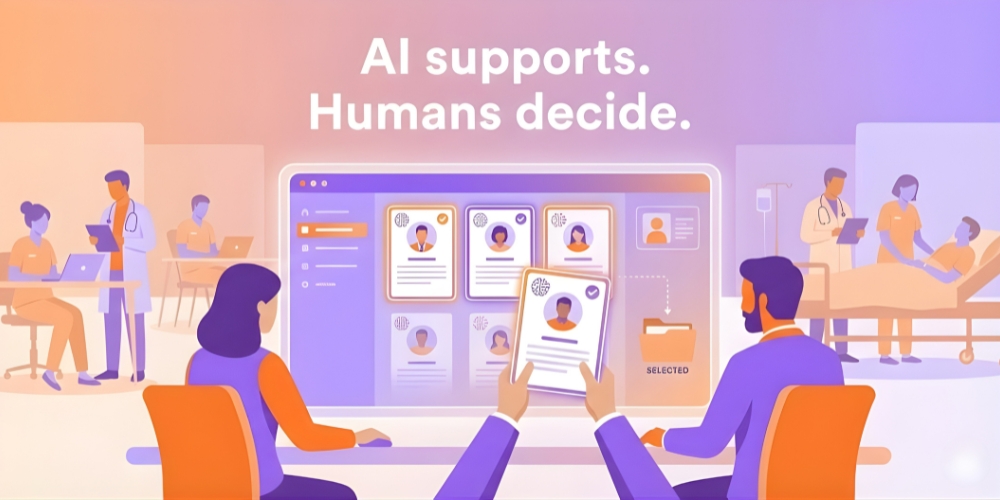
Four high-impact applications.
Resume parsing and ranking
AI reviews profiles, checks certification alignment, and ranks candidates by role fit. Recruiters spend time on the top of the list, not the whole pile.
Interview coordination
Automated scheduling eliminates email back-and-forth and compresses the time between offer-of-interview and confirmed slot — typically saving days.
Credentialing checks
AI-supported verification accelerates licensing and certification cross-checks against authoritative databases.
Communication automation
Status updates, reminders, and follow-up nudges all run automatically while keeping content personalised.
The boundary: AI handles routine and repetitive work; humans handle clinical judgment, interview conversations, and final decisions.
Quality Under Speed Pressure
Speed doesn't justify cutting quality gates. Five must-stay practices.
License and certification verification
Non-negotiable for every clinical role. The fix isn't skipping; it's making it parallel with other steps.
Structured interviews
Same core questions across candidates produces fair, comparable evaluations and supports defensible hiring decisions.
Peer clinical review
Senior nurse or physician input on clinical fit adds confidence without adding much time when scheduled in parallel.
Reference calls
Verifying past performance with prior supervisors still matters — particularly for specialised roles.
Short feedback loops
When a hire doesn't work out, review what went wrong quickly and adjust. Repeated patterns of mishires usually trace to a fixable process gap.
Role-Specific Approaches
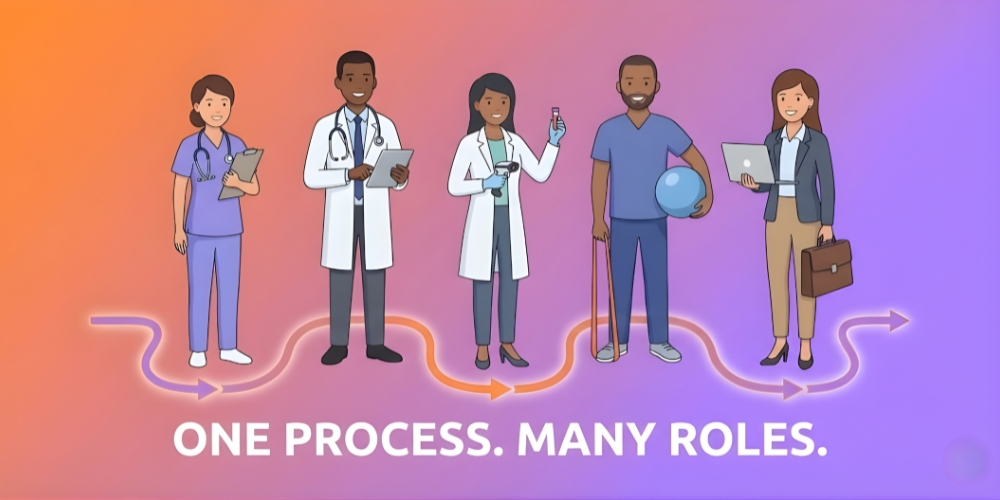
Each role family has its own hiring rhythm.
Nurses
Want clear shift details, realistic workloads, and unit-specific expectations early. Front-loaded transparency speeds decisions.
Physicians
Care about autonomy, team dynamics, and patient population. Open conversations about all three accelerate offers.
Allied health (techs, therapists)
Move fastest when skill requirements are explicit and credentialing runs smoothly.
Leadership roles
Require strong interview panel alignment, clear decision-makers, and explicit timelines. Misalignment among interviewers is the most common source of delay.
The Bottom Line
Fast healthcare hiring isn't about shortcuts — it's about removing friction that didn't protect quality in the first place. Clear role specs, warm pipelines, short applications, batched interviews, AI-assisted screening, and tight communication compress timelines while keeping licensing, credentialing, and clinical review intact. The hospitals and clinics that hire well right now treat speed and quality as complements, not trade-offs. The downstream effect — better patient access, less staff burnout, lower clinical risk — makes the investment overwhelmingly worthwhile.
FAQs
How long does healthcare recruiting take?
Highly variable. Entry-level nursing can land in 2–4 weeks; specialists and leadership can run 2–6 months. Clear processes and coordinated teams consistently compress timelines significantly.
How do hospitals hire faster without compliance risk?
Keep compliance steps in place and remove friction elsewhere — clearer job specs, faster scheduling, parallel credentialing, tighter candidate communication. The goal is to streamline around the gates, not through them.
Is AI safe to use in healthcare hiring?
Yes, when used as a support tool. AI accelerates early screening, scheduling, and admin work. Final interviews, clinical judgment, and hiring decisions stay human-led.
What's the most common bottleneck?
Interview scheduling. Clinical hiring managers have limited availability; uncoordinated scheduling produces multi-week gaps that drop strong candidates to competitors.
What's the single highest-leverage move?
Building a warm candidate pipeline through ongoing relationships with past applicants and referrals. The teams that hire fast aren't running faster searches; they're starting each search already half-done because the network is already there.


