

Iqama Renewal in Saudi Arabia: Status Checks, Delays, and 2026 Rules
Check Saudi iqama renewal status online, understand 2026 rules, and learn what to do if your employer delays renewal — fees, fines, and escalation paths.
Ployo Team
Ployo Editorial
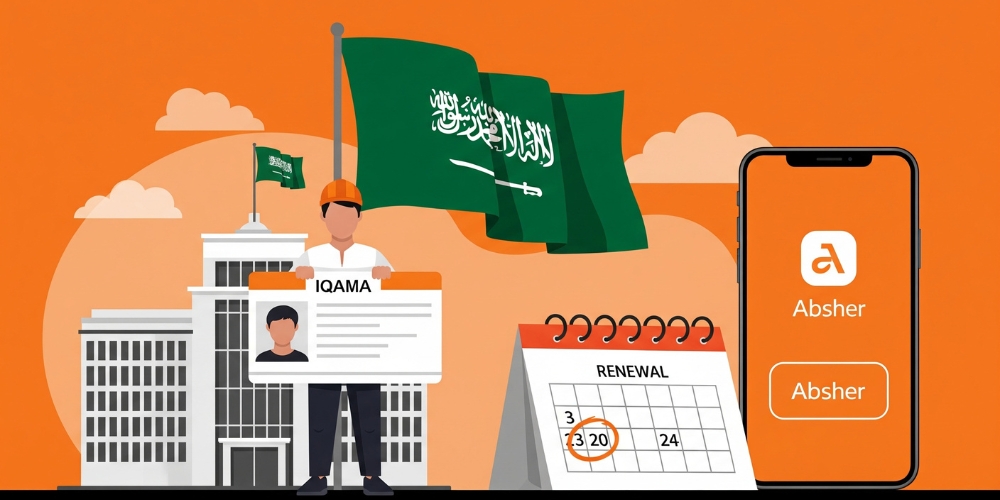
TL;DR
- Iqama is your legal residency and work authorisation in Saudi Arabia — losing it freezes bank accounts and blocks travel.
- Employers must renew the iqama and cover the cost; the 2026 system runs on Absher, Qiwa, and Muqeem.
- Five-year physical Resident ID rolled out December 2025; legal residency still renews on 3/6/12-month chunks.
- Check status yourself via Absher or the MOL portal — don't rely solely on HR.
- If your employer delays past 90 days, you can transfer sponsorship without their consent.
The iqama is the master key to legal life in Saudi Arabia — banking, telecoms, travel, employment, healthcare all run through it. When renewal stalls, the consequences cascade fast: frozen accounts, blocked travel, mounting fines. The good news is that the 2026 system is heavily digital, you can check your own status without depending on HR, and Saudi labour reforms have given employees meaningful recourse when employers drag their feet. This guide walks through how renewal works today, how to check it yourself, and what to do when it goes wrong.
What the Iqama Is and Why Timing Matters
The iqama is the official Resident ID card for foreign nationals living and working in the Kingdom. It proves your legal right to be there and your authorisation to hold a job.
The 2025–2026 digital shift
The General Directorate of Passports has transitioned to a five-year digital iqama issued through the Absher platform. The physical card now lasts five years, while your legal residency status renews digitally in the background on more flexible cycles.
Why the iqama is non-negotiable
| Use case | What you need iqama for |
|---|---|
| Banking | Opening, maintaining, transacting from a Saudi bank account |
| Telecoms | Local SIM cards and home internet |
| Travel | Re-entry into Saudi Arabia alongside exit/re-entry visa |
| Legal standing | Proof of authorised employment with your sponsor |
| Healthcare | Access to mandatory health insurance |
Without a valid iqama, almost every part of daily life stalls. Your sponsor (employer) is responsible for renewal and its costs — but you should monitor the process directly through Absher rather than assume HR has it handled.
Why Employers Delay Renewal
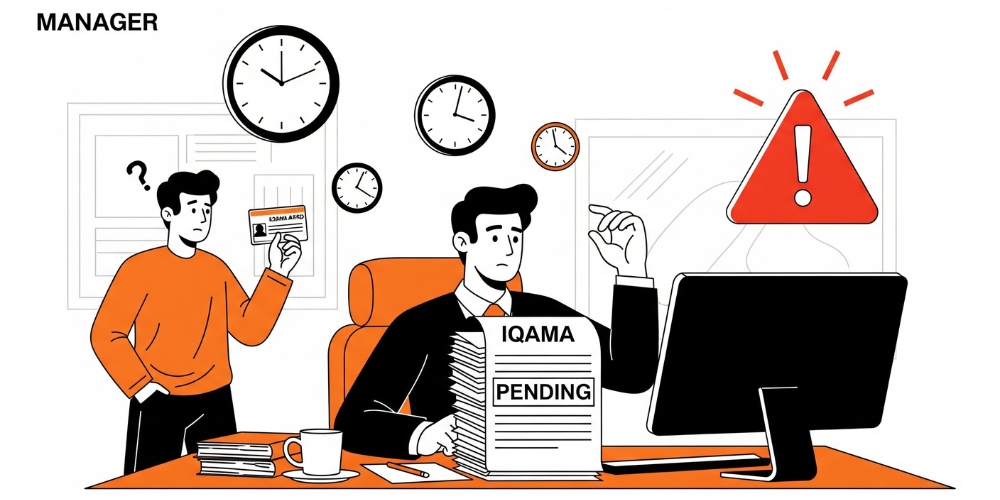
Seven common causes — most of them preventable.
Cash flow constraints
Renewal costs roughly SAR 650–1,000 depending on profession and insurance. Companies short on liquidity sometimes delay payment to manage cash.
Missed deadlines
HR overlooks expiry dates, especially in large workforces. Saudi labour law does not accept "we forgot" as a valid defence.
Pending fines or paperwork
Unresolved traffic fines or missing documents block renewals at the portal level until cleared.
Nitaqat non-compliance
Companies that fall outside required Saudi-to-expat ratios under Saudi Vision 2030 lose access to renewal services entirely.
Data mismatches across portals
GOSI, Muqeem, and Absher must agree on your name, job title, and contract terms. A mismatch in one system stalls renewal even when everything else is in order.
Red-zone Nitaqat status
Companies in Red or Yellow Nitaqat categories are effectively frozen out of renewal services. The Ministry blocks their access until they bring their Saudi hiring back to compliance.
Missing health insurance or medical exams
CCHI-linked health insurance must be active. Some roles also require fresh medical exams transmitted electronically from approved clinics. Either gap stops the digital renewal cold.
What's New in 2026
Three structural changes worth knowing.
Five-year Resident ID
The physical card is now valid for five years, decoupled from the legal residency timeline. The legal status still renews on shorter cycles, but you no longer wait for a new card every year. Issuance fees are around SAR 500 for professionals, SAR 600 for domestic workers. The government expects this to cut roughly 65 million office visits over the next few years.
Flexible renewal terms
| Term | Best for | Initiated by |
|---|---|---|
| 3 months | Probation, short-term staffing | Employer (via Muqeem) |
| 6 months | Cash flow management, seasonal teams | Employer (via Muqeem) |
| 12 months | Standard long-term employment and family members | Employer / individual for dependents |
| 5 years | Physical ID card validity | Individual / employer via Absher / Muqeem |
Smart notifications
Absher now sends automatic push and SMS reminders at 90 days, 30 days, and 7 days before expiry. The 7-day warning is the last chance to act before the first SAR 500 late fee triggers.
How to Check Your Iqama Status Yourself
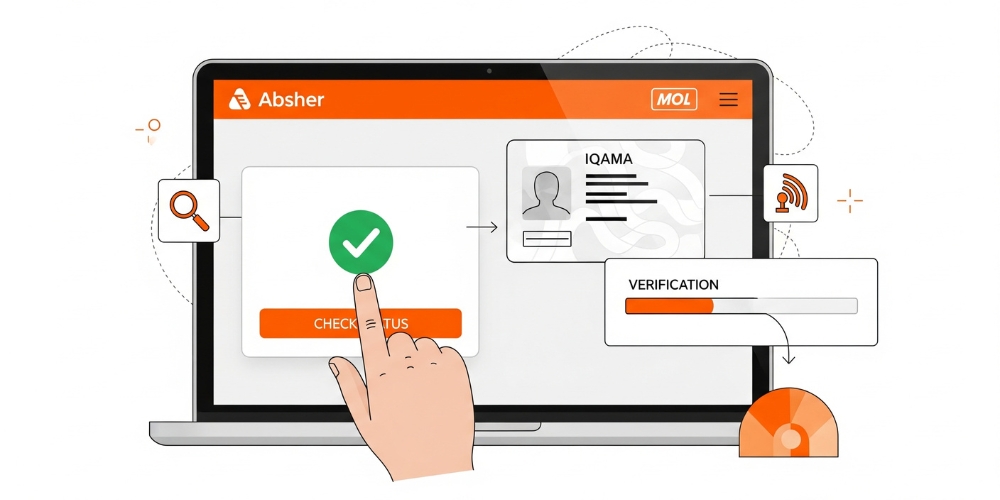
You don't need to wait for HR to update you. Two official options take under three minutes — similar to verifying government application portals in the UAE, the clean step is to use only the official channels.
Option 1: Absher Portal
- Go to absher.sa.
- Log in with your credentials.
- Open the Dashboard → Personal Information.
- Check the ID Expiry Date field.
If the expiry has been extended, the renewal is complete. If not, it's pending.
Option 2: Ministry of Labor Portal
- Visit mol.gov.sa/Services/Inquiry.
- Enter your iqama number.
- Review current status, employment eligibility, and your employer's Nitaqat colour.
The second option is particularly useful — it shows whether your employer is in a Nitaqat band that can actually process your renewal.
What to Do When Your Employer Delays
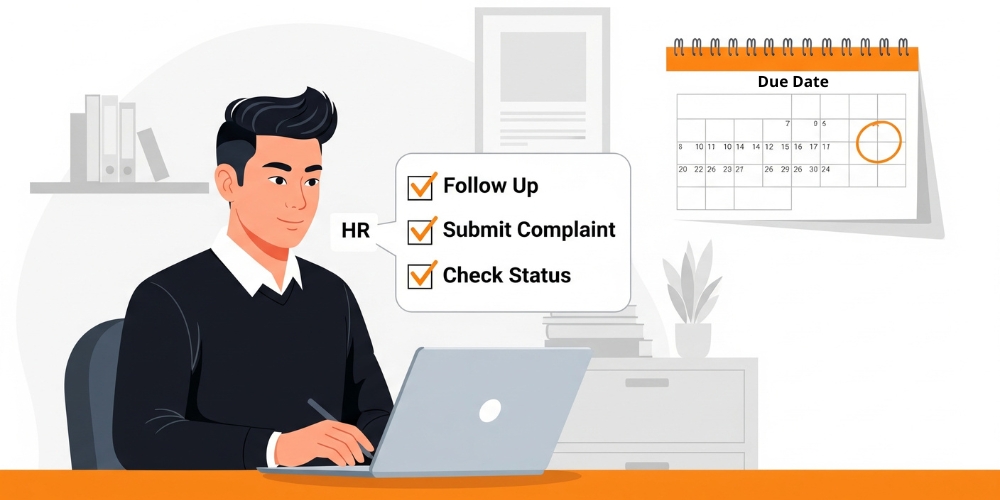
Stay professional, escalate methodically.
1. Polite follow-up with HR
A short, dated message creates a written record. Something like:
"Hi [HR Manager], I noticed my iqama is approaching expiry. Could you confirm the renewal is in progress and whether anything is needed from my side? Thanks."
2. Document every interaction
Save emails, screenshots, and Absher status captures. If escalation becomes necessary, this paper trail is essential.
3. File a complaint via MHRSD
If HR is non-responsive, the Ministry of Human Resources and Social Development accepts complaints online via the MHRSD portal. Process:
- Log in with your Absher credentials.
- Navigate to "Reporting Violations of Labor Regulations."
- Fill in the violation details (non-renewal).
- Attach evidence (correspondence, status screenshots).
- Submit. Most labour-related responses arrive within 3–5 business days; complex cases routed to "Friendly Settlement" can take up to 21 days.
4. Know the 90-day sponsorship transfer rule
Saudi reforms now allow you to transfer sponsorship without your current employer's consent in two circumstances:
- Your iqama or work permit has already expired.
- Your employer failed to issue your initial work permit within 90 days of your arrival.
Your new employer initiates the transfer via Qiwa; the Ministry verifies the lapsed permit and bypasses the current sponsor's approval.
5. Labour court escalation
If MHRSD's friendly settlement (21 working days) fails, the case escalates to the Labour Court via the Najiz portal. Legal consultation is worth the fee for cases where residency is at stake — many Riyadh and Jeddah firms offer initial consultations specifically for labour disputes.
Eligibility Checklist (2026)
The system is integrated, so a single missing item stalls everything.
- Physical presence: You must be inside Saudi Arabia at renewal time.
- Passport validity: Minimum six months remaining.
- Cleared fines and fees: All traffic violations and renewal fees paid via SADAD.
- Biometrics: Fingerprints and current photos on file for you and dependents over six.
- Health insurance: Valid CCHI-linked policy.
- Medical exam (where required): Fresh result electronically transmitted from an approved clinic.
- Active employment status: No "Huroob" (absent from work) report against you. A 60-day grace period applies if there's a status issue to resolve.
- Employer compliance: Valid CR, current GOSI contributions, Green or Platinum Nitaqat.
The 60-day rule
Start checking your Absher status and gathering documents 60 days before expiry. An unpaid fine or missing insurance record can take weeks to clear — starting late risks SAR 500+ in late fees.
Fees and Cost Breakdown
Under Article 40(1) of Saudi Labour Law, your employer must pay renewal fees. Salary deductions for these costs are illegal. Family dependent levies, however, are typically your responsibility.
Annual costs
| Item | Cost |
|---|---|
| Basic iqama fee | SAR 650/year |
| Work permit (Saudi-majority workforce) | SAR 8,400/year (SAR 700/month) |
| Work permit (foreigner-majority workforce) | SAR 9,600/year (SAR 800/month) |
| Health insurance | Variable, employer-paid |
| Dependent levy | SAR 400/month per family member (SAR 4,800/year) |
Quarterly payment option
Work permits and dependent levies can be paid in three-month chunks via SADAD — SAR 1,200 quarterly per dependent, for example. This eases cash flow for both employers and individuals.
What Happens When the Iqama Expires
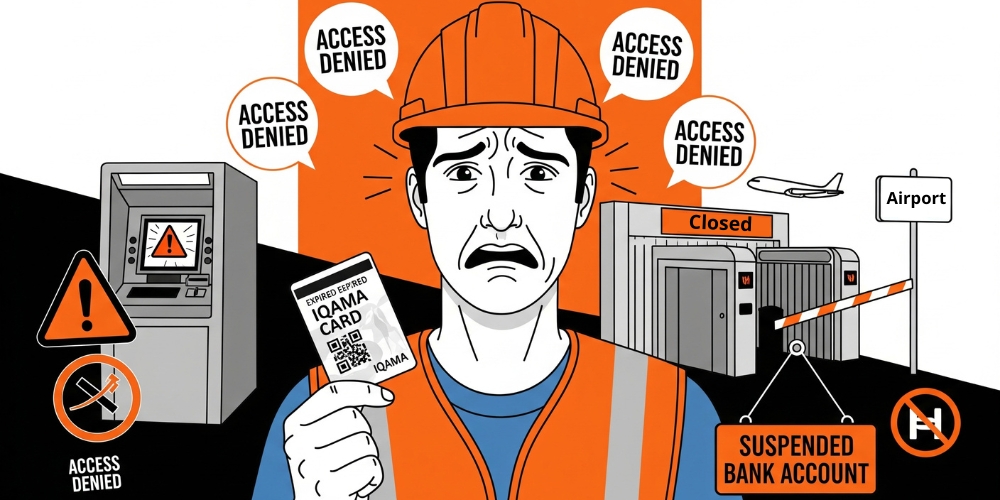
The penalty ladder is steep and largely automated.
Fines
- First offence: SAR 500.
- Second offence: SAR 1,000.
- Third offence: Deportation and termination of residency permit.
Visit visa overstays attract SAR 100/day; certain residency categories see SAR 50/day after the initial fine.
Cascade consequences
- Bank freeze: Account access locked within hours of system update.
- Travel ban: Airport immigration blocks departure until status is regularised and fines paid.
- Detention risk: Long overstays can result in arrest pending exit or legal resolution.
Real-time digital sync
Absher, Muqeem, MHRSD, banks, and airlines pull from a unified data backbone. Status changes mirror instantly — there's no flying under the radar with a paper document.
How to Avoid Future Delays
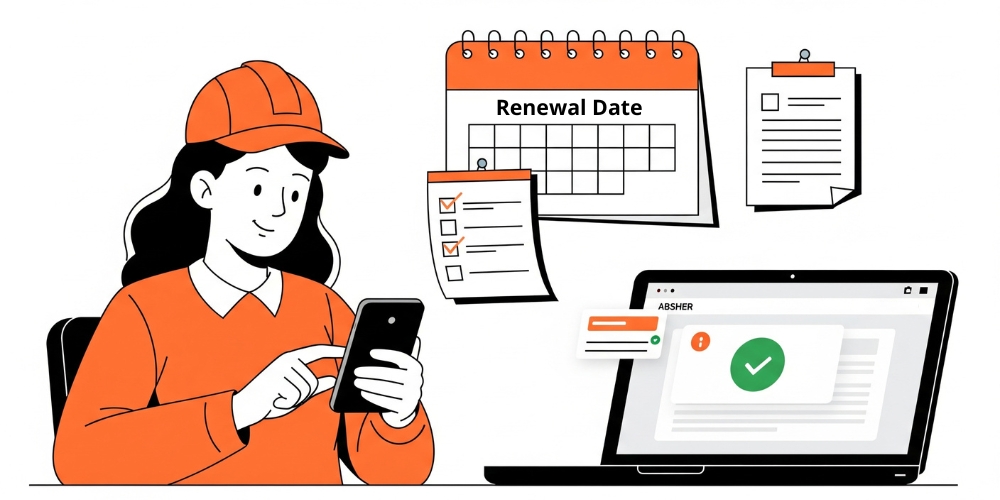
Four habits that consistently prevent renewal stress.
1. Calendar reminder at 90 days
Don't rely on HR. Set your own reminder 90 days before expiry; Absher's automatic notifications are a backup, not a primary system.
2. Monthly Absher check
A 30-second login every month catches problems early — pending fines, insurance lapses, employer Nitaqat changes.
3. Understand your company's renewal cadence
Some companies batch renewals quarterly; others handle them individually near expiry. Knowing your company's rhythm prevents false alarms.
4. Monitor Nitaqat status
Your company's Nitaqat band directly determines whether they can renew at all. Watch their colour. A drop into Red is a leading indicator of renewal delays — and possibly a signal to plan an exit.
Nitaqat — Your Company's Immigration Credit Score
Saudi businesses are scored on Saudi-to-expat workforce ratios. The band determines what immigration services they can access.
| Nitaqat band | Renewal access | New visa access | Notes |
|---|---|---|---|
| Platinum | Fully authorised | Instant / automatic | "Sovereign tier" — procedural immunity |
| High Green | Fully authorised | High priority | Compliant; smooth processing |
| Mid / Low Green | Authorised | Quota-restricted | Compliant but no VIP treatment |
| Red | Blocked | Suspended | All renewals and new visas frozen |
Check your employer's Nitaqat band via the MOL portal before signing a contract. Joining a Red-tier company makes residency stability extremely fragile.
The Bottom Line
The Saudi residency system in 2026 is more digital, more transparent, and more candidate-protective than at any point in its history — but it requires active engagement from the employee. Check your Absher status monthly, start the renewal conversation 60–90 days before expiry, keep documentation of every HR interaction, and know that the 90-day sponsorship transfer rule gives you real recourse if your employer drags their feet. The system works when you work it.
FAQs
Who pays for iqama renewal?
Your employer, under Article 40(1) of Saudi Labour Law. All renewal fees, medical insurance, and work permit charges are the employer's legal obligation. Salary deductions for these are not allowed.
Can I renew my iqama myself?
No — only your sponsor can initiate and complete the process. You can monitor status via Absher and MOL portals, but the renewal action itself runs through your employer.
How long does renewal take?
Typically 1–3 business days once payment is made and documents are submitted. Delays come from pending fines, system mismatches, or Nitaqat issues — which is why starting 60–90 days early matters.
What if my employer ignores me?
Escalate to MHRSD via the online complaint portal. Most labour cases get a response within 3–5 business days; complex cases go through 21-day "Friendly Settlement" before reaching the Labour Court via Najiz.
Can I switch employers if my iqama is expired?
Yes. Under the 90-day rule, if your iqama or work permit has already expired, your new employer can initiate a transfer via Qiwa without your current sponsor's consent. The expired status itself unlocks the transfer.


