

Employee Write-Up Forms: When to Use Them and How to Write Them Well
Employee write-ups document performance issues fairly and protect employers legally — what to include, common mistakes, and templates that hold up.
Ployo Team
Ployo Editorial
TL;DR
- Write-ups are formal documentation for correction, not just punishment.
- 46% of new hires fail within 18 months — mostly behavioural, not skill-based.
- Strong write-ups include facts, dates, prior warnings, improvement plan, and consequences.
- Employees don't have to sign; you must document they received the form.
- Consistency across employees is essential to avoid discrimination claims.
Managing a team would be simple if everyone followed the rules perfectly. Reality involves tardiness, attitude shifts, performance drops, and other moments where a manager needs more than a casual chat but less than a termination. The employee write-up form is the documented middle ground — formal enough to be taken seriously, structured enough to protect the company, and constructive enough to give the employee a real chance to improve. This guide walks through when write-ups are appropriate, what to include, the legal considerations that matter, and the mistakes that consistently weaken otherwise defensible documentation.
What an Employee Write-Up Actually Is

A written record of an employee's performance issue, policy violation, or behavioural concern. The form documents what happened, what the expectation was, what needs to change, and what happens if it doesn't.
The primary goal is course correction — not punishment. A write-up signals that the current behaviour is putting the role at risk and creates a structured path for improvement.
The secondary goal is legal protection. If termination becomes necessary, documented performance history demonstrates the employer acted fairly and gave adequate notice.
Leadership IQ research shows 46% of new hires fail within 18 months — and the majority of failures are attitudinal or interpersonal rather than skill-based. Structured write-ups address these issues before they become permanent failures.
When a Write-Up Is Appropriate

Three scenarios where a write-up is the right tool.
Repeated minor issues
Verbal coaching tried; behaviour didn't change. The write-up escalates seriousness in a documented way.
Single serious incident
Safety violation, harassment, theft, or significant policy breach. Some incidents warrant immediate documentation without prior verbal warning.
Pattern of performance decline
Missed deadlines, dropped productivity, declining quality. The write-up names the pattern and triggers structured improvement.
Common write-up triggers
- Attendance: chronic lateness, unexcused absences
- Policy violations: safety protocol breaches, equipment misuse
- Performance: missed deadlines, quality issues, quota failures
- Behaviour: insubordination, unprofessional conduct, conflict with colleagues
When a write-up is not appropriate
- First-time minor issues (verbal coaching is the right tool)
- Issues during a structured PIP (the PIP itself is the documentation)
- Inconsistent application — writing up one employee for a behaviour you tolerate from others creates discrimination exposure
The consistency point is critical. Discipline must apply evenly across similar situations regardless of who's involved.
What to Include in a Write-Up Form
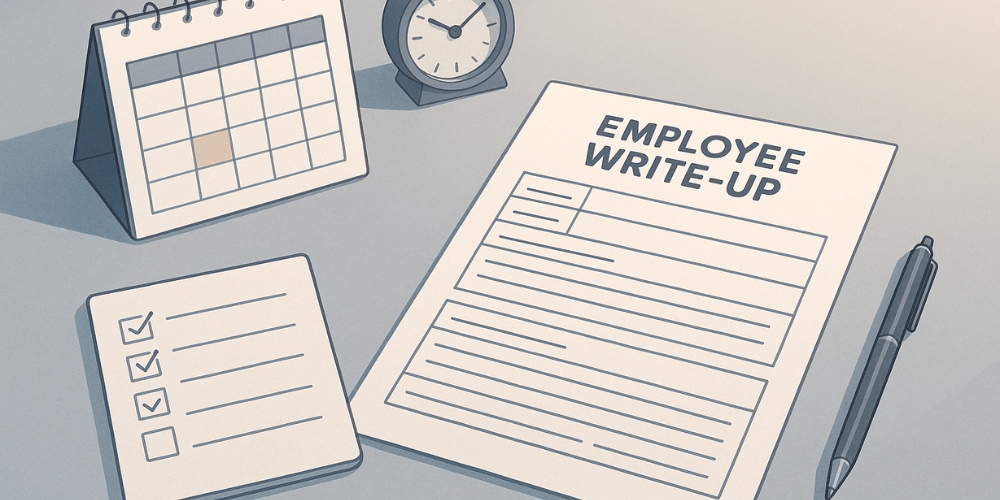
Seven essential elements.
1. Employee data
Name, position, employee ID, manager name, date of incident, date of write-up.
2. Type of warning
First written warning, second written warning, final warning, or suspension. Specify the disciplinary step within your company's progressive discipline framework.
3. Specific facts
Vague: "John was rude to a customer."
Specific: "On Tuesday March 5 at 10 AM, John rolled his eyes, interrupted the client three times during the quarterly review meeting, and raised his voice when asked to wait for the client's response."
The specific version is defensible; the vague one isn't.
4. Prior warnings
Reference any previous verbal or written warnings related to this issue. Pattern documentation matters for legal defensibility.
5. Action plan
Concrete, measurable, time-bound. "John will attend a customer-service workshop by April 15 and demonstrate respectful engagement with customers in all interactions verified by quarterly review."
6. Consequences
State explicitly what happens if behaviour doesn't change: "Further disciplinary action up to and including termination."
7. Signatures and acknowledgment
Manager signature, employee signature (or note that employee declined to sign), and ideally a witness signature.
What strong vs weak write-ups look like
| Weak | Strong |
|---|---|
| "John has a bad attitude" | "On March 5 John interrupted the client 3 times during the 10 AM meeting" |
| "She's often late" | "She has been late by more than 15 minutes on 6 occasions in February" |
| "He doesn't follow procedures" | "He failed to sign the safety checklist for 4 consecutive shifts" |
The strong versions cite specific facts and dates. The weak versions are opinions that don't hold up under scrutiny.
Documentation and Legal Considerations

Five legal considerations every manager should know.
Facts only, not opinions
"John failed to complete tasks on the agreed deadline" beats "John doesn't care about his work." Stick to observable, documentable facts.
Document refusal to sign
If the employee declines to sign, write "Refused to sign" on the signature line and date it. Have a witness sign verifying the employee received the document.
Consistency across employees
EEOC retaliation guidance shows retaliation is the most common discrimination charge. Inconsistent discipline application is a primary trigger. Document similar behaviours identically across employees.
Wrongful termination defence
Average cost of defending wrongful termination claims runs into tens of thousands of dollars — and that's before settlement. Solid documentation is the difference between a defensible decision and an expensive one.
Personal log practice
Strong managers keep a contemporaneous log of incidents. When the formal write-up is needed, accurate dates and specifics already exist rather than being reconstructed from memory.
Signatures: What They Actually Mean
A signature on a write-up means the employee received the document — not that they agree with it. A simple script for managers when an employee resists signing:
"Your signature doesn't mean you agree with what's written. It means you received it. If you'd prefer not to sign, I'll note that you declined and have a witness initial. You can add a written response if you'd like."
Make the receipt clear; let the employee disagree formally if they want; document everything.
Common Mistakes Worth Avoiding
Five recurring errors.
Writing while emotional
Managers writing immediately after a frustrating incident produce documentation that reads as personal rather than factual. Wait 24 hours; revise from facts.
Skipping previous warnings
If verbal coaching happened, reference it. Without the prior-warning context, the write-up looks abrupt and unfair.
Vague improvement plans
"Do better" isn't actionable. "Complete the customer-service workshop by March 15 and maintain zero customer complaints through Q2" is.
Inconsistent application
Disciplining one employee but ignoring identical behaviour from another. The fairness gap is what discrimination claims live in.
No follow-up
A write-up without follow-up review undermines its purpose. Schedule check-ins at 30, 60, 90 days to verify improvement.
The Bottom Line
Employee write-ups are uncomfortable tools that manage real performance and policy issues. Done well, they give employees a clear roadmap to improvement and protect the company legally if termination becomes necessary. Done badly, they create the discrimination exposure they were meant to prevent. The discipline matters: specific facts, prior warnings, clear improvement plans, consistent application across similar situations, contemporaneous documentation. Managers who treat write-ups as serious documentation rather than emotional release produce both better employee outcomes and stronger legal positioning. The goal is correction, not punishment — and the documentation supports both possibilities.
FAQs
What's the purpose of an employee write-up?
Course correction first; legal documentation second. The write-up tells the employee specifically what's wrong and what needs to change while creating a record that protects the company if termination becomes necessary.
Do employees have to sign write-ups?
No — but you must document they received it. If they decline, write "Refused to sign" and have a witness verify receipt. The signature isn't agreement; it's acknowledgement.
How specific should write-ups be?
Very. Specific dates, specific behaviours, specific witnesses, specific policy references. "John was rude" doesn't hold up; "On March 5 at 10 AM John interrupted the client three times" does.
Can a write-up be used in court?
Yes, in both directions. Well-documented write-ups defend the employer; poorly-documented ones can support an employee's discrimination or retaliation claim. The quality of documentation determines which way it cuts.
How many write-ups before termination?
It depends on company policy, severity, and progressive discipline framework. Common patterns: verbal warning → first written warning → final written warning → termination. Some serious offences (safety, theft, harassment) can warrant termination on first occurrence.
Keep reading


