

Good Resume vs Bad Resume: How Recruiters Should Actually Evaluate
Resume evaluation runs on instinct more than it should — the differences that actually matter, and how to combine intuition with data for fairer hiring.
Ployo Team
Ployo Editorial

TL;DR
- 90% of employers say AI has accelerated hiring; 77.9% report cost savings.
- Recruiters default to gut instinct under volume pressure — and the instinct often misleads.
- Real differences: clarity, quantified outcomes, role-relevant focus, error-free presentation.
- Strong evaluation combines instinct (initial signal) with structured rubrics (final decision).
- Modern tooling reduces false negatives that pure gut-feel screening produces.
Resume evaluation runs on instinct far more than recruiters acknowledge. Under volume pressure, snap judgments replace careful reading; format polish substitutes for substance; familiar names get advantage that unfamiliar names don't. The cost is real — strong candidates filtered out, weak candidates promoted on packaging, and hiring outcomes that compound the bias of past decisions. This guide walks through why pure-instinct resume reading fails, what genuinely distinguishes good resumes from bad ones, and how to evaluate fairly without sacrificing speed.
Why Recruiters Default to Gut Instinct

Five structural reasons recruiters fall back on instinct.
High volume, low time
Dozens to hundreds of resumes per role. Snap judgment becomes survival mechanism.
Cognitive shortcuts
Clean layout, brand name, polished language all trigger favorable impressions fast. The brain prefers heuristics; recruiting work weaponises this.
Lack of structured guidance
Without scoring rubrics, evaluation becomes subjective by default. Instinct fills the void where process is missing.
Experience-driven overconfidence
Long-tenured recruiters often believe they "just know" what signals matter. Experience doesn't eliminate bias — it sometimes entrenches it.
Cultural habit
Many recruiting teams inherit "trust your gut" as orthodoxy. Without explicit challenge, the practice perpetuates regardless of evidence.
How Quick Resume Judgment Costs Talent

Five failure modes of pure-instinct screening.
Overlooking substance for presentation
Polished design with weak content gets credit. Plain layout with strong content gets dismissed. The format-substance correlation is weak; the format-impression correlation is strong.
Unconscious bias accumulation
Name signals, school signals, format signals all carry biased weight. Fast decisions amplify these biases rather than control them.
Missing transferable skills
Career switchers, non-linear paths, candidates from adjacent industries all carry strong signal that fast scans miss.
Penalising format diversity
Non-traditional layouts (visual elements, single-column, project-focused) get flagged as "messy" even when content is excellent.
Over-reliance on filtering tools
Keyword-only screening produces false negatives at scale. Recruiters who treat ATS rankings as gospel miss strong candidates whose phrasing varies slightly.
Good Resume vs Bad Resume: The Real Differences
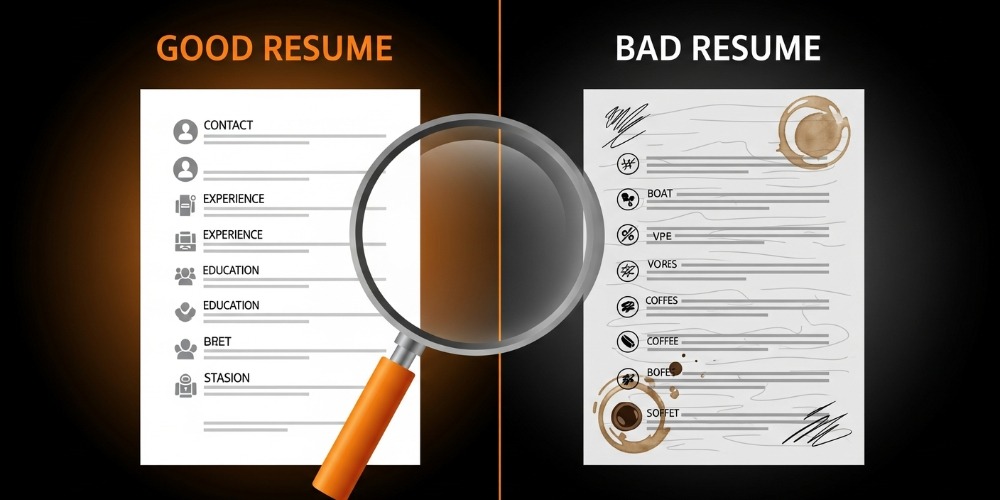
| Dimension | Good resume | Bad resume |
|---|---|---|
| Clarity and structure | Clean headings, consistent fonts, logical flow | Crowded layout, inconsistent styling, clutter |
| Relevance | Tailored content matching role | Generic content, scattered focus, filler |
| Quantified results | "Increased sales by 30%" | "Responsible for improving sales" |
| Keywords | Context-appropriate, natural integration | Keyword dumping without substance |
| Readability | White space, bullets, scannable | Dense paragraphs, walls of text |
| Error-free | Proofread, consistent dates | Typos, awkward phrasing, inconsistent dates |
| Length | One page (or two when content justifies) | Padded or crammed without reason |
Three secondary observations worth noting:
- Length: One-page is safe; two-page works when content earns it. Double-sided printing without substance dilutes rather than adds.
- Basics: Missing contact details, unclear job titles, or broken timelines signal carelessness even before substance is evaluated.
- Buzzword density: Real outcomes ("reduced churn 18%") beat aspirational language ("results-oriented leader") consistently.
How to Balance Instinct with Data

The strongest evaluation combines both — instinct for soft signal, data for objective comparison.
Workable's 2024 AI in Hiring survey shows 90% of employers say AI has accelerated hiring and 77.9% report cost savings. The pattern: AI handles consistency at scale; humans handle judgement where it matters.
Practices that work
- Use standardised scoring rubrics for every resume
- Document reasoning behind each shortlist decision
- Revisit rejected resumes quarterly for missed patterns
- Combine instinct read with explicit data check before final decision
- Use 5-point scoring on key dimensions rather than overall vibes
The goal: instinct sparks interest; data confirms it; the combination decides.
Tools That Reduce Pure Gut-Feel Screening

Four categories of tooling that consistently produce stronger evaluation.
1. Modern ATS with semantic search
Goes beyond keyword matching to understand meaning. Resume parsing tools that surface qualified candidates whose phrasing varies from job description wording. Critical when CV keyword filtering is producing false negatives.
2. AI screening and resume parsers
Context-based matching that evaluates substance over surface features. Strong tools produce explainable scoring rather than black-box rankings.
3. Skills assessment platforms
Tools like Vervoe, TestGorilla, or Codility measure actual capability rather than relying on resume claims. Particularly useful when resume polish and underlying ability diverge significantly.
4. Hiring analytics dashboards
Track the time recruiters spend reviewing resumes against actual hire success. The data reveals which gut-feel calls were right and which were wrong over time.
How to Build a Fair Resume Evaluation Process

Five practices that consistently produce fair, defensible screening.
1. Standardised evaluation templates
Every reviewer uses the same matrix — skills, experience, achievements, role fit. Eliminates the "I had a feeling" variance between reviewers.
2. Blind first-pass screening
Remove names, photos, school identifiers, and demographic signals from initial review. Reintroduce for later stages once substance has been evaluated.
3. Automated quality checks
Light automation flags missing data, date inconsistencies, or pattern anomalies — without outright rejecting candidates. Catches issues without producing false negatives.
4. Reviewer calibration sessions
Weekly or biweekly sessions where recruiters compare shortlists and discuss disagreements. Builds shared understanding of what "good" looks like.
5. Outcome feedback loops
Review 90-day performance of hires against the resume traits that drove their selection. Patterns inform future evaluation.
What Doesn't Work
Three anti-patterns worth naming.
"Trust your gut" without structure
Pure instinct produces inconsistent results and bias accumulation. Even experienced recruiters benefit from rubrics.
Format over substance
Polished resumes with thin content consistently underperform plainer resumes with substantive content in actual hire success.
Keyword stuffing acceptance
Resumes that succeed only at keyword stuffing rarely succeed in the role. Tools that reward this pattern produce predictable mis-hires.
The Bottom Line
Resume evaluation deserves more structure than recruiters typically give it. The good-resume vs bad-resume distinction is real and measurable — clarity, quantified outcomes, role-relevant focus, error-free presentation. But evaluating against these criteria consistently requires rubrics, calibration, and tooling beyond pure instinct. The companies that combine intuitive read with structured data produce measurably better hiring outcomes than companies that rely on either alone. Instinct sparks interest; data confirms it; the combination decides well. The discipline is teachable; the payoff compounds across many hires; the alternative is hiring drift that produces predictable mis-hires nobody wants to talk about.
FAQs
What's the 7-second rule in resume reading?
The average time a recruiter spends on first-pass scan — within those seconds, they decide to shortlist or skip. A concise, scannable layout helps make the right first impression possible.
Can a bad resume belong to a strong candidate?
Frequently. Many professionals with excellent skills present themselves poorly on paper. Format errors, weak phrasing, or unfamiliar layouts can hide strong substance. Combining human review with data-driven screening reduces these false negatives.
How should recruiters compare resumes fairly across industries?
By focusing on competency-based scoring — measurable outcomes, transferable skills, and demonstrated capability — rather than industry-specific job titles. Structured frameworks make cross-industry comparison fair and consistent.
Are AI tools reliable for resume screening?
Modern AI tools that use semantic matching and provide explainable scoring are reliable when audited for bias. Pure keyword-matching legacy tools produce too many false negatives to recommend.
What's the single most important improvement to resume screening?
Adopting a written scoring rubric used consistently by every reviewer. The structure-vs-vibes difference produces dramatically better hiring outcomes across nearly every measurable dimension.
Keep reading

ATS Integration Gaps: The Real Reason Hiring Stalls in 2026

How AI Reshapes Resume Screening: Speed, Quality, and Honest Limits
