

How AI Reshapes Resume Screening: Speed, Quality, and Honest Limits
AI resume screening compresses screening time and improves consistency — what it does well, the genuine limitations, and how to use it responsibly.
Ployo Team
Ployo Editorial

TL;DR
- 99% of hiring managers use AI somewhere in hiring; 98% report efficiency gains (Insight Global).
- 93% still believe human judgement remains essential.
- AI handles structured + unstructured resume data with semantic understanding.
- Real risk: bias from training data, opacity in scoring, missing non-traditional backgrounds.
- Best deployed as recruiter assistant, not autonomous decision-maker.
The volume of applications per role has outgrown what manual review can handle reliably. Strong candidates get lost in the pile; recruiter burnout compounds. AI resume screening was supposed to fix this — and largely does, when used well. The technology is mature; the discipline of using it responsibly is where most companies still fall short. This guide walks through what AI screening actually does, the genuine benefits, the honest limitations, and how to deploy it without creating new problems.
What AI-Powered Resume Screening Actually Is
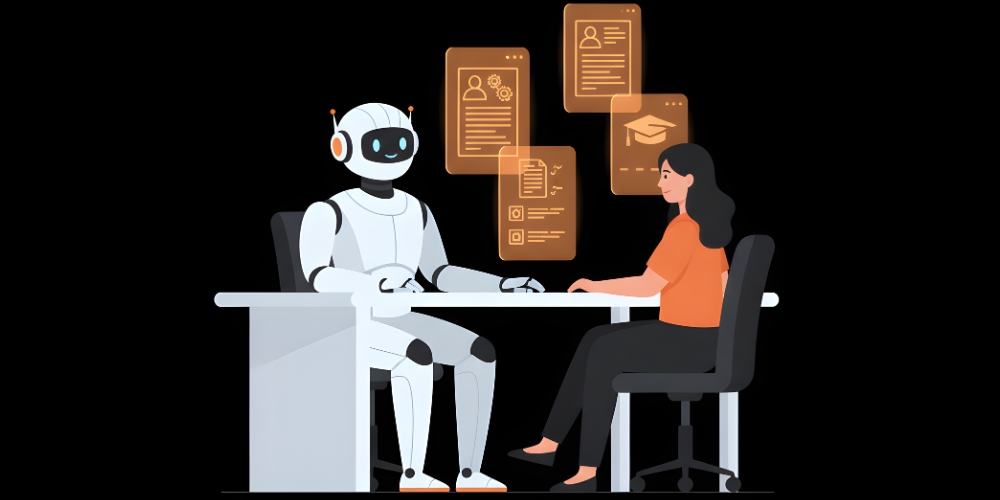
Software that uses AI to parse, analyse, and evaluate job applications against role criteria. The systems have evolved from simple keyword matching to semantic understanding of context, skills, and experience patterns.
Modern AI screening typically:
- Parses both structured data (education, dates, titles) and unstructured content (project descriptions, achievement narratives)
- Evaluates skill relevance based on context rather than exact keyword presence
- Ranks candidates against role-specific scoring criteria
- Surfaces patterns across applicant pools
- Integrates with ATS systems for unified candidate management
The advance from keyword-only matching to semantic understanding is what makes modern tools genuinely useful versus the brittle legacy systems they replaced.
How AI Transforms Resume Screening
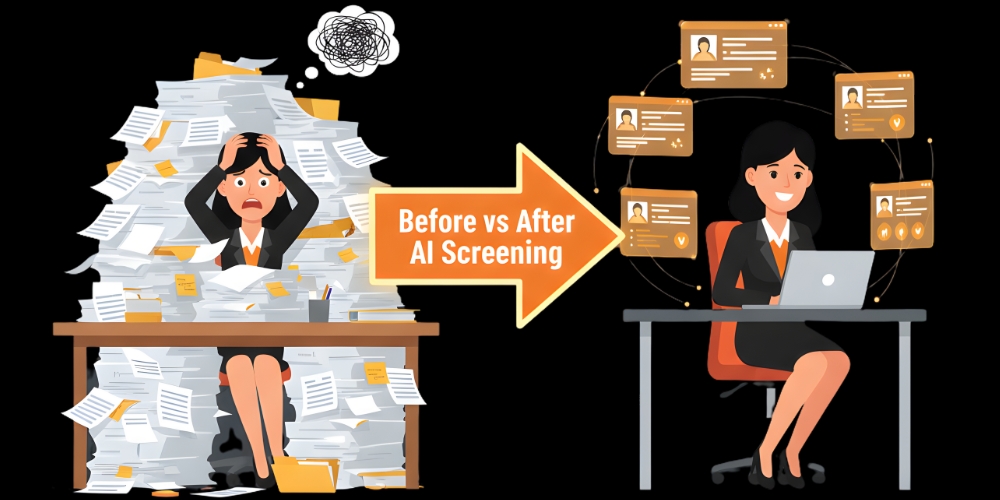
Four shifts from traditional screening.
From manual reading to AI-assisted ranking
Recruiters move from sequential resume reading to reviewing AI-ranked shortlists. Insight Global's 2025 AI in Hiring report shows 99% of hiring managers use AI somewhere in hiring and 98% report efficiency gains.
From keyword matching to context understanding
Modern systems read context. "Led product launches across three markets" gets credit for leadership and execution skills even without "managed" or "leader" explicitly appearing.
From volume bottleneck to scalable filtering
Companies handling 250,000+ applications annually (Unilever, for example) couldn't operate manually. AI screening makes scale tractable.
From inconsistent screening to systematic evaluation
Every candidate evaluated against the same criteria using the same logic. Reviewer fatigue, time-of-day variance, and bias accumulation all reduce substantially.
Balance with human judgement
The same Insight Global research shows 93% of hiring managers believe human judgement remains essential. AI handles volume; humans handle nuance, conversation, and consequential decisions.
Pros and Cons of AI Resume Screening
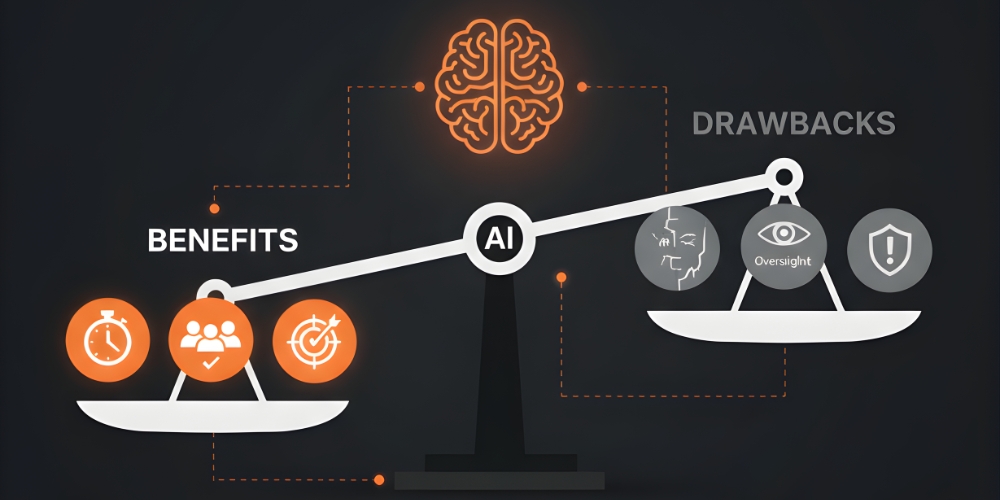
Real benefits
- Speed at scale: Thousands of resumes screened in minutes
- Consistency: Same criteria applied to every candidate
- Volume handling: Makes high-volume recruiting tractable
- Better onboarding match: Stronger initial screening produces hires more likely to succeed
- Bias reduction (when done well): Removes reviewer-fatigue variance
Honest limitations
- Risk of missing unconventional candidates: Strong people with non-standard backgrounds can be undervalued
- Bias inheritance: Models trained on biased historical data reproduce the bias
- Reduced human element: Soft signals (motivation, culture fit, growth potential) often slip past algorithmic scoring
- Accuracy limits: Performance depends heavily on training data quality and role definition clarity
The trade-off is real but manageable. Audit discipline + human override + structured rubrics produce strong outcomes; pure-algorithmic screening produces predictable problems.
Real-World Examples
Unilever
Adopted automated CV screening integrated with AI video interviews for their 250,000+ annual applications. HireBee research reports ~75% hiring-time reduction with improved candidate satisfaction.
Hilton Hotels
Uses AI software to match applications to roles and identify candidates most likely to pass training and stay 6+ months. Direct connection between screening quality and retention outcomes.
Mid-sized companies
Increasingly use AI plug-ins integrated with their ATS. Affordable scoring tools predict success based on skill overlap and surface recommendations to recruiter dashboards. Manual review still happens — but on pre-filtered shortlists rather than raw application piles.
Common Challenges in AI Resume Screening
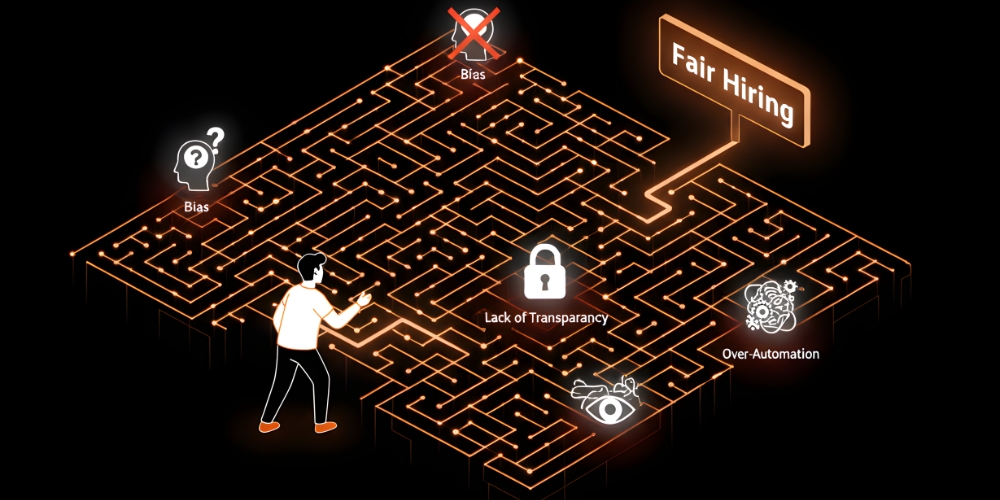
Four challenges worth managing actively.
Bias from training data
Algorithms learn from historical hiring patterns. If those patterns favoured specific schools, demographic groups, or career profiles, the model reproduces the bias. Audits and bias-aware retraining are non-negotiable.
Scoring transparency
Why did one candidate score higher than another? Black-box models that can't explain decisions create legal exposure and candidate frustration. Modern best practice: explainable scoring with documented criteria.
Over-automation risks
AI ranks candidates well on paper but can miss motivation, cultural alignment, or transferable skills. Combining algorithmic screening with AI talent assessment platforms that include behavioural and skill evaluation produces fuller pictures.
Format variance
Scanned PDFs, unusual layouts, creative formats all can confuse parsing. Modern tools handle this better than legacy systems but still vary in robustness.
How to Deploy AI Resume Screening Responsibly
Six practices that distinguish strong implementations.
1. Audit before deploying
Test the model against historical hiring data. Check for adverse impact across demographic groups. Catch issues before they affect real candidates.
2. Maintain human override
Recruiters review AI rankings and can override based on context. The override authority must be real, not theatrical.
3. Send a deliberately broad shortlist
Don't just pass the top 5% to human review. Top 20-30% with context allows recruiters to catch the strong candidates the model undervalued.
4. Audit periodically
Quarterly review of model outputs vs hire outcomes. Catch drift before it produces measurable problems.
5. Be transparent with candidates
Disclose AI use in hiring process. Provide appeal paths for adverse decisions. Trust depends on disclosure, not opacity.
6. Combine with structured interviews
Even strong AI screening produces shortlists that need human evaluation. Pair with structured interviews for full evaluation.
What Doesn't Work
Three patterns that consistently fail.
Treating AI scores as final decisions
Automation bias compounds whatever bias exists in the model. Human override authority must remain real.
Skipping audits
Models drift; candidate populations shift. Annual or quarterly audits catch drift before it becomes adverse impact.
Hiding AI use
Candidates discover AI was used. Trust damage from concealment exceeds any operational gain.
The Bottom Line
AI resume screening genuinely transforms recruiting at scale — making volumes tractable, reducing reviewer fatigue, and improving consistency. The technology is mature; the discipline of using it responsibly is the differentiator. Companies that deploy AI screening with audit discipline, human oversight, transparent disclosure, and continuous improvement produce measurably better hiring outcomes. Companies that deploy it as autonomous decision-making produce predictable bias problems and regulatory exposure. Use AI for what it does well — volume and consistency — and keep humans for what they do well — nuance, judgement, and accountability. The combination outperforms either alone.
FAQs
Do AI resume screeners filter out qualified candidates by mistake?
Yes, sometimes — particularly candidates with non-traditional backgrounds, unusual formats, or unconventional career paths. Best practice: human review of a broader shortlist than algorithmic top-of-list alone.
How does AI handle non-traditional resumes?
Modern systems with semantic understanding handle them better than legacy keyword-only tools. They can recognise transferable skills across job titles and industries. But "borderline" profiles still benefit from human review.
Can small businesses use AI resume screening?
Yes — many tools now have affordable subscription tiers. For small businesses, AI screening saves disproportionate time relative to team size and produces fairer evaluation than ad-hoc manual review.
What's the highest-leverage AI screening improvement?
Audit discipline. Models that get audited quarterly for adverse impact produce dramatically better outcomes than models that get deployed and forgotten. The audit is what separates responsible from negligent deployment.
Will AI fully replace recruiters in resume screening?
No — and probably not for the foreseeable future. The data shows 93% of hiring managers value human judgement specifically because AI misses what humans catch. The role evolves; it doesn't disappear.
Keep reading

Beating CV Keyword Filtering in 2026: How AI Changes the Game

Automated CV Screening: The Real Cost Case for Replacing Manual Review
