

ATS Integration Gaps: The Real Reason Hiring Stalls in 2026
Most recruiter slowdowns come from disconnected systems, not weak pipelines — what proper ATS integration looks like and how to fix the gaps that hurt most.
Ployo Team
Ployo Editorial

TL;DR
- Most recruiter slowness is system fragmentation, not talent scarcity.
- Strong ATS integration can cut time-to-hire by up to 60% in research benchmarks.
- A single bad hire costs up to $240K (SHRM) — much of which stems from fragmented data and missed signals.
- API-driven integration, middleware connectors, and unified CRM+ATS data fix the core slowdowns.
- Start with high-impact integrations (job boards, calendars, CRMs) and expand from there.
When recruiters report they're behind on hiring, the diagnosis is usually "we need more candidates." Audit the workflow and a different picture emerges: candidates exist, but they're stuck in the gaps between systems. Resume parsers don't talk to the ATS. The ATS doesn't talk to the scheduler. Feedback lives in five Slack threads. Reports take a week to compile. This guide breaks down where ATS integration gaps actually cost time, what proper integration looks like, and the practical sequence for fixing the slowdowns that hurt most.
What ATS Integration Actually Means
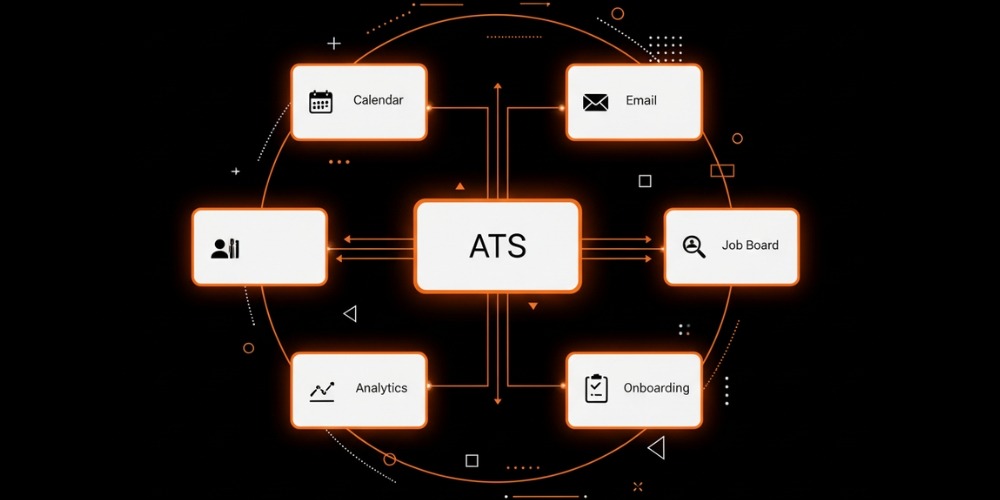
ATS integration is the set of API connections, prebuilt connectors, and middleware that lets your applicant tracking system exchange data with the other tools in your hiring stack — HRIS, job boards, assessment platforms, scheduling tools, CRM, and onboarding systems.
When done well, integration means:
- Job openings push to multiple boards from a single ATS posting action
- Candidate records flow into HR and payroll systems on hire
- Assessments trigger automatically at the right pipeline stage
- Interview scheduling syncs with calendars without email back-and-forth
- Communication history lives in one place
- Background checks initiate when candidates reach the appropriate stage
When integration is weak or absent, every system becomes a silo — and every recruiter task involves copy-paste, context switching, and risk of data loss.
Why Integration Matters Operationally

Four operational dimensions where integration drives measurable returns.
Time-to-hire compression
SelectSoftware Reviews research shows well-integrated ATS deployments can cut time-to-hire by up to 60% versus fragmented stacks. The compression compounds — every day saved is a day a competitor doesn't have to outbid you for the same candidate.
Data quality
Manual entry generates duplicates, missing fields, and inconsistent tagging. Integration eliminates the largest source of dirty data — humans retyping the same information into multiple systems. Clean data feeds cleaner analytics, cleaner reporting, and ultimately better hiring decisions.
Candidate experience
When systems are connected, candidates get timely updates, fewer dropped follow-ups, and consistent communication. The brand value of "we responded within 24 hours" is significant and almost free with proper integration.
Scalability
A small recruiting team running on integrated tooling can outproduce a much larger fragmented team. Integration scales people's effective capacity without adding headcount.
The Hidden Costs of Weak Integration

Five costs that don't show up on the budget line but quietly accumulate.
Recruiter time burned on copy-paste
Research suggests recruiters spend 20+ hours per week on manual resume filtering and data entry that integration would eliminate. Across a 5-person team, that's 100 hours weekly of pure waste.
Lost candidates from slow follow-up
Top candidates have multiple offers within days. Fragmented systems slow the response cycle past the window where the candidate is still available.
Bad hires from inconsistent screening
SHRM research puts a single bad hire's cost as high as $240K when productivity, retention, and team impact are factored in. Inconsistent screening across disconnected systems is one of the contributing factors.
Reporting blindness
Without integration, basic hiring metrics — time-to-hire, source effectiveness, drop-off rates — require manual calculation. Strategic decisions get made on outdated or incomplete data.
Tool overlap and license waste
Disconnected tools often duplicate features. Companies pay for the same capability in 2-3 systems because no single one is the source of truth.
Where Integration Gaps Slow Recruiters Down

| Stage | Manual cost | Integrated state |
|---|---|---|
| Job posting | Manual posts to 3-5 boards, inconsistent formatting | Single post, automatic syndication |
| Application intake | Resumes scattered across email, ATS, Drive | All applications into one queue |
| Pre-screening | Toggle between resume, LinkedIn, ATS notes | Single candidate record with all context |
| Scheduling | Email ping-pong, calendar collisions | One-click calendar slot proposal |
| Feedback | Scorecards in email or docs, often lost | Structured feedback at the stage |
| Hire-to-onboarding | Re-enter candidate data into HRIS | Automatic flow to HRIS and payroll |
| Reporting | Spreadsheet stitching for monthly review | Real-time dashboards |
Each row is a real source of slowdown. Together, they explain why disciplined teams with strong integration consistently outperform larger teams running on disconnected tools.
How to Fix the Integration Gaps

A practical sequence in the order they typically pay off.
1. Pick an ATS with strong API support
The single most important decision. Modern ATS platforms (Greenhouse, Workable, Lever, Ashby) expose comprehensive APIs that let downstream tools integrate without per-vendor development work. Legacy or proprietary ATS without API access become bottlenecks no matter what else is added.
2. Connect job boards via syndication
If postings are still being typed into Indeed, Glassdoor, and niche boards individually, fix this first. The hours saved per posting compound across every open role. Most modern ATS platforms include this natively.
3. Sync calendars and scheduling
Email ping-pong is one of the largest drop-off points in modern hiring. Tools like Calendly, GoodTime, or built-in ATS scheduling eliminate it with minimal setup cost.
4. Unify CRM and ATS
Candidates exist on a continuum — passive (CRM territory) to active (ATS territory). Tools like Beamery or Gem unify both views so the recruiter sees the full relationship history regardless of stage.
5. Add automated screening
Once integration is established, automated CV screening compounds the speed gain. Resume parsing + structured pre-screening eliminates the 20+ hours/week recruiters spend on manual review and pushes only qualified candidates forward.
6. Use middleware for hard-to-integrate tools
Tools like Merge, Zapier, or Make handle the integrations that don't have native connectors. Middleware is less elegant than direct API integration but covers the long tail of niche tools.
7. Set permissions and audit trails
Once data flows freely, governance matters. Permission models prevent unauthorised access; audit logs support compliance with GDPR, CCPA, and similar frameworks.
8. Implement gradually
Resist the temptation to rip-and-replace. Start with the highest-impact gap (usually job boards or scheduling), measure the improvement, then move to the next gap.
What "Done" Looks Like
A well-integrated recruiting stack passes these tests:
- Candidate data is entered once and propagates everywhere
- Job posts go live across all boards in one click
- Interview scheduling takes a single email exchange
- Feedback is captured at the stage, with deadlines
- Reports refresh in real time, not on a monthly rollup
- New tools added in the future have a clear integration path
If your stack fails any of these tests, the gap is where to focus next.
The Bottom Line
Recruiters are not slow. Fragmented systems are. The biggest single lever for hiring speed in most companies is not "find more candidates" — it's connecting the tools that already exist so candidate data, communications, and decisions flow without human copy-paste. Strong ATS integration compresses time-to-hire, improves data quality, lifts candidate experience, and scales recruiting capacity without adding headcount. The teams that treat integration as a strategic investment consistently outperform teams that treat it as IT-back-office work. Start with the gap that hurts most, prove the gain, and expand from there.
FAQs
Can small businesses benefit from ATS integration, or is it only for big companies?
Small teams often benefit more, because they run leaner. Integration removes the manual admin that disproportionately consumes a small team's capacity. Many strong ATS platforms have small-business tiers with the integration features included.
How much does ATS integration cost?
Basic integrations using native connectors are typically included in standard ATS pricing. Custom API integrations range from a few hundred to several thousand dollars depending on complexity. Middleware tools (Zapier, Make) charge per workflow, often well under $100/month for typical recruiting use.
What's the difference between ATS integration and CRM integration in hiring?
An ATS manages active candidates through the hiring funnel. A CRM manages relationships — passive talent pools, alumni, silver-medalists. When both are integrated, the recruiter sees the full relationship history from first contact through hire and beyond.
Is open API access important when choosing an ATS?
Yes. Open APIs future-proof the stack. Any tool added next year — assessment platforms, new analytics, AI screening — needs to integrate cleanly with the ATS without bespoke development. APIs are the contract that makes this possible.
What's the single highest-leverage integration to add first?
For most teams: job board syndication. The hours saved per posting cycle compound rapidly across every open role and pay for the integration work many times over.
Keep reading

Good Resume vs Bad Resume: How Recruiters Should Actually Evaluate

How AI Reshapes Resume Screening: Speed, Quality, and Honest Limits
