

How to Hire Hourly Employees Fast Without Sacrificing Quality
Hourly hiring is structurally different from salaried hiring — the step-by-step process that fills shifts fast, lowers turnover, and respects candidates.
Ployo Team
Ployo Editorial
TL;DR
- Hourly roles make up a large share of the US workforce, with high volume, high turnover, and tight timelines.
- The most common hiring failures are slow processes, weak descriptions, mismatched expectations, and unstructured screening.
- A clean 7-step process — clarify, post, screen, assess, interview, offer, onboard — fills roles consistently.
- Reliability, availability, communication, and learning ability matter more than resume polish.
- AI tools reduce friction and improve fairness without replacing human judgement.
Hourly hiring runs on a different clock from salaried hiring. The applicant pool is larger, the timeline is shorter, and the candidates are usually deciding between several offers in parallel. Slow processes lose them; sloppy expectations break retention. Strong hourly hiring is structured but fast — and the teams that get it right consistently fill shifts without the constant cycle of re-hiring. This guide walks through what makes hourly hiring different, the most common failure modes, the step-by-step process that works, and where AI helps.
What Makes Hourly Hiring Different

Hourly hiring is not just salaried hiring with a shorter time horizon. The dynamics are genuinely different:
- Pay is per hour with shifting weekly schedules. Predictability matters to candidates more than headline rate.
- Volume varies sharply. Some weeks you hire one person; other weeks you need a dozen for a launch or a seasonal ramp.
- Retail, service, and hospitality dominate the role pool. Reliability and attitude matter as much as skill.
- Fast ramp is the norm. Candidates expect to start within days, not weeks.
- The qualified pool is broad but evaluated on different signals. Long degree-credential evaluation is rarely useful here.
Traditional long hiring cycles work badly. The teams that get hourly hiring right move at the speed candidates actually expect.
Why Hourly Hiring Often Fails
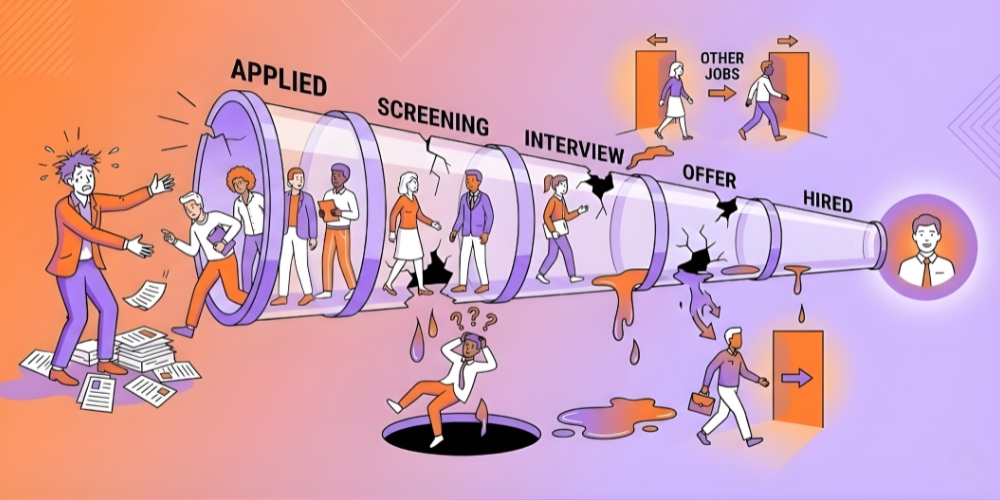
Four failure modes show up consistently.
Slow process
Hourly job seekers apply to multiple employers in parallel. If you move slowly, they accept elsewhere. BLS data on job openings and hires shows openings and hires remain elevated — the candidates have options.
Weak job descriptions
Unclear roles produce unclear expectations. Candidates self-select out when they cannot tell what the work actually involves.
Mismatched expectations
If pay, schedule, or duties shift between application and start, trust erodes immediately and retention drops.
Unstructured screening
Without consistent evaluation, you hire people who do not fit — and those people leave quickly. The cost of high turnover is real, and the process is the most fixable cause.
Without intentional structure, hourly hiring becomes a loop of opening, filling, and re-opening the same roles every few months.
A Step-by-Step Process for Hiring Hourly Employees
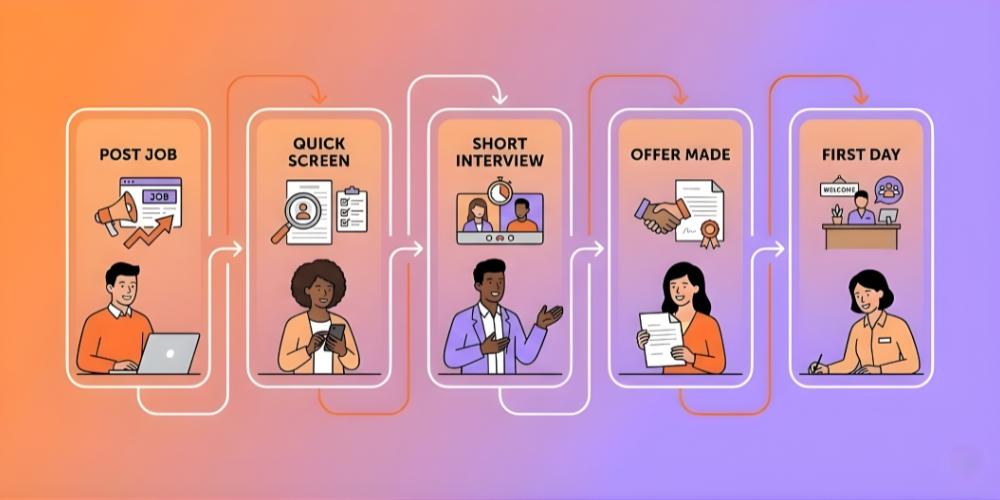
Seven steps that consistently produce strong hires.
1. Clarify the role
Write a job description that names the pay, the schedule, the daily tasks, any physical requirements, and the start date. Honest and direct. Hourly candidates make fast decisions, and clarity is what makes those decisions favourable.
2. Post where hourly candidates actually look
Indeed, local community boards, walk-in signage, niche boards for hospitality or retail where relevant. Reach matters; channel match matters more.
3. Screen efficiently
Resume scan plus a short questionnaire about availability, prior similar experience, and two or three role-relevant questions. Add pre-employment screening for eligibility and basic background — cheap insurance against problems later.
4. Add a smart assessment
A short situational scenario or role simulation reveals more than a resume can. AI-assisted cognitive testing tools help evaluate how candidates think on the job in real time.
5. Interview with purpose
Even a 15-minute structured interview confirms communication, attitude, and understanding of the role. Keep it focused on real work situations — "how would you handle [common scenario]?" outperforms abstract questions every time.
6. Offer clearly and quickly
When you have a strong candidate, move within 24 hours. State the pay, schedule, start date, and any training requirements upfront. Hourly candidates are usually deciding between options; speed wins.
7. Onboard with care
Orientation, expectations, tools, and first-shift partner. Strong onboarding reduces early attrition substantially — and reduces the re-hire loop that breaks most hourly hiring functions.
What to Look For in Hourly Employees

Skills matter but behaviour matters more. Four signals to evaluate explicitly.
Reliability
Can the person show up on time and follow a schedule? Missed shifts produce real operational problems, especially in customer-facing roles. The strongest single predictor of hourly success.
Availability and flexibility
Hourly work often involves evenings, weekends, and rotating shifts. Misaligned availability is a leading cause of early drop-off.
Communication
The candidate needs to understand instructions and ask questions when they are unclear. In safety-sensitive or fast-paced environments, this is non-negotiable.
Learning ability
Even entry-level hourly roles evolve. New tools, processes, and rules appear regularly. Candidates who learn quickly stay longer and perform better.
Common Hourly Hiring Mistakes
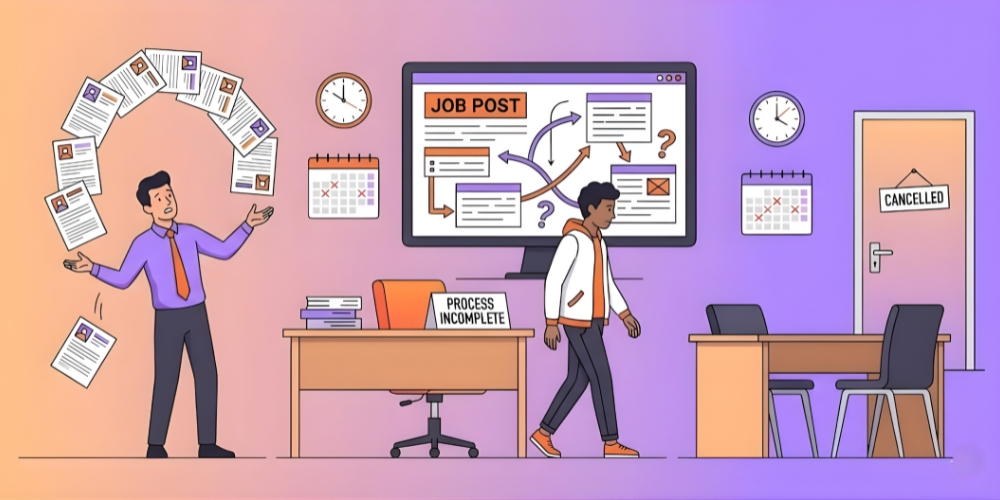
Most hourly hiring problems are not caused by candidate shortages — they are caused by avoidable mistakes in the hiring process.
Overcomplicating the process
Long forms, multiple interview rounds, slow follow-ups. Hourly candidates expect speed; complexity drives them to faster competitors.
Setting unclear expectations
When pay or shifts change between offer and start date, trust collapses immediately. Be explicit upfront, even when it slightly limits your applicant pool.
Over-relying on resumes
Many strong hourly candidates have thin resumes but perform well on the job. Weight structured interviews and skill demonstrations more heavily than CV scanning.
Skipping structured screening
Without a consistent rubric, hiring decisions get made on instinct alone. Apply the same evaluation framework to every candidate to keep quality steady.
How AI Improves Hourly Hiring

AI is most useful in hourly hiring when it removes friction without removing judgement. Two specific benefits.
Speed at scale
AI tools quickly filter applicants by availability, location, and basic qualifications, surfacing the strongest matches first. Particularly valuable when demand spikes for a seasonal launch or sudden need.
Fairer screening
When the same rules apply to every applicant, personal bias has less room to influence decisions. AI applies consistent standards across candidates — provided the system itself is calibrated thoughtfully.
The pattern that works: AI handles the mechanical part of the funnel; the human handles the conversation and the final call.
The Bottom Line
Hiring hourly employees does not have to feel chaotic. Clarify the role, move fast, screen consistently, interview with purpose, offer cleanly, and onboard with care. Add AI where it speeds the funnel without replacing the human read on each candidate. The goal is not perfection — it is consistency, clarity, and respect for the candidate's time. The teams that get hourly hiring right rebuild the cycle once and operate it cleanly; the teams that skip the discipline keep filling the same roles, month after month.
FAQs
How quickly should hourly roles be filled?
As quickly as possible once demand is confirmed. Delays of more than a week typically increase drop-off and raise the risk of understaffed shifts.
What matters most when hiring hourly workers?
Reliability, availability, and attitude. Specific skills can usually be taught; the underlying behaviours cannot.
Should hourly roles include interviews?
Yes — even short ones. A 15-minute structured interview confirms understanding, communication style, and genuine interest in the role.
Can AI actually reduce turnover in hourly hiring?
Yes, when used thoughtfully. AI's role is to match candidates more accurately to the role's actual demands, which lowers early exits and reduces the rehire loop.
What is the single biggest mistake in hourly hiring?
Slow response. Strong hourly candidates accept the first acceptable offer they receive. Teams that take days to respond consistently lose candidates to faster competitors.


