

GED vs High School Diploma: Hiring, Earnings, and Real Differences
Both GED and high school diploma open doors — what differs in time, employer perception, and earning potential, and how to make either work for you.
Ployo Team
Ployo Editorial

TL;DR
- Both credentials qualify for most entry-level jobs and college admission.
- GED takes months; high school diploma takes years.
- Some employers (corporate, government) still favour the diploma.
- BLS data: at-least-high-school median weekly earnings $853 vs $682 below.
- Skills, certifications, and presentation matter more than the credential itself.
GED vs high school diploma is one of the most-asked questions among job seekers and adult learners. Both credentials are legally equivalent in most contexts; both open doors to most jobs and colleges. But they're earned differently, perceived differently by some employers, and lead to different outcomes depending on industry and how candidates present them. This guide breaks down what each credential actually is, where they're treated equally, where one has an edge, and how to make either work for you in modern hiring.
Quick Definitions

High school diploma
Awarded after completing 3-4 years of coursework across grades 9-12 — math, science, English, electives, and state-required courses. Demonstrates long-term academic engagement plus social and behavioural skill development through classroom experience.
GED (General Educational Development)
A test-based credential earned by passing four subject exams: Language Arts, Math, Science, Social Studies. Recognised in all 50 US states, Canada, and many international jurisdictions as a high school equivalency certificate.
The substantive difference: a diploma is earned through years of coursework; a GED is earned through demonstrated knowledge equivalent to that coursework. Both signal high-school-level academic capability.
Key Differences

Five dimensions where the credentials differ.
Time to earn
- Diploma: 3-4 years of coursework
- GED: Weeks to months of focused test prep
Learning environment
- Diploma: Traditional classroom, group projects, sustained interaction
- GED: Self-paced study, often online or through adult education
Skill demonstration
- Diploma: Academic plus social, behavioural, and time-management skills
- GED: Primarily academic knowledge as measured by tests
Employer perception
Often equivalent, but some corporate and government employers still favour the diploma due to familiarity and assumed signal about persistence.
Best fit by life stage
- Diploma: Traditional students moving through standard education
- GED: Adults returning to education, career changers, those with non-linear paths
Hiring Preferences

Hiring preferences vary by sector.
Where they're treated equally
- Retail and customer service
- Hospitality and food service
- Construction and skilled trades
- Manufacturing and warehouse
- Many tech support roles
- Healthcare support positions
In these sectors, demonstrated skills, certifications, and dependability matter far more than credential type.
Where diplomas may have an edge
- Corporate administrative and professional roles
- Some government and public sector positions
- Banking and financial services
- Roles with high competition where small differentiators matter
- Some unionised apprenticeship programs
The advantage is often perception-based rather than substantive — but perception matters in hiring.
Higher education and military
- Colleges: Most US colleges accept GED equivalent to diploma; admissions often look at placement tests, GPA where available, or other indicators.
- Military: GED holders can enlist but may fall into a different enlistment tier requiring higher ASVAB scores or additional college credits for certain roles.
Impact of AI screening
Modern recruiting often uses ATS systems that scan resumes before humans. Both credentials pass standard ATS filters when correctly labeled. Listing "High School Equivalency Diploma (GED), [Year]" reads cleanly to both ATS and human reviewers.
Which Gets You Hired Faster?

The honest answer: it depends on the field and how prepared you are otherwise.
When GED can produce faster employment
- Adult re-entering workforce — earning the GED in months vs reconstructing high school over years
- Industries with labor shortages (trucking, manufacturing, healthcare support) where any qualifying credential lands work fast
- Skill-based hiring environments where certifications matter more than education path
When the diploma might have an edge
- Corporate roles where the credential is the familiar signal
- Competitive markets where small differentiators sway decisions
- Apprenticeships recruiting directly from high schools
Why neither wins alone
Speed-to-hire depends overwhelmingly on the total package — credential plus skills, certifications, interview performance, and network. BLS earnings data shows weekly median earnings of $853 for those with at-least-high-school education vs $682 without — and that data applies to both diploma and GED holders.
How to Improve Job Prospects with Either Credential

Six practices that compound returns from either credential.
1. Add industry certifications
Job-ready skills certifications (IT support, healthcare assistant, bookkeeping, trades) often matter more than credential type. Many available free or low-cost through Coursera, edX, and community programs.
2. Use modern job search methods
LinkedIn, industry-specific platforms, local networking events. Smart recruitment methods reach roles that pure job-board searches miss.
3. Present credentials cleanly on resume
For GED, write "High School Equivalency Diploma (GED) – [State], [Year]" — clear, unambiguous, passes both ATS and human review.
4. Prepare thoroughly for interviews
Structured interview preparation — research the company, practise behavioural answers, prepare specific examples — outweighs credential differences in interview outcomes.
5. Build work experience quickly
Internships, part-time roles, volunteer work all close credential gaps. Demonstrated capability beats theoretical credential preference.
6. Keep learning
Community college courses, trade programs, online certifications. The "lifelong learner" signal matters to many employers and compounds across careers.
Best Jobs for GED Holders
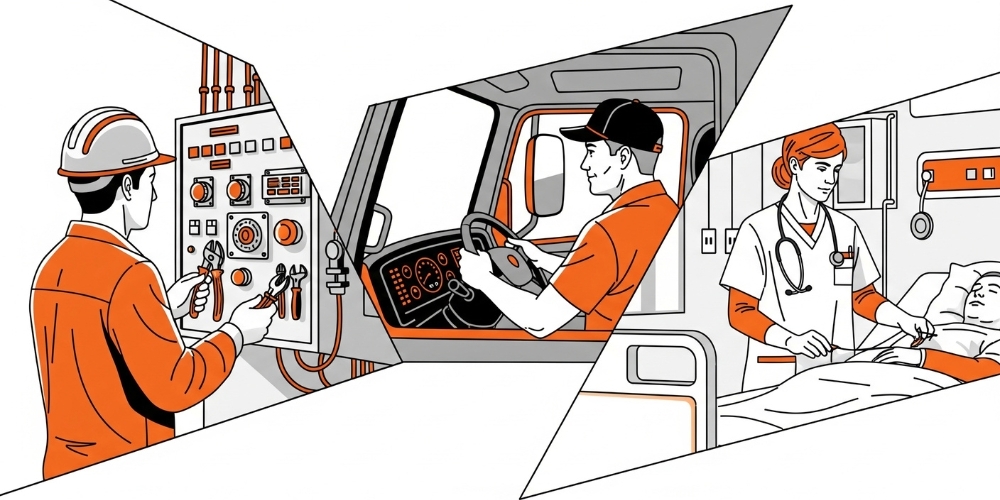
Six career areas where GED holders consistently land roles.
Skilled trades
Electrician, plumber, HVAC technician, welder. Often require trade school or apprenticeship completion rather than diploma specifically. Many offer paid training.
Healthcare support roles
Certified Nursing Assistant (CNA), Medical Assistant. Short training programs lead to credentialed roles. BLS projects faster-than-average growth for healthcare support occupations through 2033.
Transportation and logistics
Truck drivers (with CDL), delivery drivers, warehouse supervisors. Skill-based hiring with strong on-the-job training.
Manufacturing and production
Assembly line, machine operation, quality inspection. Strong opportunities in regions with active manufacturing sectors.
Security and protective services
Security guards, correctional officers, similar roles. Background check and training matter more than credential type.
Sales and customer service
Retail, call centers, customer support. Communication skills and reliability outweigh credential differences.
Best Jobs for High School Diploma Holders

Six categories where diploma holders particularly stand out.
Administrative support
Office assistant, receptionist, data entry. Employers see diploma as signal for dependability and organisational habits.
Government and public sector
Some clerical and entry-level agency positions favour diploma holders especially in competitive applicant pools.
Skilled apprenticeships
Carpentry, welding, advanced manufacturing programs sometimes recruit directly from high schools.
Hospitality management tracks
Hotel front desk supervisors, event coordinators, shift managers in larger establishments.
Law enforcement entry roles
Police cadet, community service officer programs often recruit directly from high school graduates.
Banking and financial services
Bank teller, customer service representative — diploma often listed as baseline requirement.
The Bottom Line
GED and high school diploma are legally equivalent for most purposes and produce similar earnings outcomes. The faster path to employment depends on industry, geography, candidate preparation, and how the credential is presented alongside skills and experience. Neither credential is automatically better — both open doors. The skills, certifications, work experience, and interview discipline that surround the credential matter far more than the credential itself. Whichever you have, invest in building the surrounding capability that turns it into a real career.
FAQs
Is a GED accepted for college admissions?
Yes — most US colleges accept GED as equivalent to a high school diploma. Admissions decisions also consider placement tests, SAT/ACT scores where available, and any post-GED coursework.
Can you join the military with a GED?
Yes, but with constraints. GED holders can enlist but may fall into different enlistment tiers requiring higher ASVAB scores or additional college credits for certain roles.
Which is harder — getting a GED or a high school diploma?
Different challenges. The diploma requires sustained engagement over years; the GED requires intense focused study and exam performance in a condensed timeframe. Neither is universally harder.
Do employers really care about GED vs diploma?
In many industries no — skills and experience matter more. In some corporate and government roles, the diploma still carries perceived advantage. The credential gap is real but smaller than candidates often fear.
What's the highest-leverage move for either credential holder?
Adding industry certifications. Certified Nursing Assistant, IT support credential, trade certification, or similar concrete skill credentials produce more hiring impact than the choice between GED and diploma alone.
Keep reading

Compensation Planning Explained: A Strategic HR Guide for 2026

Working in Japan as an American: The Recruiter's Reality Check
