

What a Contract Recruiter Is and When You Should Hire One
A contract recruiter is the right answer when hiring volume spikes — what the role does, when to use it, and the trade-offs against permanent recruiters.
Ployo Team
Ployo Editorial
TL;DR
- A contract recruiter is a recruiting specialist hired on a fixed-term basis — usually 3-12 months — to handle a specific surge in hiring needs.
- Unlike an agency headhunter, they embed in your team, use your tools, and represent your brand directly.
- Best for rapid scaling, specialised projects, leave coverage, or contract-to-hire evaluation.
- Trade-offs: faster ramp on hiring, less long-term continuity once the contract ends.
- AI tools amplify what contract recruiters can do — but the human persuasion side still decides whether candidates accept offers.
When hiring volume spikes faster than your internal team can keep up, you have two practical options: stretch your existing recruiters thin or bring in extra capacity. Contract recruiters are the second option. They are not headhunters working from the outside — they embed in your team, use your systems, and execute against your specific hiring needs for the duration of the contract. This guide breaks down what contract recruiters do, when companies use them, the trade-offs against permanent recruiters, and how AI is reshaping the role.
What a Contract Recruiter Actually Is

A contract recruiter is a hiring professional brought in on a fixed-term contract — typically 3-12 months — to handle a specific need. Unlike an agency headhunter who works for an external firm and earns a commission per placement, a contract recruiter operates as a temporary extension of your internal team. They use your company email, sit in your Slack workspace, attend your standups, and represent your brand directly to candidates.
The distinction matters. Agencies are useful for hard-to-fill executive searches or highly specialised roles. Contract recruiters are useful when you need internal recruiting capacity to handle volume that exceeds what your permanent team can manage. They tend to be deeply experienced in the mechanics of the contract staffing process, often having worked through dozens of company cultures and hiring stacks.
Because many contract recruiters are themselves career contractors, they bring a useful perspective on candidate experience — they understand what contract work looks like from both sides of the table.
When Companies Actually Use Contract Recruiters

The decision to bring in a contract recruiter typically follows one of four patterns. The American Staffing Association reports that around 2.5 million temporary and contract workers are placed by US staffing firms in a typical week — much of that demand comes from these four situations.
1. Rapid scaling
A Series B round of funding lands and the company needs to double engineering headcount in 90 days. Internal HR cannot scale that fast; a contract recruiter (or several) fills the gap.
2. Specialised project hiring
Launching a new product line or geography with technical or domain requirements your current team does not fully understand. A contract recruiter with that specific industry background ramps faster than training someone in-house would.
3. Leave coverage
Parental, medical, or sabbatical leave for an existing recruiter. A contract replacement keeps the funnel running without dropping continuity.
4. Contract-to-hire evaluation
Use the contract period to evaluate a recruiter's fit before extending a full-time offer. If they succeed, convert; if not, the contract simply ends.
Contract vs Permanent Recruiters
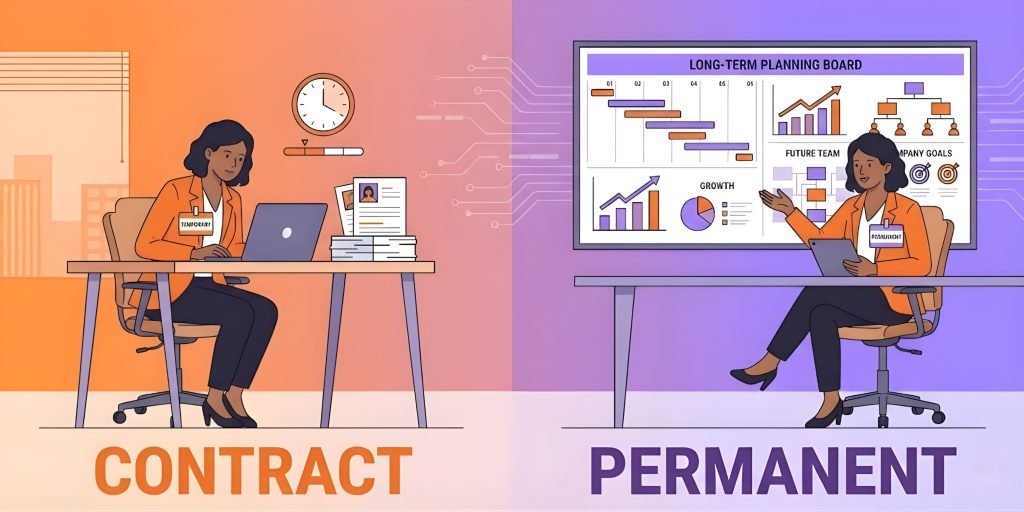
The two roles serve different strategic purposes.
| Dimension | Permanent Recruiter | Contract Recruiter |
|---|---|---|
| Commitment | Long-term, multi-year | Fixed-term, 3-12 months |
| Strategic focus | Multi-year talent strategy | Tactical execution on current hiring |
| Cultural depth | Develops over years | Picks up culture in weeks |
| Cost structure | Salary + benefits + equity | Hourly or daily rate, no benefits |
| Ideal use | Steady-state hiring at predictable volume | Surge hiring, specialised projects, leave coverage |
A permanent recruiter is an investment in long-term hiring capability. A contract recruiter is a tactical response to immediate volume. The strongest organisations use both — permanent recruiters for the baseline, contract recruiters for the peaks.
Contract professionals often know how to list contract roles in ways that attract immediate interview-ready candidates, leveraging existing networks. Strong agencies provide these specialists faster than companies can hire one directly. For broader sourcing depth, see our piece on hiring interns, which covers a complementary tactical hiring path.
Benefits and Trade-Offs
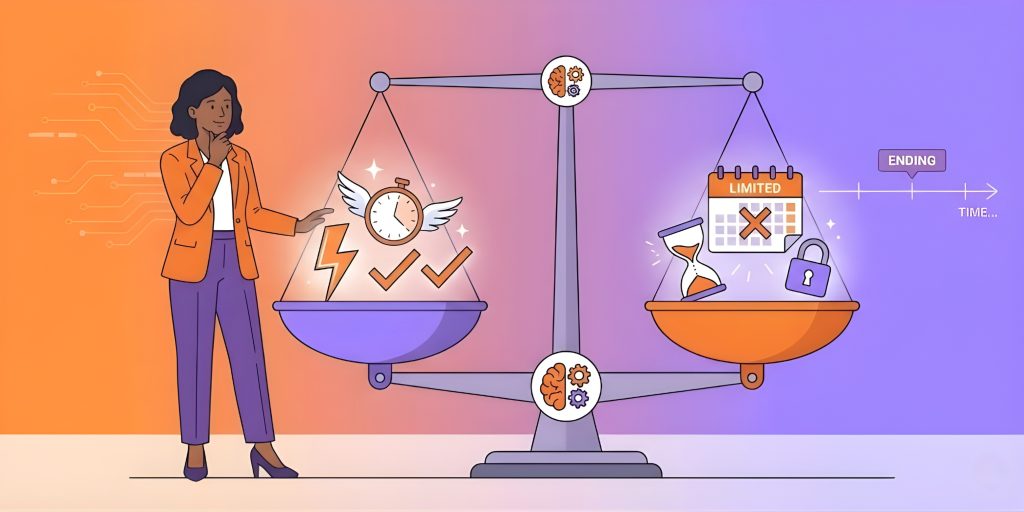
The honest case for and against contract recruiters.
Benefits
- Speed. Contract recruiters arrive with existing candidate networks and modern hiring playbooks. They hit the ground running.
- Cost. No long-term benefits, no equity grants, no 401(k) match for a short-term project. The cost-per-hire usually drops compared to permanent expansion.
- Expertise. Career contractors have worked across many companies and hiring stacks. They often bring better tactical experience than an internal hire at the same level would.
Trade-offs
- Integration time. Even experienced contractors need 2-4 weeks to learn the nuances of your specific culture, products, and hiring style.
- Continuity loss. When the contract ends, the institutional knowledge of recent candidates leaves with them. Documentation discipline matters.
The middle ground that often works: contract-to-hire arrangements. Bring in a strong contractor with the explicit option of conversion to permanent if the workload stays heavy. This pattern is especially common in contract-to-hire positions, where strong delivery often leads to a full-time offer.
How AI Strengthens Contract Recruiting

Modern contract recruiters rely heavily on AI tools to handle the volume their roles require. The key wins:
- Resume screening at scale. AI sorts hundreds of applications in seconds, surfacing the strongest matches first. Contract recruiters arrive with experience using these tools across multiple companies.
- Candidate ranking. AI scores candidates against the role's specific requirements, which is particularly useful when the contract recruiter is new to the company's preferred profile.
- Compliance and documentation. Automated platforms flag missing credentials or documentation before a candidate moves forward.
Allied Market Research's recruiting software forecast projects that the global market for recruitment software will pass $4 billion by 2032, driven largely by AI-powered tools. The contract recruiters who bring fluency with these tools deliver outsized value relative to their fee.
The human work — interviewing, persuading, closing — remains squarely with the recruiter. AI handles the mechanical work; the contractor handles the substantive work. Combined with the broader methods of recruitment discipline, the model scales effectively.
The Bottom Line
A contract recruiter is the right answer when hiring volume genuinely outpaces your team's capacity, when a specialised project needs niche expertise, when a permanent recruiter is on leave, or when you want to evaluate a recruiter before committing long-term. The role is not a substitute for a strong permanent recruiting function — it is a complement to it. Companies that use both well hire faster through peaks without over-building permanent capacity for valleys. The flexibility, when used deliberately, is one of the most underrated tools in modern talent strategy.
FAQs
How is a contract recruiter different from an agency recruiter?
A contract recruiter embeds in your team and represents your company directly. An agency recruiter works for an external firm and represents multiple clients. The fee structures are different, the cultural depth is different, and the use cases are different.
How long does a typical contract recruiting engagement last?
Most run between 3 and 12 months. Short engagements (3-6 months) suit specific project hiring; longer engagements (9-12+ months) often cover leaves or extended scaling periods.
Is contract-to-hire a good way to evaluate a permanent recruiter?
Yes, with caveats. The contract period gives both sides time to assess fit before committing. Set explicit conversion criteria upfront so neither side is surprised when the decision date arrives.
Can a contract recruiter handle senior or executive hires?
Some specialise in this; many do not. For senior-level or executive search, traditional retained-search firms often have stronger networks. A contract recruiter is best suited to volume and specialised mid-level hiring.
Does using a contract recruiter affect candidate experience?
Done well, no — candidates often cannot tell the recruiter is on contract. Done badly (with poor handoffs at contract end), candidates feel the discontinuity. The fix is documentation discipline: every candidate interaction logged for the next person.


