

360 Recruitment: The Complete Full-Cycle Hiring Model
360 recruitment explained — one recruiter, full hiring cycle. Benefits, challenges, when it fits, and how to know if outsourcing makes sense.
Ployo Team
Ployo Editorial

TL;DR
- 360 = one recruiter owns the full hiring cycle end-to-end.
- Benefits: faster hires, stronger relationships, better candidate experience.
- 8 stages: brief, research, JD, source, screen, interview, offer, onboard.
- Fits urgent, niche, or relationship-driven hiring best.
- Risks: burnout, conflicting priorities, limited bandwidth without tools.
Posting jobs, sifting resumes, scheduling interviews, negotiating offers, onboarding — multiplied across five open roles. Exhausting. 360 recruitment puts the entire cycle under one recruiter. This guide explains what it is, when it works, where it struggles, and how to decide if it fits your team.
What 360 Recruitment Is

Full-service hiring where one recruiter manages everything — from client consultation to candidate onboarding. Unlike 180 recruitment (sourcing + client relationships split between two people), 360 puts it all in one seat.
The complete circle
- Client relationship building
- Job descriptions
- Candidate sourcing
- Screening + interviewing
- Offers + negotiations
- Onboarding follow-through
One-person operation; one accountable owner.
Benefits for Recruitment Agencies

Four agency-side advantages.
Stronger client relationships
Same recruiter handles communication and sourcing. Deep role understanding; lasting partnerships.
Faster turnarounds
Single point of contact eliminates back-and-forth lag. Decisions move faster.
Better candidate experience
Candidates don't get passed between departments. One guide throughout the journey builds trust, reduces drop-off.
Higher accountability
Full ownership means clear visibility into what's working. Better metrics and optimisation.
The 8 Stages
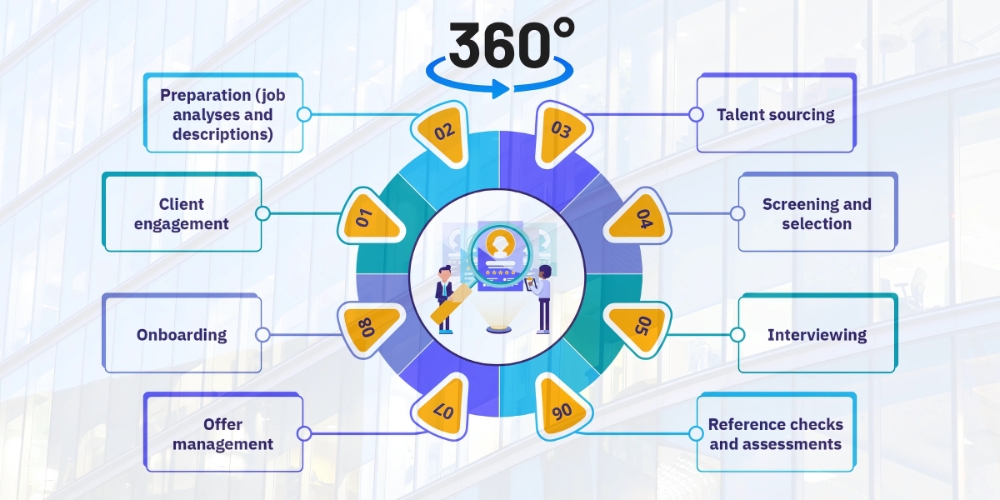
1. Client briefing
Understand role, culture, expectations. Foundation for everything that follows.
2. Market research + role profiling
Salary benchmarks, competitor activity, ideal candidate persona.
3. JD + ad creation
Clear, channel-optimised job posts.
4. Talent sourcing
Job boards, LinkedIn, referrals, databases, proactive outreach.
5. Screening + shortlisting
CV screening, phone interviews, assessments. Trim to top matches.
6. Interview coordination
Scheduling, candidate prep, smooth communication.
7. Offer negotiation
Align expectations, manage counter-offers, close the deal.
8. Onboarding support
Follow-through beyond the offer letter to reduce early attrition.
When 360 Recruiting Works Best

Four scenarios where it shines.
High-volume or urgent hiring
Single owner removes bottlenecks; communication and decisions accelerate.
Startups and scaling teams
A 360 recruiter who understands hiring goals + team dynamics simultaneously is invaluable.
Niche or specialised roles
Focused sourcing + deep client understanding + strategic negotiation — best handled by one expert.
Relationship-driven environments
Long-term partnerships benefit from one consistent point of contact.
What Makes a Strong 360 Recruiter

Five traits.
Strong communication
Confident, clear handling of both candidate and client relationships.
Consultative selling
Acting as advisor, not order-taker. Solutions aligned to client pain points.
Time management
Sourcing + interviews + client updates simultaneously requires structure.
Emotional intelligence
When to push, when to listen, how to navigate negotiation.
Resilience and grit
Full-cycle wins don't happen overnight. Persistence matters.
Common Challenges

Four common speed bumps.
Time management overload
Juggling everything at once leads to burnout without strong systems.
Conflicting priorities
Client urgency vs candidate quality engagement creates daily trade-offs.
Limited bandwidth
One recruiter can only do so much. High-volume environments stretch quality thin.
Tooling gaps
Without automation and CRM, 360 recruitment becomes hard to manage at scale.
Translation: full-cycle without time-blocking + tools + clear priorities = fast track to burnout.
When to Outsource

Four reasons companies outsource.
Speed + scale
External partners have ready talent pools and tooling — faster turnaround.
Specialised expertise
Industry knowledge and negotiation skills without full-time hire overhead.
Focus on core work
Less time on sourcing/screening = more on managing team, product, growth.
Flexible cost
Pay for what you need, when you need it.
The Bottom Line
360 recruitment isn't a buzzword — it's a full-circle solution to fragmented hiring. One recruiter, one accountable owner, consistent experience for clients and candidates. Not for everyone, but in the right fit (urgent, niche, relationship-driven), it produces materially better outcomes. Whether built in-house or outsourced, the goal is the same: better hires, fewer delays, and a recruitment process that works.
FAQs
How does 360 address bias and diversity?
Single recruiter accountability allows standardised screening, structured interviews, and consistent inclusive language. Reduces inconsistency-driven bias.
How do you measure 360 recruitment success?
Time-to-hire, cost-per-hire, offer acceptance, quality of hire, plus feedback from hiring managers and candidates.
What's the difference between 360 and 180 recruiting?
360 = one person, full cycle. 180 = split between two specialists (client manager + candidate sourcer).
Is full-desk recruiting the same as 360?
Yes — terms are interchangeable. Both describe one-recruiter end-to-end ownership.
What's the highest-leverage starting move?
Audit your current recruiter time allocation. If admin and handoff overhead exceed 30%, 360 consolidation likely reclaims hours and lifts quality.
Keep reading


Reverse Recruiters: What They Do and When They Actually Help
