

The Recruitment Process: A Complete Step-by-Step Guide
How modern recruitment works — stages, candidate and recruiter views, 2026 trends, and best practices for hiring smarter, faster, and more fairly.
Ployo Team
Ployo Editorial
TL;DR
- Average time-to-fill: ~50 days across industries; 44 days for in-demand roles.
- 57% of job seekers lose interest if hiring takes too long.
- 72% of employers say finding qualified candidates is the hardest part.
- Recruitment ≠ selection: recruitment fills the funnel; selection filters it.
- AI handles screening + scheduling; humans handle judgment + final decisions.
The recruitment process determines whether companies attract great people quickly or lose them to delays, vague descriptions, and silence. This guide walks through what the process actually is, every stage that matters, both candidate and recruiter perspectives, 2026 trends, and the practices that consistently produce better hires.
What the Recruitment Process Is
The full path from identifying a role to onboarding the new hire. Includes attracting, screening, selecting, and integrating talent.
Key terms differentiated:
- Recruitment: attracting and encouraging qualified people to apply. Top-of-funnel work.
- Selection: deciding which applicants best fit and extending an offer.
- Talent acquisition: broader, often forward-looking — building pipelines before openings exist.
- Candidate selection: specifically how decisions get made among applicants.
Per Recruiters Lineup, employers globally spend an average of 44 days to fill a role — often driven by slow screening, interview cycles, and decision delays. 72% report difficulty finding qualified candidates.
The Key Stages

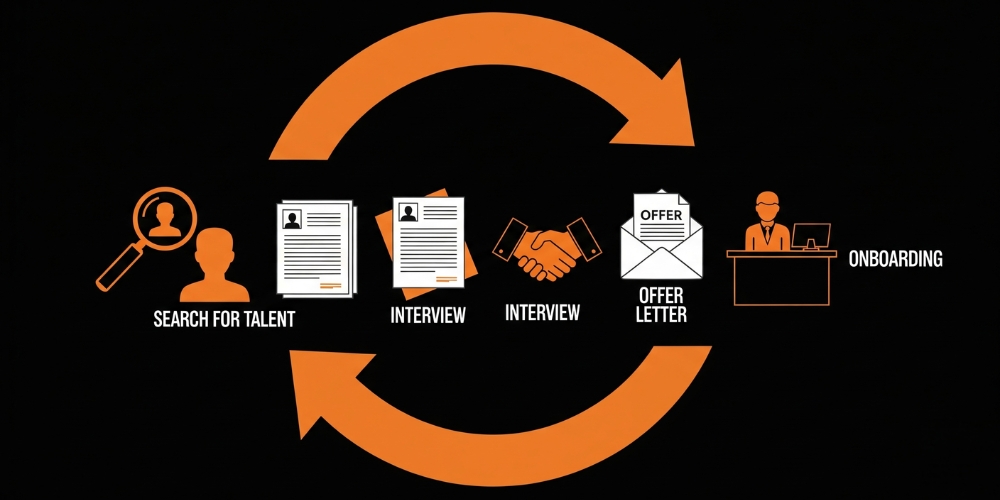
Six stages most organisations follow.
| Stage | What Happens |
|---|---|
| Job analysis + planning | Identify need, define role, skills, budget, timeline |
| Sourcing + attraction | Job ads, employer branding, social, referrals |
| Pre-screening | Resume filters, questionnaires, AI tools eliminate unfit applicants |
| Interviews + assessment | Structured interviews, tests, multi-round if needed |
| Selection | Choose best fit, make offer, negotiate terms |
| Onboarding | Paperwork, training, team integration |
Some organisations add post-hire review at 30/60/90 days to validate the hire matches expectations.
Per Infeedo, it takes an average of 50 days to fill an open position across industries. For high-demand roles, Talent MSH research puts the figure at 44 days.
From the Candidate's Perspective

What candidates actually experience.
The journey
- See the listing: read description, requirements, culture cues
- Apply: form, resume, sometimes cover letter or online test
- Pre-screening: recruiter or AI evaluates fit
- Interview: phone/video/in-person, structured interview prep matters
- Decision + offer: selection, offer, negotiation — or rejection/silence
- Onboarding: start work, train, integrate
What candidates care about
- Speed: 57% of seekers lose interest if hiring drags
- Communication: silence kills engagement and brand
- Transparency: 47% want salary range and expectations up front
Common frustrations
- Being ghosted post-interview
- Vague job descriptions
- Redundant multi-round assessments
- Long waits with no updates
Recruiters who fix these things see materially higher offer-acceptance and referral rates.
From the Recruiter's Perspective

Many moving parts to coordinate.
Core responsibilities
- Clarify role needs with hiring managers
- Write or approve job ads and descriptions
- Source candidates (ads, referrals, social, networks)
- Run pre-screening — resume filters, AI tools
- Coordinate interviews and assessments
- Compare candidates with hiring managers, decide
- Make offer, manage onboarding
Metrics that matter
| Metric | Why It Matters |
|---|---|
| Time-to-fill / time-to-hire | Speed; delays cost money and top candidates |
| Quality of hire | How well hires perform after starting |
| Application-to-hire conversion | Funnel efficiency |
| Cost per hire | Budget discipline |
| Candidate satisfaction | Brand impact; affects referrals and retention |
Common challenges
- High volume of irrelevant applications
- Balancing speed with fairness
- Avoiding bias, ensuring diversity
- Keeping candidates informed without overburdening teams
- Managing salary, skill, and timeline expectations
Best outcomes
Smooth talent acquisition process that keeps strong candidates engaged. ATS plus structured interviews plus data-driven decisions, not gut feel.
Emerging Trends for 2026
Five forces shaping recruitment now.
AI as teammate, not replacement
Beyond simple automation — AI agents help with decision support, scheduling, resume analysis, candidate matching. Recruiter productivity climbs significantly.
AI twins for recruiters
Virtual workflow assistants saving ~15 hours weekly on CRM updates, follow-ups, and research.
Entry-level role compression
Per Korn Ferry's 2025 report, 43% of companies plan to replace some roles with AI; entry-level (37%) at highest risk. Smart companies reskill junior talent rather than cut roles entirely.
Recruitment Process Outsourcing (RPO) rises
Clients shifting from one-off hires to strategic long-term partnerships, often with cross-border compliance.
Skills over degrees
Demonstrable skill matters more than where candidates went to school. AI surfaces skills faster; humans validate fit and potential.
Data-driven placements
~63% of successful placements now come from data already sitting in company databases. Clean, accurate databases drive cost-per-hire down and speed up time-to-fill.
Gen Z transparency expectations
Salary ranges, clear growth paths, fast mobile-first communication. Vague pay or progression details get skipped instantly.
The remote-office mismatch
87% of open roles are now fully in-office while 23% of candidates hold out for remote. Companies that flex remote-friendly often capture 13–40% productivity gains.
Best Practices

What consistently works on both sides.
For recruiters
Use AI for screening + scheduling. Frees time for interviews and culture-fit conversations.
Provide timely feedback. Even short rejection notes outperform silence. Per Gallup, positive candidate experiences raise offer acceptance and referrals.
Write inclusive job descriptions. Avoid jargon, gendered language, and vague requirements. Improves the candidate selection process downstream.
Track metrics. Time-to-fill, cost-per-hire, quality-of-hire. Patterns reveal where the funnel leaks.
For job seekers
Tailor resumes. Recruiters spend seconds per application. Match the ad's key terms.
Prep for structured interviews. Expect behavioural questions with measurable-result examples.
Send thank-you notes. Small action, strong impression.
Network deliberately. Many roles never reach job boards. Connections often skip automated filters entirely.
The Bottom Line
The recruitment process isn't just paperwork — it's how companies secure the right talent and how candidates find the right roles. Done well, both sides win. The teams that invest in clear stages, fair screening, fast communication, and data-driven decisions build talent advantages competitors take years to catch.
FAQs
How long does the recruitment process typically take?
Average ~50 days across industries; 44 days for in-demand roles. Highly specialised positions stretch longer. Speed depends on level, volume, and process efficiency.
What's the difference between recruitment and selection?
Recruitment attracts and fills the funnel; selection filters it down to a hire. Both matter — weak recruitment leaves no good options; weak selection picks the wrong one.
Where does AI fit best in recruitment?
Screening, scheduling, candidate matching, and analytics. Not in final decisions or relationship-building moments.
What metric matters most?
Quality-of-hire combined with time-to-fill. Each in isolation misleads; together they predict whether the process is actually working.
What's the highest-leverage starting move?
Audit job descriptions for clarity and inclusivity. Most downstream problems trace back to vague or off-putting JDs.
Keep reading

Reverse Recruiters: What They Do and When They Actually Help

SEO for Recruitment: The Complete Guide to Attracting Top Talent
