

Signs You Didn't Get the Job (And What They Actually Mean)
Spotting the subtle signs you did not land the role helps you stay proactive — what each signal means, what it does not, and how to keep momentum going.
Ployo Team
Ployo Editorial

TL;DR
- Roughly 72% of candidates report a negative experience after interviews — mostly from silence after the call.
- Common rejection signals: short interviews, no next-step discussion, vague body language, no follow-up.
- None of these are guarantees — assume rejection only when it is in writing.
- The fix is action: polite follow-up, continued applications, reflection on what to improve.
- Even after rejection, requesting feedback tactfully often surfaces useful information for next time.
The silence after an interview is the hardest part of job hunting. You walked out feeling fine, maybe even good, and then — nothing. Most candidates spend the next week alternating between "they're just busy" and "I definitely didn't get it." This guide walks through why employers go quiet, the subtle signals that often (but not always) indicate rejection, what those signals actually mean, and the moves that keep your job search productive regardless of the outcome.
Why Employers Don't Always Give Clear Feedback

The reasons employers stay vague are mostly structural. HCI's research on candidate experience found that up to 72% of applicants report negative candidate experiences — primarily because they never hear back after the interview.
When feedback does come, it is typically brief or generic. Hiring teams worry about legal exposure, fear sounding biased, or simply lack the bandwidth to write thoughtful notes. Meanwhile, Apollo Technical's 2025 recruitment research reports that 94% of professionals still want feedback after an interview — even when they have been rejected. The gap between what candidates want and what employers deliver is wide.
The cause is largely operational. Recruiting teams sit inside the broader talent acquisition process, juggling sourcing, interviewing, and offer-closing simultaneously. Crafting individual feedback often slips down the priority list. Boilerplate "not retained" emails, or nothing at all, become the default.
The cost is real. Detailed feedback is cheap to produce and produces measurable goodwill — many rejected candidates would re-apply to the same company later if they had received it.
Subtle Signs You Didn't Get the Job

Six signals that often correlate with rejection. None of them is a certainty — most can have other explanations.
The interview wraps up much earlier than scheduled
A 30-minute interview that ends in 18 minutes usually signals the interviewer made up their mind early. Engaged interviewers stretch time to learn more.
No discussion of next steps
A confident interviewer outlines what happens next — "we'll have decisions by Friday" or "the next round is a technical interview." If you leave without any roadmap, the interviewer may already be uncertain about advancing you.
Cold or guarded body language
Engaged interviewers nod, take notes, ask follow-up questions, and lean forward. Crossed arms, broken eye contact, or visible distraction often (not always) signal disinterest.
Silence past the stated timeline
If they said "you'll hear by Friday" and it is now the following Wednesday, the signal is meaningful. HR systems often mark candidates as no longer under consideration without notifying them directly.
Off-track or surface-level questions
When interviewers stop asking about the role's actual work and start asking generic filler questions, they are sometimes filling time because they have already decided.
Generic email responses
Boilerplate "not retained" or "we'll keep your application on file" responses are almost always automated rejections. The phrasing — phrases like "not indicated", "not retained", "no longer in consideration" — usually comes from tracking-system templates rather than human notes.
What These Signs Actually Mean (Don't Spiral Yet)
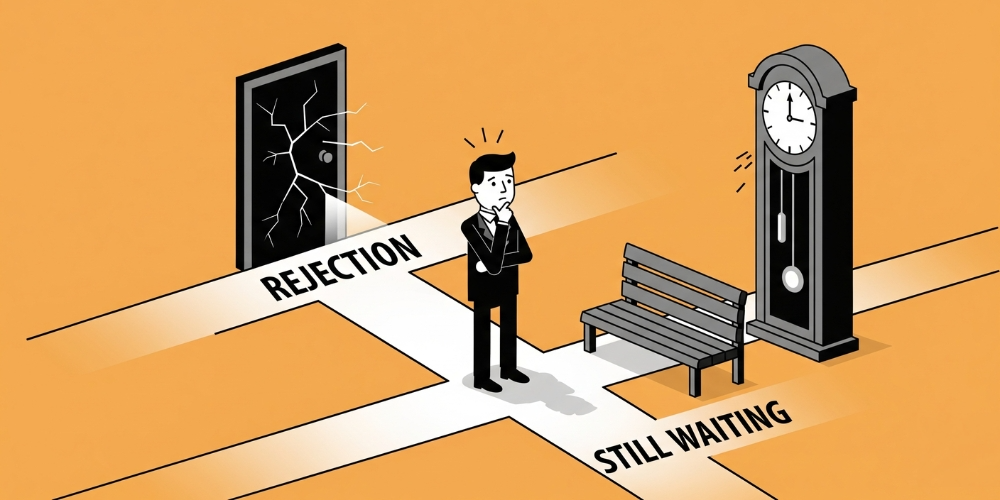
None of the signals above is a guarantee of rejection. Hiring processes are messier than they look from the outside.
Common alternative explanations:
- A short interview could be a scheduling problem on the interviewer's end
- Vague next steps may mean the company itself has not finalised the next stage
- Silence after the deadline often means the recruiter is waiting for one candidate to formally accept before notifying the others
- Cold body language can be a tired interviewer, a bad day, or a personality style
Until you have an explicit written rejection, you may still be in the running. Many candidates spend a week assuming they were rejected, only to receive an offer that was simply delayed by internal alignment. Treat absence of news as ambiguous, not definitive.
What to Do If You Suspect You Didn't Get the Job

Five moves that keep your job search alive regardless of what is happening behind the scenes.
1. Follow up politely
Wait a few days past the timeline they quoted, or about a week if no timeline was given. Send a short, professional note that thanks them for the conversation and asks if there is anything else they need from you. This keeps you visible without being pushy.
2. Keep applying
Never put all your hope on one role. The strongest candidates balance confidence with parallel momentum. Treat every interview as practice for the next one and use any rejection to sharpen your interview skills.
3. Reflect honestly
Write down what felt strong, what wandered, and what you wish you had said differently. This is the cheapest way to prepare for the next interview. Small adjustments — sharper stories, tighter answers — compound across applications.
4. Expand your network
Engage with professionals in your field. Reach out to former colleagues, mentors, or people who have done the kind of work you want next. A strong network often opens doors when the cold-application path stalls.
5. Ask for feedback tactfully
If you eventually receive a rejection, politely ask what factors influenced the decision. You may get only a generic response, but sometimes you receive something genuinely useful. Either way, the question signals professionalism that recruiters remember for future roles.
The Bottom Line
Interview silence is part of modern job searching — uncomfortable, but rarely as definitive as it feels in the moment. The signals that often indicate rejection are useful to recognise, but none of them is a certainty. The candidates who handle this period well do not let the silence stall them. They follow up politely, keep applying, reflect on what to improve, and treat every interview as data for the next one. Rejection stings briefly; staying still is what actually damages a job search.
FAQs
How long should I wait before following up?
If the recruiter quoted a timeline, wait a few days past it. If no timeline was given, a week after the interview is the standard waiting period before a polite check-in.
Do employers always notify candidates who did not get the role?
No. Some send formal rejection emails; others update internal status without contacting the candidate. This is exactly why proactive follow-up matters — silence is not always rejection.
Can I still get hired even if the interview felt uneven?
Yes. Candidates regularly underestimate how they came across. Hiring teams may have noticed strengths you did not realise you demonstrated. Until you have a formal "no", you are still potentially in the running.
Is it worth asking for feedback after a rejection?
Yes, tactfully. Most companies give generic responses, but a non-trivial share will share something useful. Either way, the request signals professionalism worth remembering for future roles.
What is the single most important habit during a job search?
Parallel applications. The best protection against rejection-induced paralysis is a steady flow of other opportunities. Momentum compounds in ways waiting on one role never can.
Keep reading


