

The ROI of Recruitment Automation: Beyond Time Saved
Recruitment automation ROI goes well beyond saved hours — cost, quality, retention, brand, compliance. The metrics, formula, and worked example.
Ployo Team
Ployo Editorial

TL;DR
- Automation cuts cost-per-hire up to 30% within first six months (HireBee).
- 9 of 10 HR pros using AI in recruiting report major time + efficiency gains (SHRM).
- ~45% reduction in manual admin work reported after automation (IQTalent).
- Hidden ROI: candidate experience, employer brand, compliance, recruiter morale.
- ROI formula: (Gain − Cost) / Cost × 100; mid-sized worked example = ~300%.
"We saved 20 hours a week" is the easy story to tell. The real ROI of recruitment automation goes much further — cost-per-hire, retention, brand, compliance, and recruiter capacity. This guide breaks down the metrics that matter, the hidden gains, and a worked example showing the math.
What Automation Actually Delivers

Beyond speed, three structural improvements.
Consistency
Routine tasks run the same way every time. Errors drop. Recruiters focus on judgment and conversations rather than admin.
Intelligence
AI-driven screening, shortlisting, and scheduling surface high-potential candidates faster than manual triage.
Scale
Multi-region, multilingual, multi-team hiring runs without proportional headcount growth. Pairs naturally with recruitment automation software and mobile workforce automation for distributed teams.
The shift is from admin firefighting to strategic hiring.
Metrics That Define ROI

Five metrics that consistently measure real impact.
Cost-per-hire
Per HireBee, organisations using advanced automation can reduce cost-per-hire by up to 30%. Pre/post measurement gives a precise savings figure.
Time-to-fill
Vacancies cost productivity and revenue beyond recruiter hours. Per SHRM's 2025 Talent Trends, nearly 9 in 10 HR professionals using AI in recruiting report major time savings.
Recruiter productivity
Per IQTalent, companies report ~45% reduction in manual admin work after automation. Recruiters take more requisitions or engage candidates more deeply.
Quality of hire and retention
Per Metaview's ROI framework, retention and hire performance are core ROI components. Better fit → lower turnover → reduced replacement costs.
Hidden process metrics
Candidate experience, employer brand, risk reduction. Harder to cost out, but materially impact future sourcing, acceptance rates, and compliance exposure.
Hidden ROI Sources
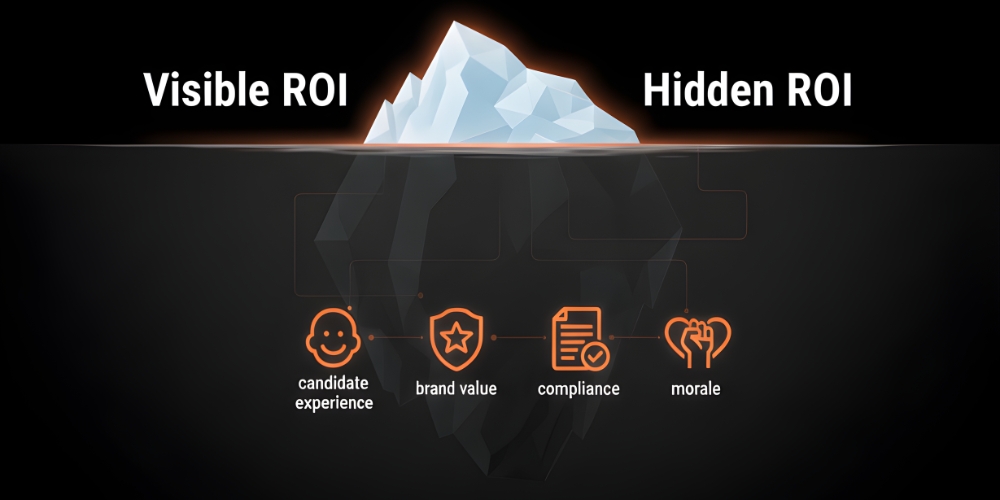
Five gains that don't show up on the time-saved spreadsheet.
Candidate experience
Timely updates, personalised communication, clear feedback. Improves acceptance rates and referrals — quietly cutting future sourcing costs.
Employer brand
Consistent messaging and smooth interview flow reinforce reputation. Candidates talk; reputation travels faster than paid recruitment marketing.
Compliance and reduced risk
Automated consent management and audit trails reduce compliance errors and protect against fines or disputes.
Process accuracy at scale
Automated workflows eliminate duplicate entries, missed interviews, dropped follow-ups. Makes global hiring automation genuinely viable rather than chaotic.
Recruiter morale
Freeing recruiters from tedious admin boosts engagement. Happier recruiters engage better with candidates — feedback loop into higher-quality hires.
How to Calculate ROI

Simple formula, real numbers.
ROI = [(Gain from Investment − Cost of Investment) / Cost of Investment] × 100
Worked example: mid-sized company
Investment: $25,000 in automation tools (screening, scheduling, reporting).
| Metric | Before | After |
|---|---|---|
| Time-to-hire | 45 days | 28 days |
| Cost-per-hire | $6,000 | $4,000 |
| Annual hires | 50 | 50 |
- Savings per hire: $2,000
- Total annual savings: $2,000 × 50 = $100,000
- ROI = [(100,000 − 25,000) / 25,000] × 100 = 300%
Add hidden gains — reduced bias, improved retention, better brand — and real return climbs further. Downstream efficiencies (performance reviews, feedback loops) compound the case.
The Bottom Line
The ROI of recruitment automation goes well beyond "time saved". It's smarter decisions, lower cost-per-hire, stronger retention, better candidate experience, reduced compliance risk, and freed-up recruiter capacity. Once automation pays for itself in the first few hires, every subsequent hire is pure efficiency gain. The compounding value is unmistakable across local scaling, global expansion, or distributed teams.
FAQs
What are the main automation ROI categories?
Cost-per-hire reduction, time-to-fill speed, candidate experience improvement, and data-driven quality gains.
Is automation worth it for small businesses?
Yes. Cloud-based tools scale with team size; small companies access enterprise-grade features without heavy infrastructure.
What's the typical cost-per-hire reduction?
Often 30%+ within six months when sourcing, screening, and scheduling automate together.
How does automation affect retention?
Better matching improves culture fit and performance, reducing early turnover.
What KPIs should be tracked?
Cost-per-hire, time-to-fill, recruiter efficiency, candidate satisfaction, quality of hire, and retention rate. Skip one and the ROI picture becomes incomplete.
What's the biggest risk in projecting ROI?
Overestimating instant results. Real returns depend on adoption, training, data quality, and integration — projections that assume zero ramp time inflate first-year gains.
Keep reading


