

Mobile Workforce Automation: 2025 Trends and Real Benefits
Mobile workforce automation has scaled from pilot to production — top trends, benefits, market data, and the platforms reshaping distributed operations.
Ployo Team
Ployo Editorial
TL;DR
- Global MWM market growing from ~$6.39B (2024) to $7.18B (2025), 12.2% CAGR (Business Research Co).
- US has ~93.5M mobile workers (Statista) — ~60% of the workforce.
- 78% of companies use AI in at least one business area in 2025 (Archie App).
- Top 2025 trends: AI-driven scheduling, IoT/sensor insights, cloud integration, paperless ops.
- Real benefits: real-time visibility, faster scheduling, lower cost, better compliance.
Field teams, service crews, and remote workers used to operate with spreadsheets, paper logs, and disconnected apps. Mobile workforce automation has changed that — and the companies adopting it are seeing real productivity, cost, and morale improvements. This guide walks through what's driving the shift, the 2025 trend headlines, and the concrete benefits worth pursuing.
What Mobile Workforce Automation Is

Purpose-built systems to coordinate, monitor, and support mobile or field staff. The stack typically includes mobile workforce management platforms, scheduling software, real-time tracking, and field-data capture.
These platforms let mobile workforce managers dispatch jobs, track equipment, allocate technicians, monitor status, and capture field data (photos, signatures, geo-location). Cloud connectivity plus analytics produces visibility that paper and phone calls never delivered.
For industries like utilities, mobile workforce management for utilities has become a key deployment area.
Why It's Rising Now

Four forces converging.
Market scale
Business Research Co projects the global MWM market from ~$6.39B in 2024 to $7.18B in 2025 — 12.2% annual growth.
Workforce composition shift
Statista data shows the US alone may have 93.5M mobile workers by 2024 — about 60% of the workforce.
AI maturity
Archie App's research shows 78% of companies using AI in at least one business area in 2025. Automation is no longer experimental.
Service expectation pressure
Manual dispatch, paper logs, and disconnected systems can't meet modern service-level expectations. Mobile-first tools become baseline.
Combined with strong teamwork ethics for remote work, workforce planning tools, and AI talent assessment tools, mobile automation closes the gap between distributed teams and central operations.
Key 2025 Trends
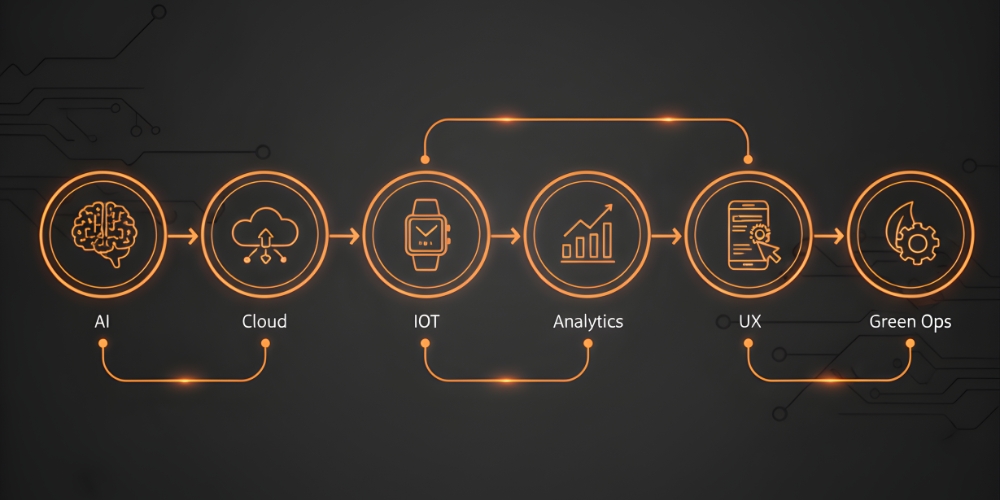
Six trends shaping the space.
AI-powered scheduling and dispatch
Predictive analytics assign jobs based on availability, proximity, and skills. AI balances workloads and predicts bottlenecks before they happen.
IoT and sensor-driven field insights
Connected devices give MWM software real-time visibility. Field tools detect equipment failures before they occur, improving maintenance accuracy.
Cloud-based integration
Modern MWM platforms integrate HR, CRM, and ERP systems. Managers and field workers see the same data; miscommunication drops.
Data-driven performance management
Time tracking is giving way to outcome tracking — efficiency, service quality, customer satisfaction. Mobile dashboards make this visible without micromanagement.
UX and accessibility focus
In 2025, usability is a real differentiator. Simpler interfaces, offline functionality, and accessibility options matter for field workers in low-connectivity zones.
Sustainability and paperless ops
Digital forms, instant approvals, e-signatures. Companies cut paper use significantly while speeding reporting.
Concrete Benefits

Seven measurable gains.
Real-time visibility
Mobile tracking gives managers instant insight into task completion, travel times, and delays. Accountability without surveillance.
Faster, more accurate scheduling
Automated job allocation eliminates calendar overlaps and gaps. Fewer missed appointments, faster customer response.
Better collaboration
Chat, status, and reporting in one platform. Field workers upload photos and signatures instantly; report-generation time drops by hours.
Lower operational cost
Coordination improves; delays shrink; admin overhead falls. The aggregate effect is significant across distributed operations.
Better compliance
Automatic audit trails for utilities, logistics, and regulated industries. Compliance without extra paperwork.
Smarter decisions
Combined with AI assessment and planning tools, automation ensures the right person handles the right task at the right time.
Improved morale
Repetitive admin handled by tools means field workers focus on real work. Clarity supports remote teamwork ethics — accountability without constant supervision.
The Bottom Line
Mobile workforce automation isn't a future trend anymore — it's the operating system for any company with field or distributed teams in 2025. The trends are clear: AI-driven scheduling, IoT insights, cloud integration, paperless ops. The benefits are concrete: speed, transparency, cost reduction, compliance, morale. Companies adopting deliberately gain agility their competitors don't have; companies waiting see the gap widen each quarter.
FAQs
How does automation improve remote team management?
Single dashboard for assigning, tracking, and monitoring tasks. Automated alerts replace lengthy check-ins; teams stay aligned without micromanagement.
Which industries benefit most?
Utilities, logistics, telecommunications, healthcare — anywhere with significant mobile or field operations. Automation manages schedules, compliance, and assets from anywhere.
What's the highest-leverage starting point?
Scheduling and dispatch automation. The combination produces immediate visible benefits and builds momentum for further automation across the operations stack.
How long does implementation take?
4–12 weeks for typical SMB deployments; 3–6 months for large enterprises with deep system integration. Phased rollouts beat big-bang launches.
Does automation replace field-team supervisors?
No. It frees them from admin and gives them better data to coach, plan, and support. Supervisors move from operational firefighting to strategic management.


