

Teamwork Ethics That Make Remote Work Actually Work
Remote work succeeds on teamwork ethics — transparency, reliability, respect, fairness, accountability. The practical playbook for leaders and employees.
Ployo Team
Ployo Editorial

TL;DR
- 54% of remote managers strongly trust their teams to be productive (Gallup).
- 12% performance boost for clearly measured remote roles (US GAO).
- Five core ethics: transparency, reliability, respect, fairness, accountability.
- Leaders set norms; employees practise daily — both matter.
- Without ethics, trust erodes faster on remote teams than co-located ones.
Remote work isn't new, yet teams still struggle to make it effective. Without face-to-face cues, misunderstandings compound, trust fades, and deadlines slip. Teamwork ethics are the lifeline — the agreements that keep distributed teams fair, reliable, and aligned. This guide breaks down what they are, why they matter more remotely, and how both leaders and employees practise them daily.
What Teamwork Ethics Are

Shared values and behaviours that guide how people work together. Fairness, follow-through, respect, accountability — the invisible rules of collaboration.
In remote settings, these values become doubly important. Without water-cooler chats, teams rely on clear communication, honest progress reporting, and mutual respect. Ethical teamwork creates a safe space where people are treated fairly, heard clearly, and counted on regardless of location.
Why It Matters More Remotely

Two pieces of evidence from current research.
Trust gaps are wider
Per Gallup research, only 54% of remote managers strongly trust their teams to be productive; 57% of employees feel trusted by their manager. Small missteps erode the gap fast.
Measured remote roles outperform
Per US GAO research cited in The Guardian, clearly measured roles show ~12% performance boost when working remotely. But teams must build intentional cohesion through fair guidelines and shared values.
Five Core Ethics That Drive Success
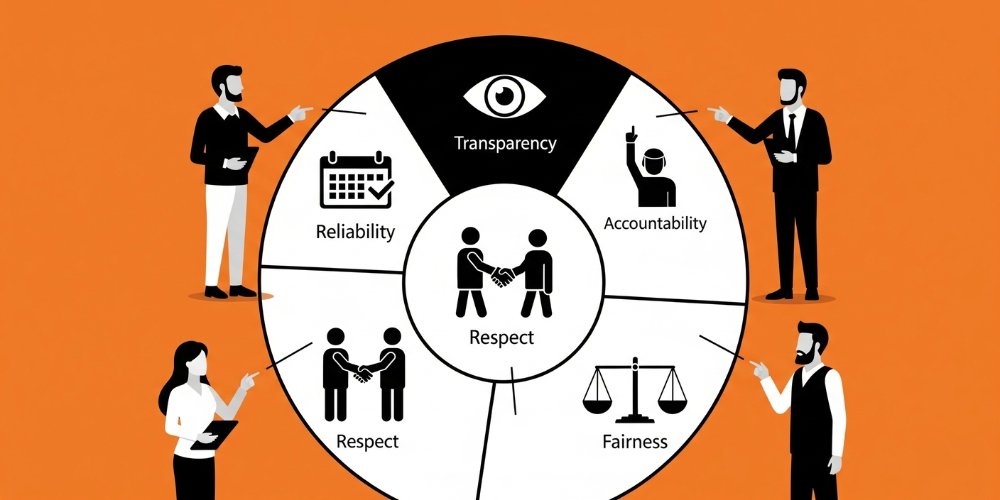
Transparency
Share progress, blockers, and risks early so nobody is guessing.
- Example: Friday update with done + next + risks
- Action: Add a standing "risks and asks" section to weekly updates
Reliability
Follow through on commitments. If timing changes, reset the plan fast.
- Example: See you'll miss Tuesday → flag on Monday with new ETA
- Action: Set personal deadlines 24 hours ahead for buffer
Respect
Treat time and focus as valuable. Clear availability, concise messages, muting when not speaking.
- Example: Rotate meeting slots across time zones
- Action: Add working hours and response window to your profile
Fairness
Balance workload and credit. Rotate complex tasks; spread recognition broadly.
- Example: Alternate ownership of hardest backlog items
- Action: Keep a simple "who did what" log for visibility
Accountability
Own mistakes without drama. Share impact, propose fix, close the loop.
- Example: Shipped a bug → post root cause + patch
- Action: Add "what I learned" line when things go wrong
How Employers Promote Ethics

Five practices that consistently lift team ethics.
Set clear expectations
Define norms for communication, availability, feedback. Reduces ambiguity that erodes trust.
Model the behaviour
Leaders who follow through, admit mistakes, respect time set the standard the team adopts.
Regular check-ins
Weekly meetings or virtual water-cooler moments reinforce values without feeling forced.
Train on remote etiquette
Transparency, fairness, responsiveness across all team members — not assumed knowledge.
Celebrate ethical choices
Recognise small acts — helping a peer, owning an error. Reinforces what gets repeated.
How Employees Practise Ethics

Five everyday actions.
Communicate clearly
Quick responses, clarifying questions, regular updates. No one feels left out.
Respect boundaries
Time zones and personal schedules matter. Hold back late-night messages unless urgent.
Own your outcomes
Admit mistakes, ask for help, follow through. Reliability compounds into trust.
Share knowledge
Document processes, mentor juniors, post updates. Reduces single-points-of-failure.
Manage your work ethic
Self-discipline plus collaboration. Personal deadlines, focused meetings, minimal distractions.
Strong remote workers shine in conflict interview questions because they've built genuine ethical habits.
Benefits of Ethical Remote Teams

Four compounding benefits.
Higher productivity
Clear standards eliminate wasted effort and friction.
Stronger trust and morale
People feel valued → engagement stays high → retention improves.
Stronger collaboration
Fairness + accountability → fewer duplications + cleaner handoffs.
Better hiring outcomes
Ethical teams attract stronger candidates. Interviewers probing cultural fit or organisational skills are often testing for ethics as the hidden factor.
The Bottom Line
Remote work is here to stay — but success isn't about tools or schedules. It's about people showing up with fairness, accountability, and respect. Teamwork ethics turn potential chaos into productive collaboration. When leaders and employees commit to practising these values daily, remote teams stop merely surviving and start genuinely thriving.
FAQs
What do teamwork ethics mean for virtual teams?
Shared values — fairness, accountability, respect, transparency — guiding how team members behave in remote settings.
Why are ethics important for remote success?
Without them, trust and clarity disappear quickly. Ethical behaviour builds the reliability needed for distance collaboration.
What happens if ethics are ignored?
Miscommunication, declining morale, missed deadlines. Over time, lack of ethics erodes trust to the point where remote work becomes structurally hard.
Where should teams start?
Pick one core ethic — usually transparency — and build it into the next 30 days of work. Quick win, then layer in the rest.
What's the highest-leverage starting move?
Publish working hours, response expectations, and decision-log links across the team. Removes 80% of the ambiguity that erodes remote trust.
Keep reading


