

HR Automation Software: How AI Gives Recruiters Hours Back Each Week
Recruiters lose 20–30 hours weekly on manual work — how HR automation software and AI compress that, with real time-saving numbers and adoption tips.
Ployo Team
Ployo Editorial

TL;DR
- Recruiters spend 20–30 hours per week on manual work (STEPS Consulting).
- 35% of recruiter time goes to scheduling alone (GoodTime).
- Per 100 candidates, automation saves ~150–160 hours across tasks (Teamdash).
- Wins extend beyond time — candidate experience, lower cost-per-hire, scalability.
- Keep humans in decision-making; let automation handle repetitive admin.
Recruiters routinely lose half their week to repetitive admin — resume sorting, scheduling, follow-up emails, onboarding paperwork. That time has compounding costs: slower hiring, worse candidate experience, burnt-out recruiters making more mistakes. HR automation software paired with AI changes the equation significantly. This guide walks through what's actually getting automated, the time savings real data shows, and how to keep the human side intact.
Where Recruiter Time Actually Goes
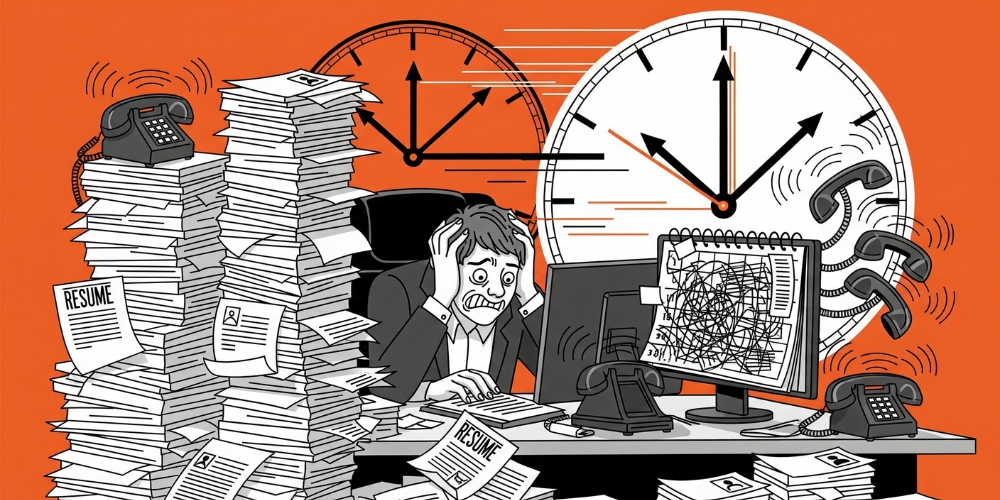
Six high-volume manual tasks consume most of the recruiter week.
Candidate sourcing
Job boards, networks, referrals. Hours per role finding applicants.
Resume screening
One-by-one review against role criteria. Linear time spend that scales badly.
Interview scheduling
Calendar coordination, reschedules, hiring-manager availability juggling. Often the biggest single time sink.
Candidate communication
Confirmations, follow-ups, rejection emails, clarifications. High volume, low complexity.
Background and reference checks
Credential verification, contacting past employers. Lower volume but sequential by default.
Onboarding paperwork
Contracts, system access, orientation logistics. Repetitive across every hire.
Each task in isolation is small. Aggregated across a recruiter's portfolio, they consume 60%+ of available time.
How AI Compresses the Work
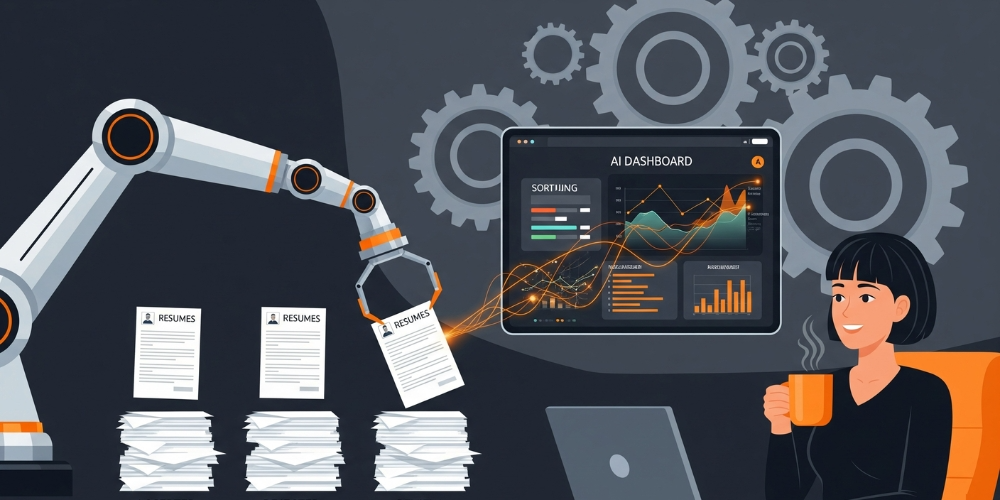
Six specific compressions.
AI resume screening
Hundreds of resumes screened against job criteria in minutes. The recruiter reviews the top of the ranking, not the entire pile.
Automated scheduling
Calendar integrations, auto-invitations, intelligent rescheduling. Cuts scheduling time from hours per role to minutes.
Automated onboarding
Onboarding automation triggers contracts, system access, and welcome flows as soon as offers are accepted.
Personalised follow-ups
Templated but personalised messages send at the right times — no candidate falls through the cracks.
Parallel background checks
API-driven verification runs simultaneously with other workflow steps, eliminating sequential delays.
AI candidate matching
Skills-based ranking surfaces top fits instantly. Reduces both manual review time and human bias.
The Time-Savings Numbers
| Source | Task | Manual | Automated | Saving |
|---|---|---|---|---|
| STEPS Consulting | Screening + scheduling + admin | 20–30 hrs/week | Compressed substantially | ~10–20 hrs/week |
| GoodTime | Interview scheduling alone | ~35% of recruiter time | Near-zero with automation | >24 hrs/week |
| Teamdash | Per 100 candidates (screening/scheduling/follow-up) | 10–20 min per step | 1–2 min per step | ~150–160 hrs |
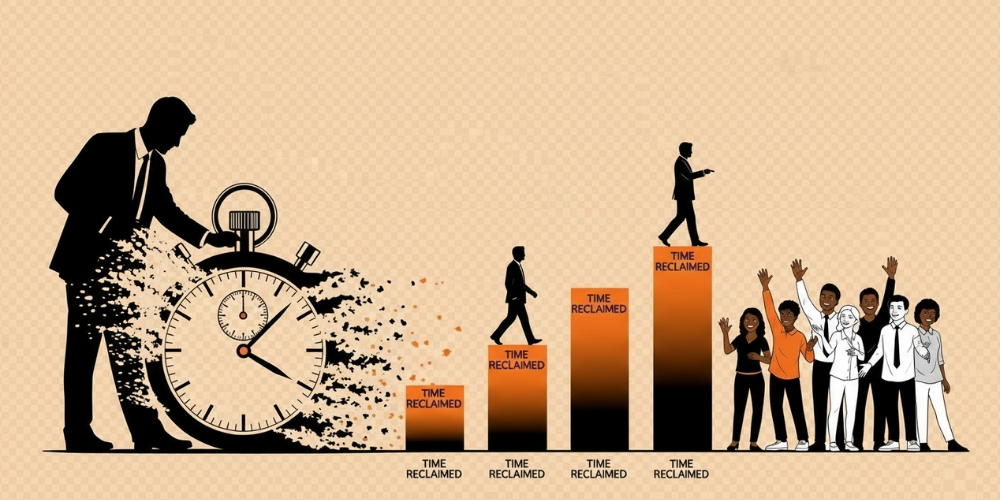
For high-volume teams, the compounded effect can effectively double recruiter capacity without doubling headcount.
Benefits Beyond Time
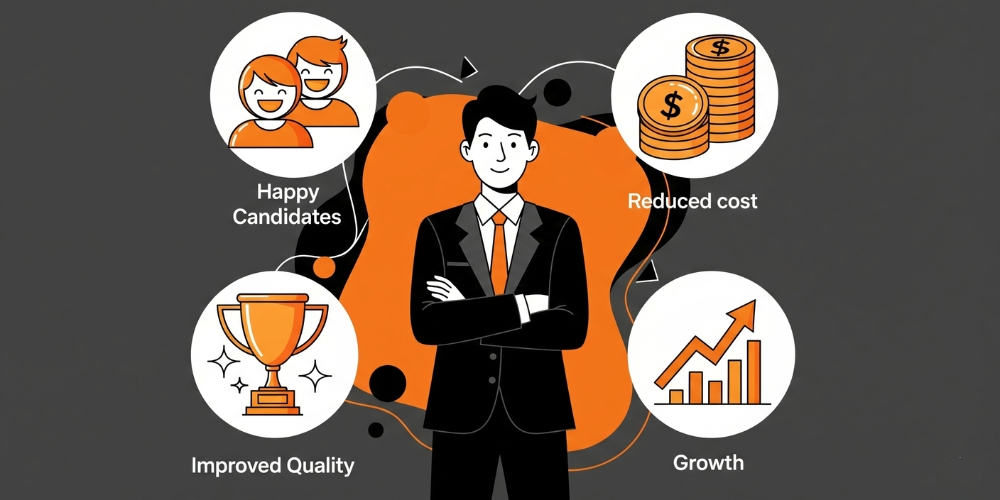
Five structural gains.
Better candidate experience
Faster updates, quicker decisions, smoother onboarding. Candidates notice immediately.
Lower cost per hire
Each recruiter handles more openings without burnout. Direct headcount savings at scale.
Higher hiring quality
AI evaluates skills-first rather than gut-feel. Bias drops; evaluation consistency rises.
Scalability
Volume spikes don't require proportional recruiter hiring. Capacity expands with software, not headcount.
Data-driven decisions
Every action logged in the automated HR system surfaces patterns — source effectiveness, time-to-hire variance, drop-off points.
Keeping the Human Touch

Automation done badly produces cold, robotic experiences. Four principles keep it human.
Humans in decision loops
Let AI handle automated CV screening; let recruiters make the final shortlist. AI accelerates; humans decide.
Automation triggers personal touches
Use automation to flag the right moment for a personal recruiter note — not to send the note itself.
Don't automate empathy
Rejection feedback, sensitive conversations, candidate concerns — these stay human. Automation supports, not replaces.
Voice consistency
Automated messages should match your employer brand voice. Generic templates undermine the brand; consistent ones reinforce it.
Recruitment automation software like Ployo doesn't just automate steps — it intelligently vets candidates, ranks them, and surfaces culture-fit insights, freeing recruiters to focus on the relationship-building that humans do uniquely well.
The Bottom Line
HR automation has moved from "nice to have" to "table stakes" for any recruiting team running meaningful hiring volume. The teams that adopt it well aren't replacing recruiters with bots; they're freeing recruiters to spend time on what humans uniquely do — relationships, judgment, sensitive conversations. The result is faster hiring, better candidate experience, and recruiters who stay longer because they're doing more meaningful work. Start with one workflow, prove the ROI, expand from there.
FAQs
What tasks can HR automation handle?
Resume screening, interview scheduling, background checks, candidate communication, onboarding paperwork, and payroll. Anything repetitive and rules-based is a candidate for automation.
How much time can recruiters save?
10–20 hours per week depending on role volume. For high-volume hiring, the saving can effectively double recruiter capacity without adding headcount.
What's the best HR automation software?
Depends on company size and hiring needs. Most mature teams use platforms integrating ATS, candidate communication, and payroll. AI-driven platforms add intelligent vetting and culture-fit ranking on top.
Will automation cost me my candidate experience?
Only if implemented badly. Automation done well actually improves candidate experience through faster responses and consistent communication. The key is keeping human judgment for moments that need it.
What's the highest-leverage first workflow to automate?
Interview scheduling for most teams. It's the highest-volume, most-frustrating manual task — and automation savings compound immediately across every role. Resume screening is a close second for high-volume hiring.


