

Global Hiring Automation: From Chaos to Consistent Scale
Global hiring automation eliminates chaos in international recruiting — what it actually does, benefits for both sides, and how to roll it out well.
Ployo Team
Ployo Editorial

TL;DR
- International hiring multiplies complexity — laws, time zones, languages, compliance.
- Recruiters spend ~40% of time on manual repetitive tasks like resume review.
- Gartner: automation can cut recruiting cycle time by up to ~30%.
- Strong global hiring automation: screening, scheduling, communication, compliance gates, analytics.
- Best deployed phased — automate one workflow, prove value, expand.
International hiring sounds exciting in board meetings and feels chaotic in execution. Every new country adds labour law, time zone, language, and compliance complexity that compounds across hires. Without structure, every international hire reinvents the wheel. Global hiring automation replaces the chaos with consistent, repeatable workflows that scale across jurisdictions. This guide walks through what global hiring automation actually does, the benefits it produces, and how to roll it out without overwhelming teams.
Why Global Hiring Feels Chaotic

Five structural reasons international hiring becomes overwhelming.
Fragmented compliance requirements
Each country has its own labour laws, tax requirements, contract standards, and visa procedures. Copying one country's process into another almost always creates exposure.
Time zone and scheduling friction
Coordinating interviews across Tokyo, Berlin, Sao Paulo, and Austin produces calendar back-and-forth that delays the process and frustrates candidates.
Inconsistent process by region
Without unified systems, local teams develop their own approaches. Some require extra interviews; some skip background checks; some communicate slowly. Inconsistency damages employer brand and slows decisions.
Manual workflow overload
Recruiter Flow research shows recruiters spend ~40% of their time on manual resume review and follow-up. Scaling this manually across multiple countries quickly becomes impossible.
Lack of measurement
Without standardised metrics across regions, comparing hiring speed, drop-off rates, or candidate satisfaction is impossible. Without measurement, improvement stalls.
What Global Hiring Automation Actually Is

Software-driven workflows that standardise international hiring across regions while accommodating local requirements.
Core capabilities:
- Resume parsing and screening — consistent criteria applied to candidates globally
- Automated scheduling — calendar sync across time zones
- Multi-channel communication — email, text, reminders automatically dispatched
- Standardised assessments — same evaluation framework with regional translation
- Compliance gates — checks that prevent candidates moving forward until local requirements are met
- Global dashboards — visibility into every region's funnel from one view
The software becomes the operating discipline that human teams couldn't sustain manually at scale.
How Automation Brings Consistency
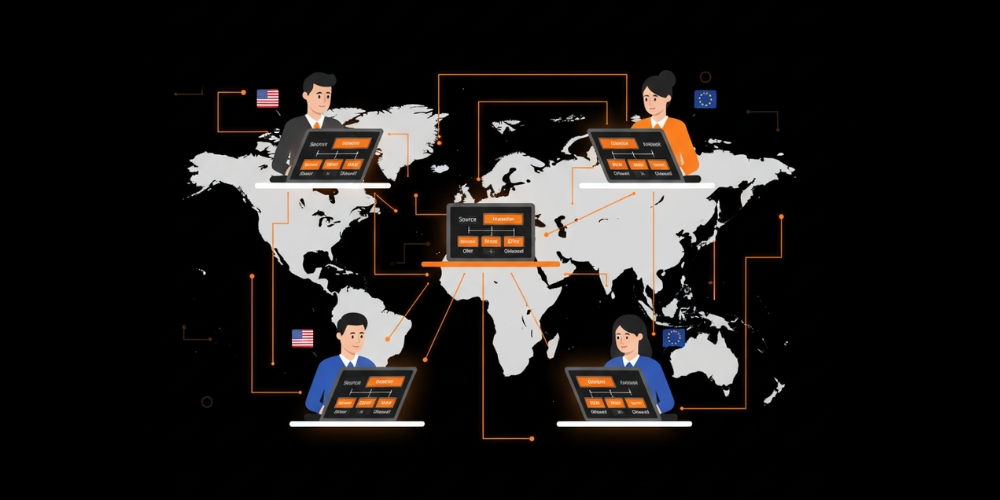
Seven specific consistency gains.
Enforced workflow structure
Stages, approvals, and rules pre-defined. Every candidate follows the same process; deviations are exceptions, not norms.
Uniform evaluation reduces bias
Standardised assessment forms and scoring rubrics applied to every candidate. Less variance from individual interviewer judgement.
Central visibility
Leadership sees the global funnel from one dashboard. Time-to-hire, conversion rates, drop-off points all comparable across regions.
Predictable scalability
New country entries follow established patterns rather than starting from scratch. Localisation is configuration, not rebuild.
Automated compliance gates
Legal checks, contract templates, taxation rules embedded in workflows. Candidates can't advance until compliance is satisfied.
Human error reduction
Forgotten emails, missed reminders, inconsistent scheduling all disappear when automation handles the mechanics.
Resource allocation through analytics
Consistent data feeds workforce planning and analytics for capacity forecasting and bottleneck identification.
Benefits for Recruiters and Employers

Five concrete operational gains.
Time savings
Gartner research shows automation can cut up to 30% of recruiting cycle time. Across 100+ hires per year, the reclaimed capacity is substantial.
Cross-region consistency
Hiring managers in London follow the same process as those in Dubai or Singapore. Miscommunication and inconsistency disappear.
Improved compliance
Pre-configured workflows enforce local labour laws automatically. The compliance posture strengthens across every new market.
Scalable expansion
Entering new countries doesn't require rebuilding the process — just configuring local variations.
Stronger employer brand
Smooth, professional candidate experience signals organisational competence and reflects positively in employer brand perception.
Benefits for Candidates
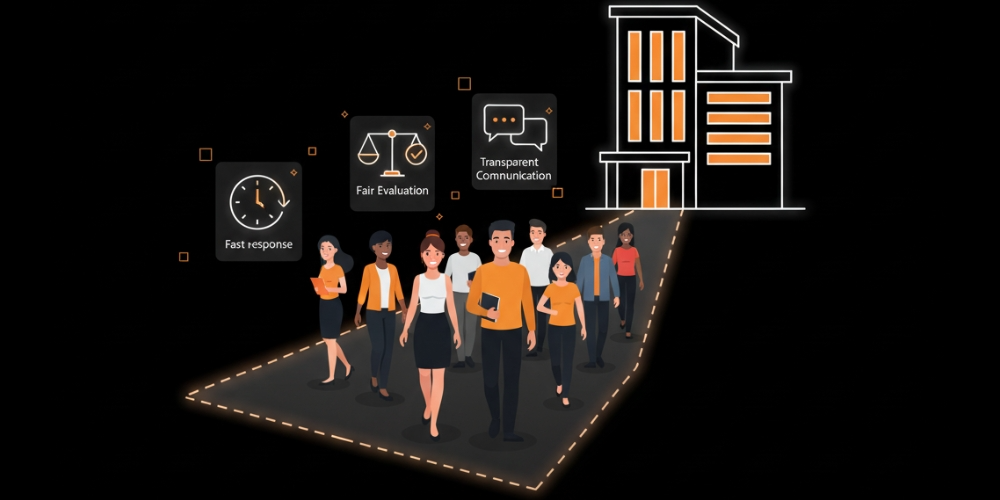
Four candidate-experience improvements.
Faster response times
Automated acknowledgments, status updates, and reminders eliminate the silence that frustrates candidates and drives drop-off.
Streamlined scheduling
One-click calendar booking across time zones replaces the email ping-pong that loses candidates daily.
Fairer evaluations
Same assessments applied to every candidate using same criteria reduces individual reviewer bias and improves perceived fairness.
Transparency
Status updates at every stage, consistent communications, clear timelines — all signals of organisational respect for candidate time.
Best Practices for Implementation

Six practices that consistently produce strong rollouts.
1. Start small, scale gradually
Pick one workflow (often scheduling or screening) and automate it first. Prove value before expanding scope. Phased rollouts succeed more than big-bang launches.
2. Build compliance in from day one
Embed regional rules in workflows. Catching compliance issues at scale is dramatically harder than preventing them.
3. Keep recruiters in the loop
Automation supports humans, doesn't replace them. Involve recruiters in tool design and configuration to ensure adoption.
4. Integrate with existing systems
ATS, HRIS, communication tools should connect cleanly. Disconnected automation creates new chaos rather than solving old chaos.
5. Measure and improve continuously
Track funnel metrics, candidate satisfaction, recruiter efficiency. AI hiring trends and predictive models layer on top to forecast and optimise.
6. Balance automation with personalisation
Mechanical workflows automated; relational moments stay human. Final interviews, offer calls, and culture conversations need real people.
The strongest implementations pair automation with data-driven hiring practices to compound the benefits.
What Doesn't Work
Three anti-patterns worth avoiding.
Big-bang rollouts
Automating everything across all regions simultaneously usually fails. Phased rollouts produce better outcomes.
Tool-first approach
Buying automation tools without process design produces faster chaos. Process first; tools second.
Removing human judgement
Pure algorithmic hiring decisions create legal risk and quality problems. Humans must remain in the loop for consequential decisions.
The Bottom Line
Global hiring automation is the structural answer to the chaos that international recruiting otherwise creates. The teams that implement it well produce faster hiring, stronger compliance, better candidate experience, and predictable scale across jurisdictions. The teams that don't keep paying the manual-coordination tax that compounds with every new country. The technology is mature; the implementation discipline is what separates success from cautionary tales. Start small, prove value, expand thoughtfully, and the international hiring engine becomes a strategic capability rather than ongoing struggle.
FAQs
How does automation help with international compliance?
By embedding local labour rules, contract templates, and mandatory checks directly in workflows. Automation prevents the oversight errors that manual processes consistently produce at scale.
Does automation replace recruiters?
No — it shifts the work. Repetitive administrative tasks move to automation; judgement, relationships, and culture evaluation stay with humans. The recruiter role becomes more strategic, less administrative.
How does automation improve candidate experience?
Faster response times, easier scheduling across time zones, fairer evaluation through consistent criteria, transparent status updates. Candidates feel respected; conversion to offer-acceptance improves.
What's the highest-leverage automation to start with?
Usually interview scheduling — the time-zone coordination friction is universal and the automation impact is immediate. Resume screening is a close second for high-volume hiring.
Can small companies benefit from global hiring automation?
Yes — particularly when entering new international markets. Modern automation tools have small-business pricing tiers that produce disproportionate value for lean teams expanding across borders.
Keep reading

AI Matching in Recruitment: How Algorithms Pair Candidates to Jobs

Legal and Ethical Risks of AI in Hiring: A Practical Risk Map
