

Full Cycle Recruiting Explained: How It Works and When to Use It
Full cycle recruiting puts one recruiter in charge end-to-end — the six steps, the benefits, and when this approach fits best.
Ployo Team
Ployo Editorial

TL;DR
- One recruiter owns the entire hiring process from job opening to onboarding.
- Six stages: planning, sourcing, screening, interviewing, offer, onboarding.
- Strong structured recruitment shows 62% greater new-hire productivity (HBR).
- 66% of candidates say great hiring experience drives offer acceptance (CareerPlug).
- Best fit for startups, SMBs, lean teams that value consistency and accountability.
Many companies treat hiring like a relay race — sourcing here, interviewing there, onboarding somewhere else, with candidates handed off between teams that don't fully coordinate. The result: missed candidates, communication gaps, and a process that feels chaotic to everyone involved. Full cycle recruiting solves this by putting one recruiter (or small dedicated team) in charge of the entire process. This guide walks through what full cycle recruiting actually is, the six stages it covers, the benefits and trade-offs, and how to make it work well.
What Full Cycle Recruiting Is
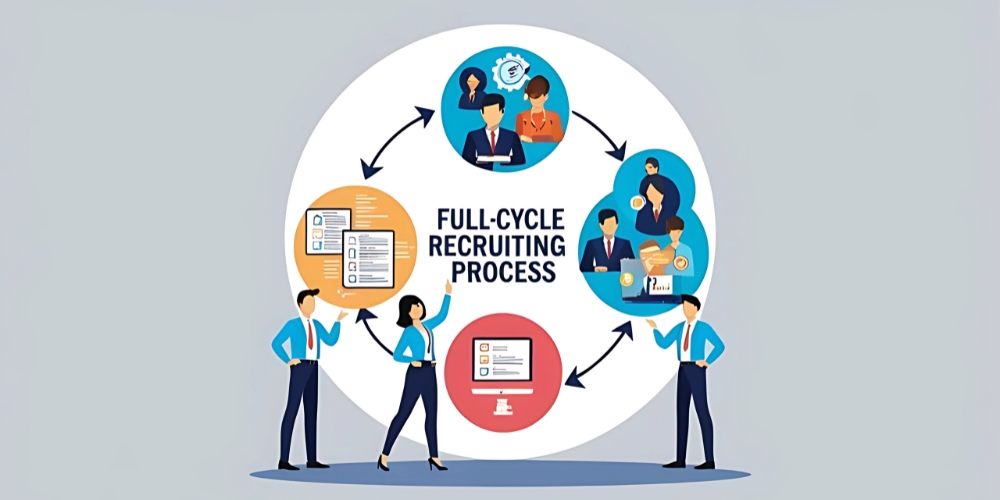
Full cycle recruiting — also called "full life cycle recruiting" or "360 recruiting" — is a hiring model where one recruiter manages every stage of the recruitment process: sourcing, screening, interviewing, selecting, offering, and onboarding.
Unlike fragmented models where different teams handle different stages, full cycle recruiting puts continuity at the centre. The candidate has one consistent point of contact; the hiring manager works with one accountable owner.
HBR research shows organisations with structured recruitment processes see 62% greater new-hire productivity than those without standardised systems.
Common job titles
- Talent Acquisition Specialist
- Full Cycle Recruiter
- Recruitment Consultant
- Hiring Manager (in lean teams)
Regardless of title, the responsibility is the same — driving the entire hiring lifecycle from vacancy to onboarding.
The Six Stages of the Recruitment Process Cycle

1. Planning and requisition
Align with hiring managers on what the role actually needs. Write a clear job description — must-have skills, nice-to-have skills, responsibilities, success criteria. Define screening criteria and interview structure.
2. Sourcing candidates
Job boards, employee referrals, LinkedIn search, passive candidate outreach, agency partnerships where needed. Strong sourcing is multi-channel — single-channel sourcing limits the pool unnecessarily.
3. Screening and shortlisting
Resume review, phone screens, structured assessments. Strong screening combines AI-assisted filtering with deeper human review of qualified candidates. The discipline is in the rubric — same criteria applied to every candidate.
4. Interviewing
Schedule interviews, brief panel members on what to evaluate, debrief afterward. Strong recruiters prep candidates so they show up ready, and prep interviewers so panel conversations are coordinated.
5. Offer and negotiation
Craft an offer aligned with candidate expectations and company budget. Explain benefits, equity, growth opportunities clearly. Negotiate respectfully when needed; close decisively when alignment exists.
6. Onboarding
The hire isn't complete when the offer is signed — it's complete when the new employee is productive. Strong onboarding sets clear 30/60/90-day goals, hands over tools, makes introductions, and ensures day one feels like genuine welcome.
Benefits of Full Cycle Recruiting

Four operational gains over fragmented models.
Improved candidate experience
One consistent contact, clear communication, no handoff gaps. CareerPlug research shows 66% of candidates say great hiring experience drives offer acceptance.
Faster time-to-hire
No waiting for handovers between teams. Decisions get made faster; bottlenecks get resolved by one person with full context.
Higher quality hires
Full visibility across stages lets recruiters fine-tune assessment and interview based on what actually predicted success in past hires.
Increased accountability
One person owns the result. Gaps are easier to identify and fix; finger-pointing disappears.
Full Cycle vs Traditional Fragmented Recruiting
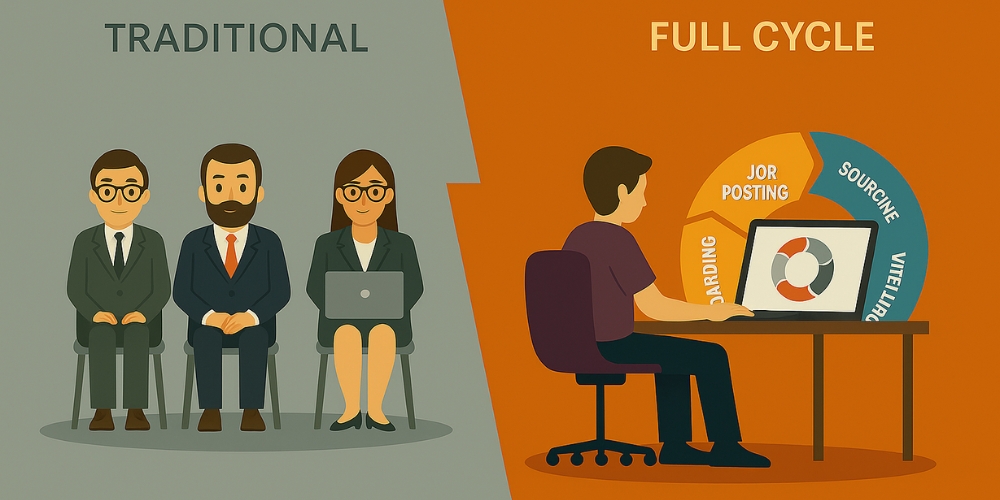
| Dimension | Full cycle | Fragmented |
|---|---|---|
| Ownership | One recruiter | Multiple teams |
| Candidate experience | Personal, consistent | Variable, with handoffs |
| Speed | Faster (no handovers) | Slower (dependencies) |
| Accountability | Clear single owner | Distributed, harder to trace |
| Specialisation | Generalist depth | Per-stage specialisation |
| Best for | Startups, SMBs, lean teams | Large enterprise scale |
| Recruiter workload | Heavier per person | Lighter per person |
The trade-off is real. Full cycle works well for smaller scale; fragmented specialisation can work better at high volume where each stage has dedicated experts.
When Full Cycle Recruiting Fits Best
Five situations where the model genuinely excels.
Startups and SMBs
Lean teams can't justify per-stage specialists. One full cycle recruiter handles the work that would require 3-5 specialists in a larger company.
High-quality, low-volume hiring
When each hire matters more than the cumulative volume, continuity beats specialisation.
Roles requiring relationship-driven sourcing
Senior, executive, or specialist roles where building candidate relationships matters more than fast filtering.
Companies prioritising candidate experience
When the brand investment in hiring experience is strategic, single-owner accountability protects it.
Internal teams that value end-to-end visibility
Where leadership wants one person to know exactly what's happening across the hiring funnel rather than aggregating from multiple sources.
When Fragmented Recruiting Fits Better
Three situations where specialisation outperforms.
High-volume hiring at scale
Companies hiring 100+ people monthly often benefit from sourcing specialists, screening specialists, and recruiter coordinators rather than expecting one person to do all of it.
Highly technical or niche roles
Specialised sourcing knowledge (specific technical skills, specific industries) sometimes warrants dedicated specialists rather than generalist coverage.
Geographic or compliance complexity
Multi-country hiring with different legal requirements per jurisdiction often benefits from regional specialists.
Tips for Strong Full Cycle Recruiting

Five practices that consistently produce strong outcomes.
1. Invest in the right ATS
A modern ATS with built-in sourcing, scoring, scheduling, and analytics dramatically compresses full cycle recruiter workload. The tooling cost is small compared to the productivity gain.
2. Personalise outreach
Generic LinkedIn messages produce generic response rates. Mentioning specific work, mutual connections, or role-specific details measurably improves engagement.
3. Automate the mechanics
Scheduling, reminders, candidate communication, and reference checks all benefit from automation. The recruiter's time shifts to relationship work and judgement.
4. Track meaningful metrics
Time-to-fill by source, quality-of-hire at 90 days, retention by hire source. The data reveals which parts of the process to improve.
5. Build feedback loops
Survey candidates and hiring managers after each hire. Use the feedback to improve the next cycle. Small adjustments compound across many hires.
The Bottom Line
Full cycle recruiting is the right model when continuity, accountability, and consistent candidate experience matter more than per-stage specialisation. For startups, SMBs, and lean teams, it consistently outperforms fragmented models. For high-volume scale, fragmented specialisation often delivers more. The model itself isn't right or wrong — it's right or wrong for the specific company context. Choose deliberately, invest in tooling that supports it, and the discipline pays back across every hire.
FAQs
What is the 360 recruitment cycle?
Another name for full cycle recruiting. The "360" refers to one recruiter owning the complete hiring loop from job requisition to onboarding.
What's the opposite of full cycle recruiting?
Fragmented or specialised recruiting models where different teams handle different stages — sourcing specialists, interview coordinators, onboarding teams operating as separate functions.
How long does a typical full recruiting cycle take?
2-6 weeks for most roles. Some hires move faster (1-2 weeks for tight matches); others run longer (8+ weeks for executive search or specialist roles).
Who does full cycle recruiting fit best?
Startups, SMBs, agencies, and lean internal teams where efficiency, accountability, and candidate experience are top priorities. Large enterprises often benefit more from specialisation.
Is full cycle recruiting harder than fragmented?
It can be — particularly solo. Modern tooling, automation, and discipline make it manageable. The reward is higher-quality hires, faster timelines, and stronger candidate experience.
Keep reading


Reverse Recruiters: What They Do and When They Actually Help
