

How to Write Effective Job Descriptions That Attract the Right Talent
Effective job descriptions hire better and faster — twelve practical tips, the mistakes to skip, and the structure recruiters use to win the right hires.
Ployo Team
Ployo Editorial

TL;DR
- The job description is the single highest-leverage document in the hiring process — it filters who applies, who succeeds, and who stays.
- The best descriptions use searchable titles, a compelling summary, action-led responsibilities, and a clear must-have / nice-to-have split.
- Inclusive language and pay-range transparency demonstrably lift application volume.
- The most common failure mode is sounding generic — "fast-paced", "self-starter", "rockstar" — instead of specific.
- Refresh descriptions yearly, customise per platform, and write for the candidate's perspective, not just the company's.
A well-written job description does work the rest of the funnel cannot replicate: it pulls in the right people, repels the wrong ones, and sets expectations long before the first interview. A weak one floods the recruiter with noise, attracts mismatches, and quietly opens the door to legal risk. The good news is that writing one well is a craft, not a mystery — there are twelve repeatable moves that consistently lift quality, and a handful of common mistakes worth avoiding.
This guide covers both. It is a tactical companion to our overview of why the job description is the most important document in hiring.
Twelve Tips for Writing an Effective Job Description
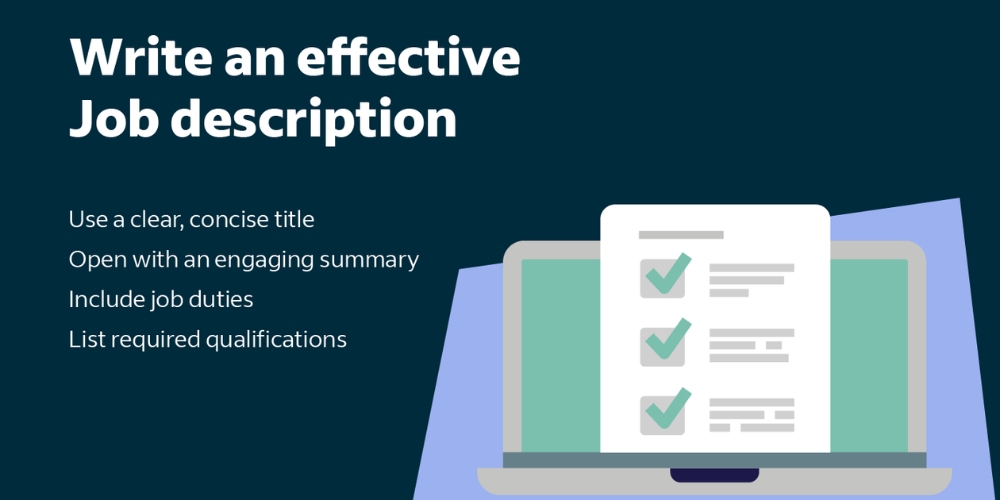
1. Use a job title candidates actually search for
Skip the cute titles. "Coding Boss" and "Marketing Maestro" do not exist on job boards. "Senior Software Engineer" and "Marketing Manager" do — and they are what your future hires type into the search bar.
2. Open with a real summary, not a paragraph of HR boilerplate
The first 50 words decide whether the rest of the description gets read. Lead with what the role actually does, the impact it has, and one specific reason this team is worth joining. Treat it as a 30-second elevator pitch, not a corporate "About Us."
3. Write responsibilities as concrete bullets
Each bullet should start with a strong action verb and describe a specific task or outcome. "Own quarterly campaign planning across paid and lifecycle" beats "Responsible for marketing activities."
4. Separate must-haves from nice-to-haves
The single most damaging mistake is mixing the two. Candidates who hit four of five must-haves but none of the nice-to-haves walk away thinking they are unqualified. A clear split tells them exactly when to apply.
5. Use inclusive, bias-aware language
Words like "rockstar", "aggressive", and "dominant" measurably reduce female applications. Words like "collaborative" and "balanced" lift them. Our deep dive on inclusive language in job descriptions covers the patterns; a free tool like Gender Decoder catches the rest.
6. Describe the company in two or three sentences, not two paragraphs
Candidates do not need a corporate history. They need one specific reason this team is worth joining — mission, recent product win, growth stage, customer segment. Specifics earn attention; generic blurbs lose it.
7. Be explicit about growth and learning
Strong candidates want a path, not a paycheck. Mention what learning, mentorship, or progression looks like in this seat. If there is a real promotion track, say so.
8. Publish a pay range whenever you can
Fortune reported that the share of US job postings disclosing a pay range jumped from 18.4% to 43.7% between February 2020 and February 2023. Beyond compliance, transparency lifts trust and filters out misaligned applicants before the first call.
9. State the work arrangement clearly
Remote, hybrid, or on-site — and which days, if hybrid. McKinsey's survey on flexible work in America found that 87% of workers choose flexibility when given the option. Leaving this implicit costs you applications.
10. Format for scanners, not readers
Most candidates skim before they read. Use H2s, short paragraphs, and bullet lists. Anything longer than three lines of prose risks being skipped.
11. Stay on the right side of compliance
Include the required ADA statement, avoid discriminatory phrasing, and limit the description to genuinely essential functions of the role. The cost of getting this wrong is paid in legal exposure, not just bad PR.
12. Set a yearly review cadence
Roles drift. The job description that worked 18 months ago is usually three iterations stale. A quick annual review against the team's actual current work keeps the document honest.
What to Avoid While Writing Job Descriptions

Even a description that hits all twelve tips can fall flat in a few specific ways.
Sounding like every other posting
Phrases like "fast-paced environment", "wear many hats", and "self-starter" are so universal they convey nothing. Replace them with concrete details about the team's actual work, customers, or stage.
Writing the description in a vacuum
The strongest descriptions are drafted with input from someone currently doing the job or working closely with it. Skipping that step usually produces a description that matches the org chart but not the actual work.
Forgetting the candidate's perspective
It is easy to list what the company needs and forget to address what the candidate wants — career impact, interesting problems, the team they will work with, where this role goes next. A description that reads only as a list of demands loses the candidates you most want.
Posting the same description across every platform
Indeed and LinkedIn reward different formats. A specialist board like Stack Overflow or Wellfound rewards a more direct, founder-style voice. A single copy-paste across all boards leaves performance on the table.
Burying the "why"
Candidates rarely care about the job in isolation. They care about why it exists, why now, and what the team is trying to do. One sentence on the role's strategic context routinely outperforms three paragraphs of tasks.
The Bottom Line
An effective job description is not a formality. It is the document that decides who applies, who self-selects out, who succeeds in the role, and how performance is later measured. Treat it as a real piece of writing — specific, honest, candidate-aware, kept up to date — and the rest of the hiring funnel gets dramatically easier. Skip the craft, and every downstream stage will work harder than it needs to.
FAQs
How long should a job description be?
For most roles, 400-700 words is the sweet spot. Long enough to cover responsibilities, must-haves, scope, growth, and what success looks like; short enough to be read on a phone in under two minutes.
What is the single most important section of a job description?
The first 50 words. If the summary does not earn a candidate's attention, they will not read the rest of the description carefully enough to decide whether to apply.
Should I publish a salary range even when it is not legally required?
Yes, where possible. Salary transparency tends to lift application quality, build trust, and filter out misaligned applicants early. The downside is rarely as large as recruiters expect.
How often should we refresh a job description?
At minimum once a year. Whenever the scope of the role changes, whenever a person leaves and the next hire has a different mandate, and whenever current applications come in noticeably weaker than the previous round.
Who should sign off on the final job description?
The hiring manager owns the substance. The recruiter pressure-tests for clarity, length, and market fit. One person currently working alongside the role should read it for "this matches what the job actually is" — that final reviewer is the cheapest sanity check available.
Keep reading

Writing Job Descriptions for Startups: Templates and Common Mistakes

