

Fractional Chief Automation Officer: When and Why Companies Hire One
A fractional Chief Automation Officer brings senior automation leadership part-time — when to hire one, what they do, and how to find a strong fit.
Ployo Team
Ployo Editorial
TL;DR
- Fractional CAOs bring senior automation leadership at a fraction of full-time cost.
- ~88% of organisations now use AI in at least one business area (McKinsey 2025).
- ~50% of current work tasks can be automated with existing technology.
- Best fit for growing companies between "small DIY" and "need a full-time exec."
- Strongest fractional leaders focus on outcomes, not tool selection.
Automation is now a strategic capability, not a side project. But most companies between 50-500 employees can't justify a full-time Chief Automation Officer — and can't afford the chaos of automation without senior direction. Fractional CAOs fill the gap: experienced leadership for a fraction of the time and cost. This guide walks through what a fractional CAO actually does, when to hire one, what to look for, and the mistakes companies consistently make in automation leadership.
What a Fractional Chief Automation Officer Is
A fractional Chief Automation Officer (fCAO) is a senior automation leader working part-time with a company — typically 5-20 hours per week, often for 3-12 month engagements.
The role focuses on:
- Assessing current automation and AI maturity
- Identifying highest-leverage automation opportunities
- Setting strategic direction for tool selection and integration
- Coaching internal teams through implementation
- Measuring outcomes and adjusting course
Some companies combine automation and AI leadership into a single fractional Chief AI Officer role — the boundary between automation and AI has blurred substantially as modern automation increasingly leverages AI capabilities.
The discipline isn't about tools; it's about systematically reducing manual work that should no longer be manual. McKinsey research suggests ~50% of current work tasks could already be automated with existing technology — but only when someone experienced steers the effort.
Why Companies Are Hiring Fractional Automation Leaders

Three structural pressures drive the demand.
Tool sprawl without strategy
McKinsey's 2025 AI research shows 88% of organisations now use AI in at least one business area. But most are doing this without coherent direction — point tools accumulating without integration, value, or strategic coherence.
AI adoption pressure without internal expertise
Leadership wants AI deployed; internal teams don't know where to start. Without senior guidance, AI experiments run for months without producing measurable value.
Cost of a full-time CAO
Full-time Chief Automation Officers command $300K-$500K+ packages with equity. For companies between 50-500 employees, the cost-benefit doesn't work — but the leadership gap is real.
Fractional leadership addresses all three: senior direction without senior overhead, focused on the highest-value automation opportunities first, with built-in flexibility as the company scales.
What a Fractional CAO Actually Does

Five activities consistently appear in fractional CAO engagements.
1. Process mapping and assessment
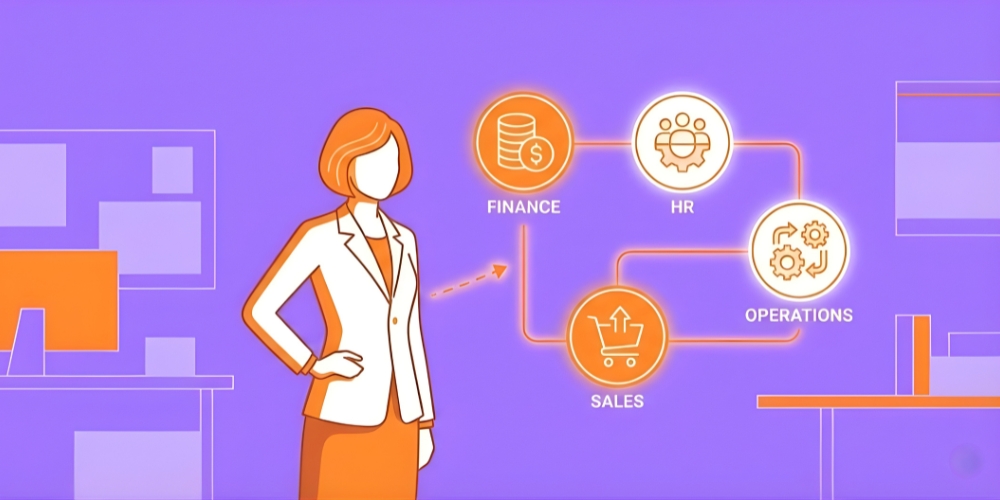
Reviews how work actually happens across teams — including hiring workflows, talent assessment processes, customer operations, finance, and engineering. Identifies where manual work is structurally unnecessary.
2. Prioritisation
Not everything should be automated. Strong fractional CAOs identify which 3-5 areas produce the most leverage — usually onboarding, reporting, customer support, or data movement — and focus there first.
3. Tool selection and integration
Recommends specific tools that fit company scale and need. Critically, also identifies tools to retire — tool sprawl is one of the biggest hidden costs in mid-sized companies.
4. AI capability building
Where AI genuinely fits, designs the implementation: AI in hiring workflows, AI in customer support, AI in data analysis. Distinguishes AI hype from AI value.
5. Team coaching and change management
The automation works only if people use it. Strong fractional CAOs spend significant time on adoption, training, and addressing the culture changes that automation requires.
Fractional vs Full-Time CAO
Different engagement models for different company contexts.
| Dimension | Fractional CAO | Full-Time CAO |
|---|---|---|
| Cost | $5K-$25K/month | $300K-$500K+/year |
| Scope | Focused on top priorities | Comprehensive ownership |
| Hours | 5-20/week | 40+/week |
| Best for | 50-500 employee companies | 500+ with complex systems |
| Engagement length | 3-12 months typical | Permanent or multi-year |
| Risk | Lower (easier to adjust) | Higher (long hiring cycle) |
The honest read: fractional fits companies who need direction more than they need ongoing ownership; full-time fits companies large enough that the workload genuinely justifies a permanent role.
When to Hire a Fractional CAO

Five signals that the timing is right.
Tool overload
Teams are using 10+ tools that don't connect well. Logins multiply; data lives in silos; manual transfers between systems are constant.
Slow handoffs between teams
Work flows poorly across functional boundaries. Marketing-to-sales, sales-to-customer-success, customer-success-to-product all involve manual coordination that should be automated.
Stalled AI experiments
Multiple AI pilots run for months without producing measurable outcomes. The pattern signals lack of strategic direction, not lack of capability.
Leadership uncertainty
Executives know automation matters but can't agree on what to automate first. Internal politics or unclear priorities are blocking progress.
Growth pressure
Company is scaling fast but operational complexity is scaling faster. Without intervention, the operational drag will compound.
Skills to Look For in a Fractional CAO

Five characteristics that distinguish strong fractional leaders.
Plain-language communication
Can explain complex automation concepts to non-technical executives without dumbing them down. Critical for the change management work that determines whether automation actually gets adopted.
Business-first thinking
Understands business goals before recommending tools. Technology-first thinkers tend to recommend more tools than the company needs.
Cross-industry experience
Patterns repeat across industries. Strong fractional CAOs have seen similar problems in different contexts and can apply solutions that worked elsewhere.
Knows when NOT to automate
Some processes shouldn't be automated. The judgement of when to leave things alone comes from experience and matters more than people realise.
Outcome focus
Measures success in saved time, reduced errors, smoother handoffs, and business outcomes — not in tools deployed.
Common Mistakes Companies Make

Five recurring failures.
Buying tools before setting direction
Tool purchases without strategic context produce sprawl. Strategy must precede selection.
Expecting instant results
Even fast automation requires planning, change management, and team adaptation. The "deploy it Monday, see results Tuesday" expectation produces disappointment.
Treating automation as an IT project
Automation touches people, habits, and decisions. Pure IT ownership without business-side engagement produces unused tooling.
Automating broken processes
Automation amplifies whatever it's built on. Without process rationalisation first, automation produces faster dysfunction.
Skipping measurement
If you can't measure time saved, errors reduced, or volume increased, you can't know what's actually working. Measurement infrastructure matters more than people realise.
The Bottom Line
Fractional Chief Automation Officers fill a real gap for growing companies that need senior automation leadership but can't justify full-time executive cost. The model works when companies engage thoughtfully — clear scope, measurable outcomes, realistic expectations, and willingness to act on the strategic direction the fractional leader provides. The companies that benefit most treat fractional leadership as the bridge from "automation chaos" to "automation maturity" rather than as a quick fix. With AI adoption accelerating and tool sprawl compounding, the case for senior automation leadership has never been stronger — and the fractional model makes it accessible to companies that couldn't otherwise reach it.
FAQs
How much does a fractional Chief Automation Officer cost?
Typical range $5K-$25K/month depending on hours and seniority. Most engagements are 3-12 months. Significantly cheaper than full-time CAO cost ($300K-$500K+/year) for companies between 50-500 employees.
When should a company hire a fractional CAO?
When automation efforts feel scattered, growth is straining existing systems, AI experiments stall, or leadership lacks clear direction on what to automate first. Earlier intervention typically produces better outcomes than waiting for crisis.
Can startups benefit from a fractional CAO?
Yes — often more than larger companies. Early automation decisions shape long-term workflows; getting these right saves substantial rework later. A few months of fractional guidance often pays back many times over.
How is a fractional CAO different from a consultant?
Fractional leaders embed in the company over months, accountable for outcomes. Consultants typically deliver assessments and recommendations then leave. Fractional engagement produces stronger implementation discipline.
What's the highest-leverage area for a fractional CAO to start with?
Usually one of: customer support automation, internal reporting workflows, or onboarding/hiring processes. These touch many people, produce visible wins, and build organisational buy-in for broader automation.


