

Entry-Level AI Jobs in 2026: Roles, Salaries, and How to Land One
AI hiring is broad enough that PhDs aren't required — the most accessible entry-level AI roles, the skills that matter, and how to break in.
Ployo Team
Ployo Editorial

TL;DR
- Entry-level AI jobs typically start $65K-$95K with strong remote-work availability.
- PhDs are required for research roles, not for most applied AI positions.
- Most accessible roles: data analyst, AI/ML support engineer, AI trainer, prompt engineer, ML ops.
- Skills matter more than credentials — Python, SQL, cloud platforms, portfolios.
- Bootcamps and certificates can substitute for traditional degrees in most applied roles.
The "you need a PhD to work in AI" myth keeps capable people from a market that's actively hiring them. Research roles do require deep credentials. Applied AI roles — the vast majority of openings — care more about demonstrated capability than letters after your name. This guide walks through which entry-level AI jobs are most accessible, what skills they actually require, where to find them, and how to land one without years in academia.
Do You Really Need a PhD to Work in AI?

Short answer: no. A PhD helps for research-heavy positions — advanced algorithm design, theoretical modelling, cutting-edge research. The majority of AI roles focus on applying existing tools, not inventing new ones.
Modern hiring increasingly values:
- Hands-on project experience
- Tool fluency (TensorFlow, PyTorch, scikit-learn, LangChain)
- Cloud platform comfort (AWS, GCP, Azure)
- Real demonstrated outcomes
- Communication ability for cross-functional collaboration
Even prompt engineer roles — which sound technical — care more about curiosity, experimentation, and clarity than academic credentials. The talent supply for applied AI is far thinner than the headlines suggest, which is why companies hire bootcamp graduates and self-taught practitioners alongside CS degrees.
The Most Accessible Entry-Level AI Roles
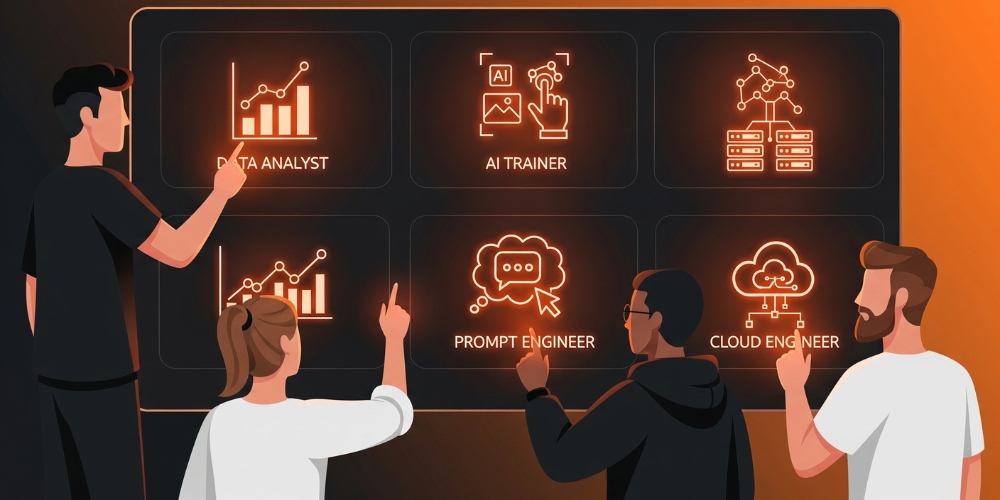
Five role categories that consistently hire entry-level candidates.
1. Data Analyst
Clean, organise, visualise data so machine learning models can learn from it. Great Learning data puts US data analyst salaries at $65,000-$86,000 median.
Required skills: SQL, Python, Excel, visualisation tools (Tableau, Power BI), statistical thinking.
2. AI/ML Support Engineer
Maintain deployed models, debug pipelines, support data infrastructure. Entry-level engineers handle the operational layer that lets data scientists focus on model building.
Required skills: Python, SQL, basic cloud (AWS/GCP), debugging, version control.
3. AI Trainer / Labeling Specialist
Not glamorous but essential. Label data for NLP models, image recognition, autonomous systems. Entry pay is lower ($35K-$55K), but the role gives genuine AI exposure and pathway to higher-tier roles.
Required skills: attention to detail, quality consistency, basic ML literacy.
4. Junior Prompt Engineer
Test and refine prompts for generative AI deployments — content generation, customer service, marketing automation. The job exists because companies need humans who can think systematically about LLM behaviour.
Required skills: clear writing, experimentation discipline, basic understanding of LLM behaviour, domain knowledge in the target area.
5. Remote AI Roles
The growth of remote AI work post-2020 has dramatically expanded geography. From entry-level positions in NYC tech to fully-remote opportunities, employers are hiring globally.
The remote opportunity matters most for candidates outside major tech hubs — companies that hire remote care less about location than capability.
Skills You Actually Need

Six skill areas that consistently appear in entry-level AI job requirements.
Programming
Python is foundational. Add libraries: pandas, numpy, scikit-learn, plus framework basics in TensorFlow or PyTorch.
Math basics
Linear algebra and probability — enough to understand what models are doing, not PhD-depth.
Data handling
SQL is more important than people expect. Many entry-level AI jobs involve more data engineering than model building.
AI tools and platforms
Cloud ML platforms (AWS SageMaker, Google Vertex AI), Hugging Face for open-source models, OpenAI APIs for LLM work.
Version control and collaboration
Git, GitHub, basic CI/CD literacy. Software engineering hygiene matters even for ML-focused roles.
Soft skills
Communication, especially for prompt engineering and any cross-functional work. The ability to explain model decisions to non-technical stakeholders is rare and valuable.
How to Gain Experience Before Your First AI Job
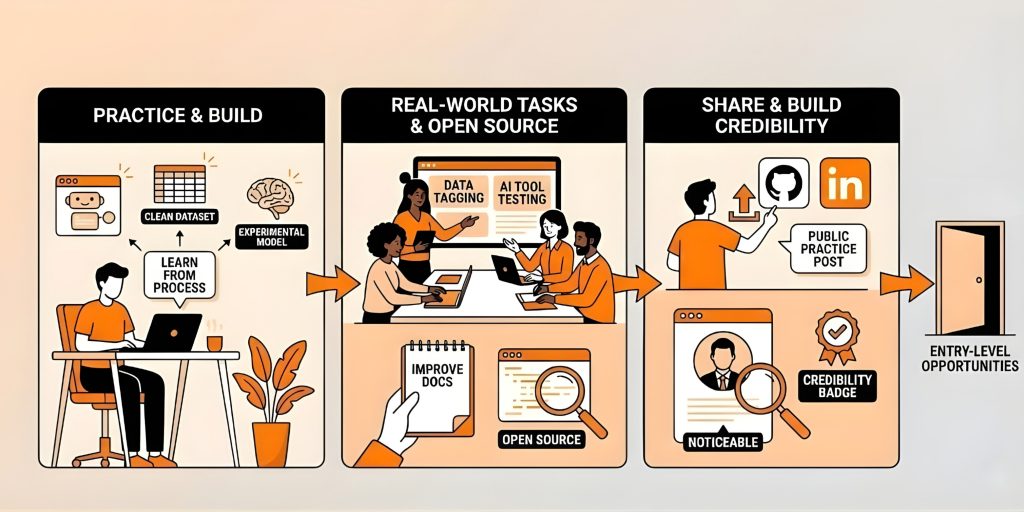
The chicken-and-egg problem — you need experience to get hired, but you need to get hired to get experience — is solvable through deliberate practice.
Build small public projects
A simple chatbot, a sentiment analyser, a model that classifies images of your hobby. Doesn't need to be production-grade — needs to be demonstrably yours.
Open-source contributions
Tag issues, improve documentation, add small features to AI libraries on GitHub. Public contribution history beats interview claims.
Kaggle competitions
Even non-winning Kaggle entries demonstrate end-to-end ML thinking. Recruiters look at Kaggle profiles for entry-level candidates.
Document your work publicly
LinkedIn posts, Medium articles, personal blog. Sharing how you solved a small problem builds credibility and visibility.
Take real projects on freelance platforms
Upwork and similar offer small AI gigs (data cleaning, basic modelling, prompt tuning). Real client work — even small — signals professional capability.
Where to Find Entry-Level AI Jobs
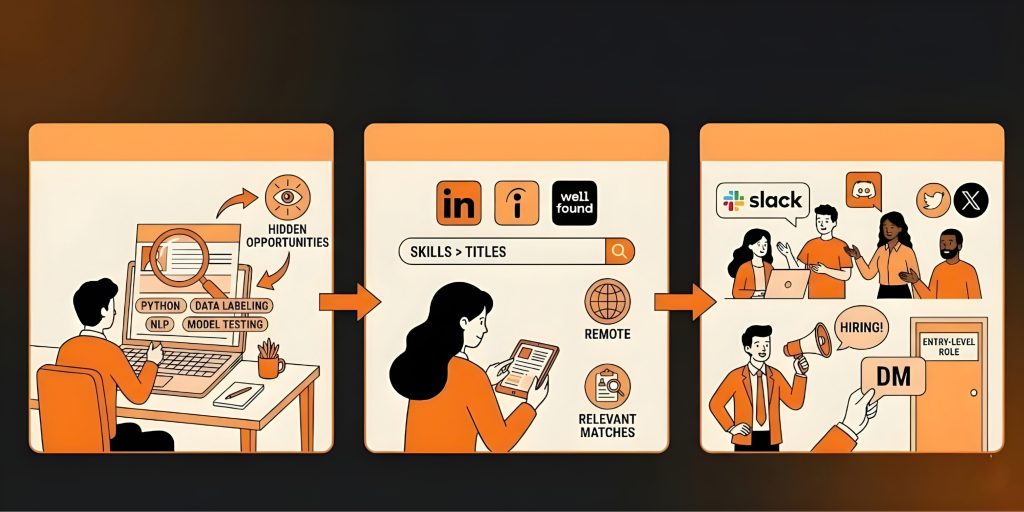
Five search strategies that consistently produce results.
Search by skill, not title
LinkedIn, Indeed, Wellfound. Search "Python data labeling NLP" rather than "AI engineer." Many entry-level roles are titled "Analyst" or "Associate" — the AI work is in the description.
Join AI communities
Slack groups, Discord servers, Reddit communities (r/MachineLearning, r/learnmachinelearning). Jobs often surface here before public posting.
Follow founders and AI teams
Twitter/X, LinkedIn, personal blogs. Many hires happen through a single post-and-DM rather than formal application.
Target AI-native companies
Hugging Face, Anthropic, OpenAI, Cohere, smaller AI startups. These companies need junior support and are willing to hire on capability rather than credentials.
Look at AI-adjacent roles
Data engineering, MLOps, analytics roles often involve significant AI work without "AI" in the title. The skill development translates directly.
How to Land Entry-Level AI Roles Without a PhD

Five practical moves that consistently distinguish hired candidates from unhired ones.
1. Build a public portfolio
3-5 small projects showcased on GitHub with clear READMEs. Recruiters look at code far more often than resumes claim — make it findable and easy to evaluate.
2. Get one or two credentials
Google's AI/ML certification, Coursera's deep learning specialisation, Udacity nanodegree, or similar. The credential itself matters less than what it signals about your discipline and current knowledge.
3. Network strategically
Modern recruitment is increasingly relationship-driven. Meetups, hackathons, virtual events, online communities. Many roles are filled before public posting.
4. Target remote-first companies
Hugging Face, Automattic, GitLab, and AI-native startups often have international hiring pipelines. Don't limit to local geography.
5. ATS-optimise your resume
Most companies use applicant tracking systems. Include keyword matches for the specific role — Python, TensorFlow, NLP, specific cloud platforms — where they genuinely apply to your background.
The Bottom Line
Entry-level AI hiring is more open than most candidates realise. PhDs are required for research roles; applied AI roles want demonstrated capability. The path in is straightforward — build skills systematically, document them publicly, build a portfolio that shows real work, network in AI communities, and target the roles where your background actually fits. Remote work has dramatically expanded geographic access; modern AI startups are openly willing to hire bootcamp graduates and self-taught practitioners. The companies and candidates who get this dynamic right are matching up faster than the conventional career-advice infrastructure can keep up.
FAQs
Is a master's degree enough for AI jobs?
Yes — for nearly all applied AI roles. Master's degrees in CS, data science, or applied math combined with portfolio projects produce strong entry-level outcomes. PhDs are mostly required for research positions.
Which entry-level AI jobs pay the most?
Junior ML engineers and prompt engineers at AI-native companies typically top the entry-level pay scale, especially in tech hubs (NYC, Bay Area, Seattle). Data analyst roles are more accessible but pay less initially.
Can a bootcamp realistically get me into AI?
Yes, with structured projects beyond just course completion. Bootcamps that include capstone projects, mentor relationships, and portfolio development consistently produce employed graduates. Pure-coursework bootcamps without project rigour produce weaker outcomes.
Are entry-level AI jobs available remotely?
Increasingly yes. Many AI-native companies hire remote-first. Larger tech companies offer remote roles but often with location preferences. Don't limit your search geographically.
How long does it realistically take to land an entry-level AI job?
3-12 months from starting serious skill development, depending on background and portfolio quality. Candidates with CS or quantitative backgrounds typically land faster; complete career changers often need 9-18 months of focused work.
Keep reading

Compensation Planning Explained: A Strategic HR Guide for 2026

Working in Japan as an American: The Recruiter's Reality Check
