

How to Ask for Interview Feedback by Email: Templates That Actually Work
A well-written feedback request email after an interview surfaces real growth signal — the timing, structure, and tone that consistently get replies.
Ployo Team
Ployo Editorial

TL;DR
- Only ~41% of candidates ever receive interview feedback — asking improves your odds.
- 70% of rejected candidates view employers more positively when given detailed feedback.
- Wait 24-48 hours after the decision or 1-2 weeks if silence persists.
- Keep emails under 200 words, polite, focused on growth not disappointment.
- Personalisation beats generic templates every time.
The silence after an interview is one of the most uncomfortable parts of job-seeking. Most candidates never push past it — they accept the rejection (or the silence), wonder what went wrong, and move on without learning. The candidates who ask for feedback respectfully gain real insight into what to improve, sometimes keep the door open for future roles, and consistently come across as more mature professionals. This guide walks through when to ask, how to structure the email, what to say, and the mistakes that prevent replies.
Why Request Feedback After an Interview?

Four genuine benefits beyond closure.
Growth and improvement
Novoresume's interview statistics show only ~41% of candidates actually receive feedback. The ones who ask increase their odds substantially — and the insight informs every future interview.
Signals professional maturity
Asking thoughtfully demonstrates self-awareness, learning orientation, and grace under disappointment — exactly the qualities recruiters remember.
Keeps the door open
Even a rejection isn't necessarily final. Many companies keep silver-medal candidates in mind for future roles. Polite follow-up builds the relationship rather than ending it.
Better candidate experience for the next person
JobScore research shows 70% of rejected candidates view employers more positively when given detailed feedback. Your request demonstrates that candidates value feedback — which can shift company practice over time.
When to Send Feedback Request Emails
Timing matters. Three windows work consistently.
Right after rejection (24-48 hours)
The natural moment. The decision is fresh in the interviewer's mind; your name still ties to specific impressions. This is when you'll get the best feedback if you'll get any.
After 1-2 weeks of silence
If you haven't heard anything 1-2 weeks post-interview, a gentle status-plus-feedback email is appropriate. Frame as continued interest, not impatience.
After a second-round silence
If the second interview ended without follow-up after a week, a polite check-in works. Often the interviewer is gathering panel feedback and your nudge is welcome.
What doesn't work
Asking the day of the interview ("Just wanted to know how I did") seems eager but reads as needy. Wait at least until the next business day. Asking months later ("Following up six months after our interview…") usually fails — memory has decayed past usefulness.
Structure of a Professional Feedback Request Email
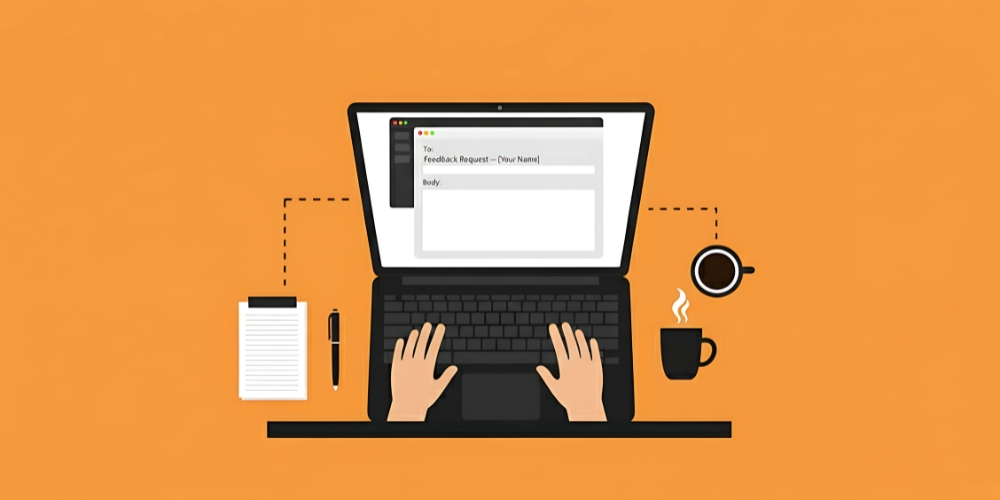
Six components that work in any feedback request.
1. Clear subject line
Examples that work:
- "Feedback Request — [Your Name], [Role Title]"
- "Following up after our [Date] interview — [Your Name]"
- "Thank you and feedback request — [Role Title]"
The subject should help the recipient identify you and the role immediately.
2. Personal greeting
"Hi Sara," or "Hello Mr. Adams," — by name, never "Dear Hiring Manager."
3. Opening thank-you
"Thank you for the time you spent with me discussing the [Role] last week." Sincere, brief, role-specific.
4. Context reminder
Recruiters interview many candidates. Help them place you: "I met with you and Jamie on March 15 about the Senior Marketing Manager position."
5. Feedback request
The core ask, framed around growth:
"I understand the team has decided to move forward with another candidate. If you're able to share any thoughts on areas where I could strengthen future applications, I'd genuinely appreciate the perspective."
6. Closing
"Thank you again for the consideration. I hope our paths cross again."
Sign off professionally with your contact details.
Example Templates
Template 1: After rejection
Subject: Feedback Request — [Your Name], [Role Title]
Hi [Interviewer's Name],
Thank you for taking the time to meet with me on [Date] about the [Role] position. I appreciated learning more about [specific thing discussed].
I understand the team has decided to move forward with another candidate. If you're able to share any feedback on areas I could strengthen — whether technical, behavioural, or fit-related — I'd be grateful for the perspective.
Thank you again for the opportunity. I hope our paths cross again in the future.
Warm regards, [Your Name] [LinkedIn] | [Phone]
Template 2: After silence (1-2 weeks)
Subject: Following up — [Your Name], [Role Title]
Hi [Interviewer's Name],
I wanted to follow up briefly on the [Role] interview from [Date]. I remain very interested in the opportunity and the team.
If you've already made a decision or are still in deliberation, I'd appreciate any update you can share. And if it's not the right fit, any feedback you could offer on my interview would help me grow.
Thank you again for considering me.
Best, [Your Name]
Template 3: After second-round silence
Subject: Thank you — [Your Name], [Role Title]
Hi [Interviewer's Name],
Thank you for the time you and the team spent with me last [day]. I came away even more interested in the opportunity.
I wanted to check in on next steps when you have a moment. And if there's specific feedback from the panel I could reflect on, I'd welcome that as well.
Best regards, [Your Name]
Tips for Writing Effective Feedback Request Emails

Seven practices that consistently improve reply rates.
Personalise
Reference something specific from the interview — a topic discussed, a question asked, an insight shared. Generic emails get generic responses (or none).
Frame around growth
"How I can improve" lands better than "why I wasn't selected." The framing shifts the conversation toward forward-looking insight.
Be patient but proactive
If two weeks pass without reply, one polite nudge is fine. More than one starts feeling pushy.
Use a clear subject line
Make it easy for the recipient to locate the conversation. "Feedback Request — Sarah Chen, Marketing Manager" beats "Following up."
Mind the tone
Polite, confident, not desperate. Even after multiple rejections, the tone matters. Post-interview thank you emails and feedback requests live in the same register.
Add a closing thanks
Gratitude keeps the door open. Even brief — "Thanks again for your time" — works.
Proofread
Typos in a feedback request undermine the request itself. Read it aloud once before sending.
Common Mistakes to Avoid
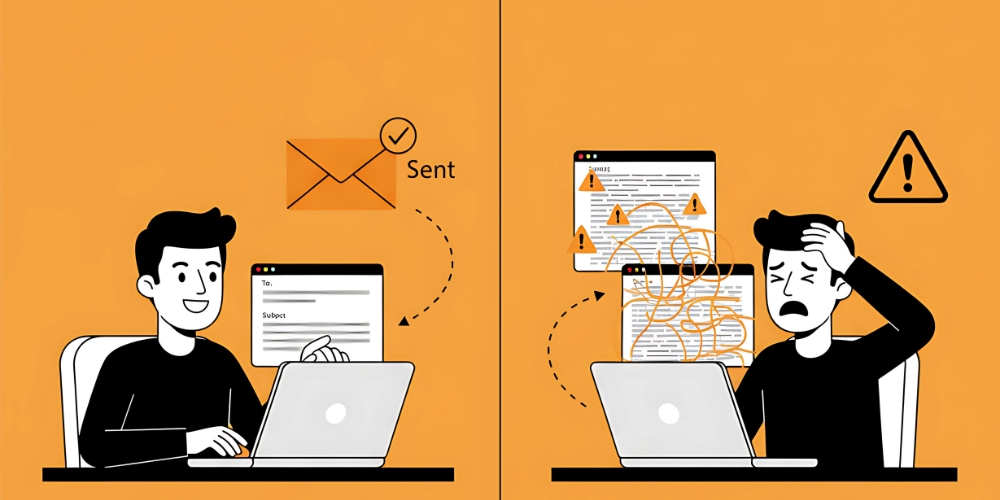
Six errors that consistently kill reply rates.
Sounding entitled
"Please explain why I wasn't selected" puts the recipient on the defensive. "I'd appreciate your thoughts" invites dialogue.
Sending too soon
Same-day messages read as desperate. Wait at least one business day after the decision.
Writing too long
Anything over 200 words usually gets skimmed. Keep emails tight.
Skipping context
Recruiters handle many candidates. Always remind them which role and which interview.
Forgetting gratitude
Even after rejection, a thank-you costs nothing and keeps the relationship warm.
Pure copy-paste
Templates are a starting point, not the final email. Add your specifics — references to the conversation, the role, the team.
The Bottom Line
The feedback request email after an interview is one of the quietest ways to differentiate yourself as a candidate. Most candidates never send one; the ones who do consistently come across as more mature, more growth-oriented, and more memorable. The mechanics are simple — wait for the right window, write a short respectful email, frame around learning, and accept whatever response (or non-response) you get. The compounding benefit across many interviews is real: better feedback informs sharper future answers, the relationships warm rather than cool, and the reputation of "thoughtful candidate" travels across industries quietly but reliably.
FAQs
Should I ask for feedback if I was rejected?
Yes. It's one of the best ways to improve for future interviews. Keep the tone polite and growth-oriented; many interviewers will give honest feedback if asked respectfully.
What if the interviewer doesn't respond?
Don't take it personally. Many companies have policies that limit detailed feedback to avoid legal exposure. If there's no reply after one polite nudge, move on with the reflections you can produce yourself.
How long should a feedback email be?
100-150 words is ideal. Should fit on one screen, easy to scan, professional in tone. Anything longer typically loses attention.
Can asking for feedback help in future opportunities?
Yes. It signals professionalism and growth orientation. Many recruiters remember thoughtful candidates and consider them for future roles or refer them to colleagues.
What if it's been more than a month since my interview?
The window has mostly closed. Memory has decayed; details are vague. You can still try — frame as "in case you have a moment to reflect" — but expect lower reply rates.
Keep reading

Finding Your Career Passion: A Practical, Test-Based Approach

Surviving 12-Hour Shifts: Routines for New Hires and Employers
