

Can AI Write Job Descriptions That Actually Attract Top Talent?
AI can draft a sharp job description in minutes — see what it does well, where it falls short, and how to combine the speed with real human judgement.
Ployo Team
Ployo Editorial
TL;DR
- AI drafts a clean, structured job description in minutes — useful as a starting point, never as the final draft.
- The strongest gains: speed, inclusive-language flagging, consistent formatting across roles, and SEO optimisation.
- The real risks: trained-in bias, generic tone, and loss of the company's voice.
- The pattern that works: AI generates the structure and the language hygiene, a human writes in the specificity and the culture.
- Privacy matters when AI tools ingest candidate data or resumes — choose tools that handle this cleanly.
The first draft of a job description is the part recruiters dread most. It is also the part AI does best. In two minutes, a modern generator can produce a structured, inclusively-worded, SEO-friendly description with reasonable defaults. The remaining 20 minutes — the part that makes the description yours — is still human work. This guide walks through what AI does well, where it falls short, and the practical pattern that combines the speed of automation with the judgement of an experienced recruiter. For the deeper case on why the JD matters at all, see our tactical guide to effective job descriptions.
What AI Actually Does Well in Job Description Writing
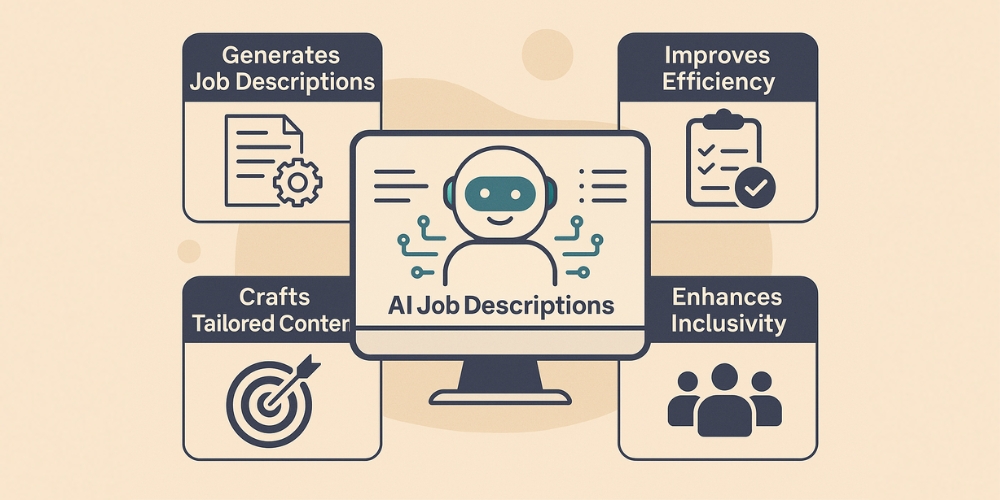
Modern job-description AI tools have absorbed thousands of high-performing postings as training data. That training shows up as good defaults: action-led verbs, scannable bullets, a consistent structure (responsibilities → must-haves → nice-to-haves → about us), and reasonable headline phrasing.
The mechanical layer is exactly where AI shines. Hand it a role title and a few must-haves, and it produces a draft that hits every structural beat. The good tools also flag biased language, suggest inclusive alternatives, and add the SEO patterns (clear titles, keyword-friendly bullets) that lift a posting's organic reach on Google for Jobs and LinkedIn.
The Real Benefits, Honestly

Four wins consistently show up.
Real speed
A draft that used to take 45 minutes lands in five. For high-volume hiring or a startup opening a dozen roles at once, that compounds quickly.
Built-in inclusion checks
Most modern tools flag gender-coded vocabulary ("aggressive", "dominant", "rockstar") before the description goes live. WeSolv's research on inclusive hiring cites Atlassian as a high-profile example: inclusive job description language lifted applications from women and underrepresented groups by roughly 25%. The bias check is the most directly measurable AI feature in the JD workflow.
Better candidate alignment
When the JD is generated alongside a model that understands real candidate profiles — see AI candidate matching — the requirements list tends to be more realistic and the resulting applicant pool more aligned.
Consistency across roles
For teams hiring a dozen or more roles a year, AI keeps formatting, tone, and structure consistent without anyone having to police a style guide. The employer-brand benefit is real and quietly underrated.
Built-in SEO
Modern tools structure the page for organic visibility — clear job titles, keyword-rich bullets, scannable formatting. The same description that ranks better on Google for Jobs typically reads better for humans too.
The Limits and Ethical Bits

The honest weaknesses.
Bias in, bias out
If the training data carried biased framing, the generated descriptions can reproduce it. Tools that publish their bias-evaluation methodology are meaningfully better than tools that do not. Treat the inclusion checker as a backstop, not a guarantee.
Loss of brand voice
A description generated entirely by AI tends to sound like every other AI-generated description. The structural quality is there; the voice is not. Strong descriptions need at least a paragraph of company-specific colour that no model can write for you.
Over-reliance produces sameness
The risk for high-volume teams: every role description starts to read identically, which silently erodes the employer brand. Use the AI for the structural draft, but rewrite at least the opening and "about us" sections by hand.
Privacy considerations
Tools that pull from resumes or candidate data to generate content sit inside GDPR and CCPA. Confirm what the tool stores, how long, and where — the same diligence you would apply to any other vendor handling candidate data.
The Working Pattern
A repeatable workflow that gets the most out of the tools:
1. Start with specifics, not boilerplate
Feed the tool real requirements ("build scalable web services in Python and Go"), not vague ones ("develop software"). The output quality tracks input quality almost linearly.
2. Anchor on the right keywords
If the role's main searches are "Senior Backend Engineer" and "Python developer remote", make sure those phrases appear in the headline and the first 100 words. The AI will help; you still need to know which keywords matter for this market.
3. Rewrite the opening yourself
The first 50 words decide whether the rest gets read. Whatever the AI produced, rewrite it to sound like your team. This is the single highest-leverage edit.
4. Run the inclusion check, but read the output
Most tools flag the obvious — "rockstar", "competitive", "aggressive". Read the description anyway. Patterns the model misses (overly long must-have lists, implicit assumptions about location or background) need a human eye.
5. Keep the human bits human
The "about us" paragraph, the team-specific colour, the one concrete reason this role exists now — none of those should be model output. They are what separate your posting from the eight other "Senior Backend Engineer (Remote)" listings the candidate is reading this morning.
6. Iterate every quarter
Industry vocabulary shifts; stale descriptions cost applications. A quarterly refresh — easier with AI in the loop — keeps each posting current.
The Bottom Line
AI cannot write a job description that attracts top talent on its own. It can write 70% of one in five minutes, and it can do the hygiene work — bias flags, formatting, SEO — better than most recruiters would. The remaining 30% is voice, specificity, and the company-specific signal that no model has seen. Use AI for what it is good at, write the rest yourself, and you will publish more postings of higher quality in less time than any pure-human workflow can match.
FAQs
Will AI replace recruiters in writing job descriptions?
No. It will replace the boilerplate-drafting part of the work and free recruiters to focus on the voice, specificity, and judgement parts. The role gets sharper, not redundant.
What is the single most important edit to make on an AI-generated job description?
Rewrite the first 50 words. That section decides whether the rest of the description gets read, and it is the part most likely to sound generic in AI output.
Are AI job description tools good at avoiding bias?
The bias-flagging features catch the most common issues — coded vocabulary, "wishlist" requirements, exclusionary phrasing. They are not perfect. Treat the checker as a backstop rather than a guarantee.
Do AI tools handle SEO for job postings?
Most modern tools do. The bigger lift comes from structuring the page well — schema markup, clear titles, scannable bullets — which AI tools tend to do correctly by default.
Are there compliance risks to using AI for job descriptions?
The descriptive output itself is low risk. The risks live in adjacent tools that ingest candidate data or resumes. Confirm what your vendor stores, where, and for how long, and you are usually in good shape.
Keep reading

How to Write a Software Engineer Job Description That Hires Better

What Talent Acquisition Managers Actually Do in Modern Hiring
