

What to Take to a Job Interview (And What to Leave at Home)
The exact checklist of what to bring to a job interview — resumes, ID, portfolio, references — plus the things candidates accidentally sabotage themselves with.
Ployo Team
Ployo Editorial

TL;DR
- Bring 3-5 printed copies of your resume on quality paper, plus a portfolio if relevant.
- Carry photo ID with photocopies kept in a clean folder.
- Three professional references and a notepad with a working pen.
- Two or three thoughtful questions prepared for the interviewer.
- Leave behind: bulky bags, snacks, anything that makes you check your phone, irrelevant documents, gifts, and heavy fragrances.
The way a candidate walks into an interview matters more than most people realise. Walking in unprepared — even if your resume is excellent — signals to the interviewer that you treated the conversation casually. The fix is straightforward: a slim, organised set of essentials, packed the night before, with everything in its place. This guide walks through exactly what to bring, what to leave at home, and the small habits that turn a bag into a confidence prop.
What to Bring to a Job Interview
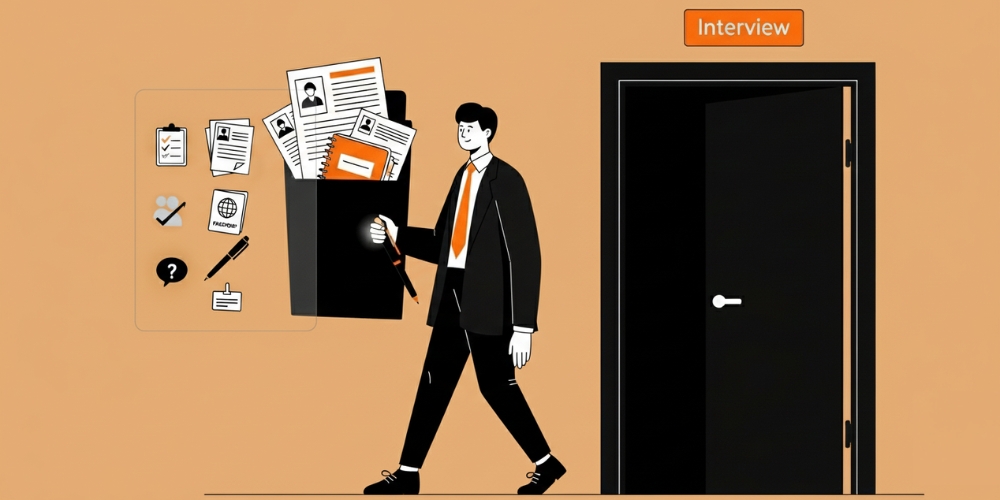
Six essentials cover almost every interview format. Pair this list with our broader interview dos and don'ts playbook for the wider preparation framework.
1. Printed copies of your resume
Three to five copies on good-quality paper. Even if you emailed the resume ahead, the interviewer may not have a copy handy — being able to slide one across the table is small but signals preparation.
2. Portfolio or work samples (if relevant)
For design, marketing, engineering, or any role where tangible work matters, bring a portfolio. Tablet, printed booklet, or a single curated set of examples — whichever format fits your work best. Showing beats telling.
3. Photo identification and copies
Carry the original government-issued ID (driver's license, national ID, or passport) plus a clean photocopy. Some interviewers verify identity; others ask for the copy. Either way, you are prepared.
4. A short reference list
Three professional references — ideally a former manager, a peer, and a senior person from outside your team — with name, title, company, contact details, and a one-line note on your working relationship.
5. Notebook and a working pen
Two reasons. First, taking quick notes signals seriousness. Second, the act of writing keeps your hands occupied and your mind grounded. Don't use your phone for notes — it looks distracted regardless of intent.
6. Two or three thoughtful questions
Prepared, written down, and ready to ask. Use our list of questions that reveal toxic workplaces for the sharper probes worth bringing. If you also need a strong opening, our guide on answering "tell me about yourself" covers the moment that usually starts the conversation.
What to Leave at Home
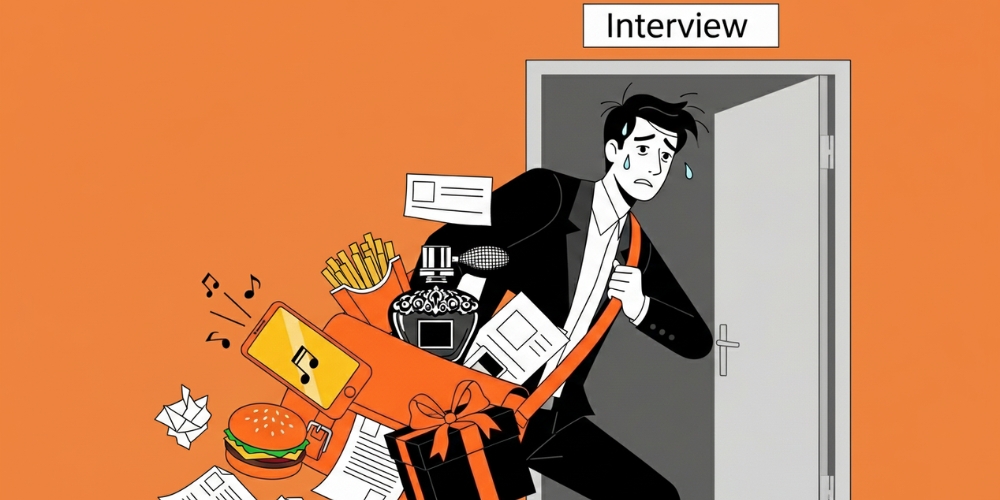
Six things that consistently work against candidates.
Bulky or messy bags
Backpacks loaded with weekend clutter, shopping bags from earlier errands, an oversized purse. A slim folder or briefcase containing only what you need looks professional; anything more looks distracted.
Food and drinks
Even if you skipped breakfast, do not walk in with a coffee cup or a snack. The visual reads as casual; the smell is sometimes worse. Eat beforehand; tuck a water bottle out of sight.
Visible phone use
Glancing at the phone — even quickly — signals the interview isn't your priority. Silence the phone fully, put it away, and resist the urge. Even if you must take notes digitally, a notebook is consistently the better visual.
Stacks of irrelevant documents
Older certificates, outdated reference letters, every project from the last five years. Stick to current, relevant material. A document avalanche signals confusion rather than thoroughness.
Gifts for the interviewer
Awkward at best, transactional at worst. A thoughtful thank-you note within 24 hours is the better move. Never bring a gift.
Heavy fragrances
In a small interview room, strong perfume or cologne is genuinely distracting. Skip fragrance entirely, or use a very light touch. You want the interviewer focused on your answers, not opening a window.
How to Pack the Night Before
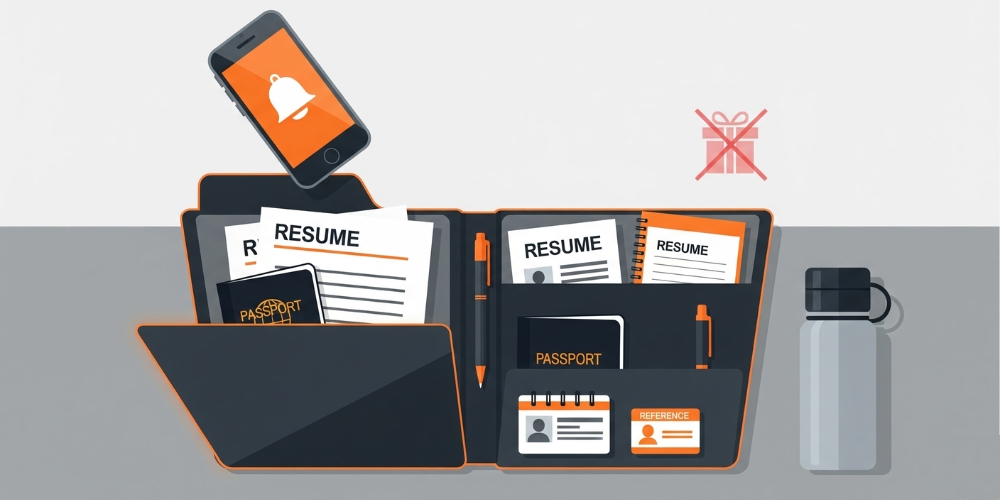
Four habits that turn the preparation into muscle memory.
Build a core kit
A slim folder or sleeve. Inside: 3-5 resumes, ID with photocopy, short reference list, notebook with working pen. That is the standard kit for almost every interview format.
Do a pre-interview check
Right before leaving: silence the phone, skip last-minute perfume, double-check the folder is fully packed, and zip up. Holding the folder when you walk in projects organisation immediately.
Add a backup page
If a test or task is likely, include one extra page with key accomplishments, a short project example, and two thoughtful questions. Doubles as a calm-yourself reference if nerves hit.
Pre-draft the follow-up
Slip a draft of the thank-you note in the back of the folder. After the interview, polish and send within 24 hours. Same-day follow-up consistently lifts outcomes — and pre-drafting removes the friction.
The Bottom Line
What you bring to an interview matters less than what you say, but the small signals stack. A slim, organised set of essentials communicates seriousness and preparation; a bulky bag, a buzzing phone, or a forgotten resume undermines everything that follows. Pack the night before, do a pre-departure check, and walk in knowing every item in the folder has a purpose. The candidates who get this right look composed before they have said a word — and that composure carries through the rest of the conversation.
FAQs
Is it appropriate to bring a gift to a job interview?
No. Gifts make the interaction awkward and can read as transactional. A polished thank-you note within 24 hours of the interview is the right move.
Is it OK to ask what to bring to an interview ahead of time?
Yes — and it actually demonstrates preparation. A quick email to the recruiter confirming what's needed (especially for technical interviews that may require equipment) is professional and welcomed.
Should I bring my social security card or sensitive documents?
Not to the first interview. Standard photo ID is sufficient for verification at this stage. If an offer is extended, HR will request the additional documents through proper secure channels.
Can I take notes on a phone or laptop during the interview?
Not ideal unless explicitly invited. A notebook and pen consistently look more professional, and the visual difference matters more than the slight inconvenience.
What is the single most important thing to bring?
Three to five printed copies of your resume on quality paper, plus the two or three thoughtful questions you have prepared. Those two things — and what they signal about your preparation — are the highest-leverage items in the folder.
Keep reading


