

What a Physician Recruiter Actually Does in Healthcare Hiring
Physician recruiters keep hospitals staffed in the middle of a shortage — the role, the strategies, the in-house vs agency choice, and where AI fits.
Ployo Team
Ployo Editorial
TL;DR
- Physician recruiters specialise in finding, evaluating, and placing licensed physicians — a job that is structurally harder than general recruiting.
- The US could face a shortage of around 86,000 physicians by 2036, which amplifies the role's importance.
- Core duties: sourcing, credential verification, site visits, contract negotiation, credentialing support.
- In-house recruiters know one health system deeply; agency recruiters bring broader candidate pools. Both have a place.
- AI is automating busy-work — sourcing, screening, predictive analytics — but the human persuasion that closes a relocation offer remains essential.
Healthcare is in the middle of one of the most acute talent shortages in any industry — and the physician recruiter is the role keeping hospitals staffed through it. The job is structurally harder than recruiting in most other domains: longer pipelines, stricter credentialing, deep market shortages, and individual hires that can swing a hospital's revenue by hundreds of thousands of dollars per year. This guide walks through what physician recruiters actually do, why the job is uniquely difficult, the in-house vs agency choice, and where AI is starting to lift the role without replacing it.
What a Physician Recruiter Actually Is

The differentiator from a general healthcare recruiter is focus. A general recruiter might handle nurses, administrators, and clinical specialists alongside physicians. A physician recruiter focuses exclusively on MDs and DOs — and that depth matters because medical licensing, board certifications, and physician-specific career drivers are non-trivial to navigate.
The role is part salesperson, part career counsellor, part project manager. They engage physicians who already have several competing offers, sell the role and the community, and shepherd the candidate through a process that can run 6-12 months from first contact to start date.
Becoming a physician recruiter typically requires a background in HR, business, or healthcare administration, paired with strong communication skills. Compensation tends to run higher than general recruiting because the role's complexity — medical credentialing, licensing rules, specialty-specific nuances — takes years to build proficiency in.
What Physician Recruiters Do Day to Day

Five core responsibilities cover most of the role.
1. Sourcing and outreach
Physician recruiters use specialised databases, medical job boards, and professional networks (AMA, specialty associations) to find candidates. The pool is small and the candidates are heavily targeted by competitors — strong recruiters develop specific, low-friction outreach approaches. Choosing the right recruiter for your role matters disproportionately in this space.
2. Screening and credential verification
A resume tells you very little about a physician. Recruiters verify board certifications, check for disciplinary actions, validate state licenses, and confirm clinical philosophy aligns with the hospital's service model. Mistakes at this stage are expensive.
3. Site visit coordination
Bringing a physician to a new city is a multi-day production. Recruiters coordinate spousal employment conversations, school visits for children, real estate exposure, and tours that sell the city as well as the role. The site visit is often where offers are won or lost.
4. Contract negotiation
The recruiter sits between the hospital's budget and the physician's expectations. Compensation, signing bonuses, loan-repayment assistance, call schedules, and partnership tracks all need to be calibrated.
5. Credentialing support
Hospital privileges, state licensing, DEA registration — the paperwork is substantial. Strong recruiters help the candidate through it; weak recruiters lose candidates to administrative friction.
Why Physician Recruitment Is So Difficult

Three structural factors make the role harder than most.
The supply problem is real
The AAMC's research projects a US physician shortage of around 86,000 by 2036. Demand outpaces supply, especially as the population ages. Recruiters are competing for a shrinking pool of candidates against every other health system in the country.
Physicians are heavily targeted
Strong candidates receive dozens of cold outreach messages every week. Generic emails are ignored at scale. Standing out requires building real trust, often over months, before there is even an open role to discuss.
Opportunity cost on vacant seats
A single vacant surgical position can cost a hospital tens of thousands of dollars in lost revenue every day. The pressure to hire quickly is real; the cost of hiring badly is also real. Recruiters operate in the middle of that tension every day.
In-House vs Agency Physician Recruiters

The two paths look similar from the outside and operate very differently in practice.
In-house recruiters
Work directly for a hospital or health system. Know the culture, the medical staff, the patient demographics, and the long-term strategy in depth. Strongest at building consistent talent pipelines for predictable hiring needs. Compensation tends toward base salary with modest variable upside.
Agency recruiters
Work for third-party firms serving multiple healthcare clients. Maintain broader candidate networks and reach passive candidates effectively. Strongest at filling urgent or hard-to-source roles where the in-house team is stuck. Compensation often includes meaningful commission tied to successful placements.
Many hospitals use both — in-house for ongoing pipeline work, agencies for urgent or specialised needs. As remote hiring tools become more common, candidate sourcing across channels is increasingly done from a distance, which broadens both pathways.
How AI Is Reshaping Physician Recruitment
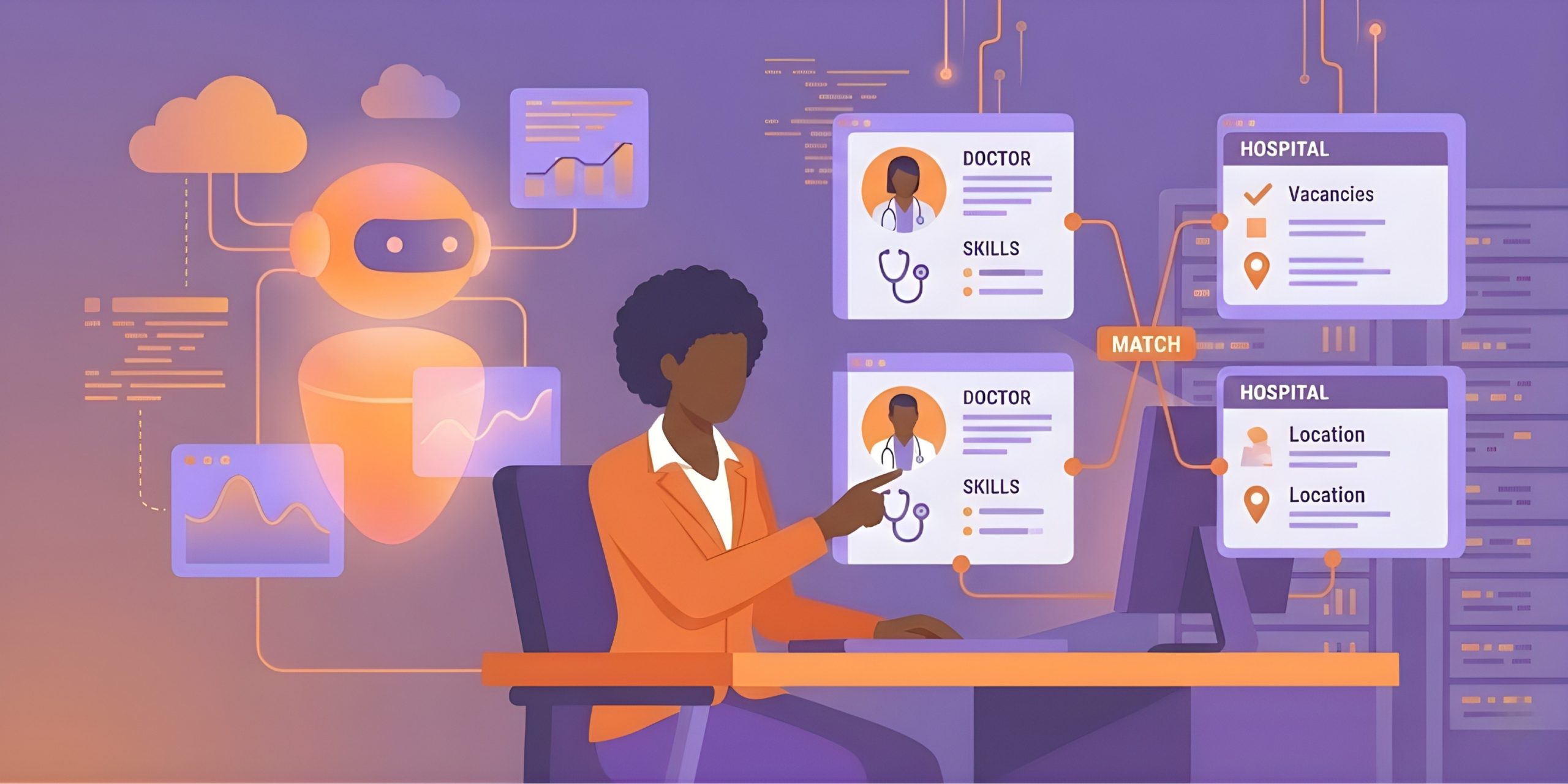
AI is automating the "busy work" that used to consume recruiter hours. Three specific places it adds clear value.
Predictive analytics
AI tools can identify physicians who may be reaching a burnout point, evaluating new opportunities, or showing engagement patterns that suggest openness to change. Recruiters reach out earlier and with more relevant context.
Initial screening automation
Chatbots handle the first-pass questions on relocation, benefits, schedule, and base requirements. Recruiters spend their time on the conversations that need real expertise.
Better matching
AI compares physician profiles — sub-specialty, training programs, clinical interests, geographic preferences — against role requirements with much higher precision than human matching alone. The shortlist quality rises measurably.
The hard part of the role does not go away. Convincing a physician to relocate their family across the country still requires real conversation, real trust, and the kind of judgement AI cannot replicate. AI lifts the productive ceiling; humans still close the offer.
The Bottom Line
Physician recruitment is one of the most consequential and most difficult specialisations in modern recruiting. The talent shortage is real, the pipelines are long, the credentialing is complex, and every successful hire matters enormously to patient care and hospital operations. Strong physician recruiters combine deep market knowledge, real relationship-building, and increasingly sophisticated tooling to keep hospitals staffed through structural shortages. For hospitals struggling with vacancies, investing in the right recruiter — in-house, agency, or both — is one of the highest-leverage decisions available.
FAQs
How long does a typical physician hire take?
Anywhere from 6 to 12 months from first contact to start date. That covers sourcing, interviews, site visits, contract negotiation, and the credentialing required for hospital privileges and state licensing.
Why is physician hiring so much harder than other healthcare hiring?
A small global supply of qualified candidates, a long training pipeline that cannot be scaled quickly, and physician-specific requirements around clinical autonomy, schedule, and geography. The combination makes perfect-match hires rare.
What is the difference between an in-house and an agency physician recruiter?
In-house recruiters work for a specific health system and know its culture deeply. Agency recruiters serve multiple clients, maintain broader candidate networks, and tend to fill urgent or hard-to-source roles. Hospitals often use both depending on the need.
Can AI replace physician recruiters?
No. AI lifts the productive ceiling — sourcing, screening, predictive analytics — but the persuasion and relationship work that closes a physician hire is firmly human. The role gets more strategic, not redundant.
What is the single most underrated part of the physician recruiter role?
Site visit coordination. The site visit is often where offers are won or lost — and it is the part of the process that AI is least able to support. Strong recruiters invest heavily here.


