

UAE Employment Law 2026: Employer Compliance Guide
UAE employment law explained — contracts, working hours, leave, gratuity, termination, penalties, and recent 2024–2025 updates that employers must know.
Ployo Team
Ployo Editorial

TL;DR
- Federal Decree-Law No. 33 of 2021 (effective Feb 2022) is the operating framework.
- All contracts must now be limited-term, max 3 years.
- Gratuity: 21 days' pay/year first 5 years; 30 days/year after.
- Standard week: 8 hours/day, 48 hours/week; Ramadan reduced.
- Fines for non-compliance reach AED 1M.
Running a business in the UAE means staying compliant with UAE employment law — and the framework has been substantially modernised since 2022. This guide breaks down contracts, working hours, leave, gratuity, terminations, recent updates, and the practical compliance checklist that keeps employers safe.
What UAE Employment Law Is
The current law (Federal Decree-Law No. 33 of 2021) came into effect February 2, 2022, replacing the 1980 framework. Built to align with global standards while maintaining flexibility.
What it covers
- Hiring and onboarding
- Working hours and overtime
- Leave entitlements
- Termination and end-of-service benefits
- Anti-discrimination and harassment protections
The biggest structural shift: all employees must now be hired under limited-term contracts. Employers were required to transition by February 2023 per Ministerial Resolution No. 27 of 2023.
This applies across all seven Emirates — DIFC and ADGM free zones follow their own common-law-based frameworks.
Who It Applies To

Covered
- All private-sector employees outside free zones
- UAE nationals and expatriates
- Full-time, part-time, temporary, flexible workers
- Domestic workers (under separate Federal Law No. 10 of 2017)
Not covered
- Employees in DIFC or ADGM free zones
- Federal government employees
- Local government employees
- Armed forces, police, security personnel
Mainland UAE + non-financial free zones (JAFZA, DAFZA) are fully bound by the framework. Ties closely with workforce policies like the Nafis Program for national hiring. UAE has strengthened anti-discrimination protections on race, gender, religion, nationality.
Key Provisions
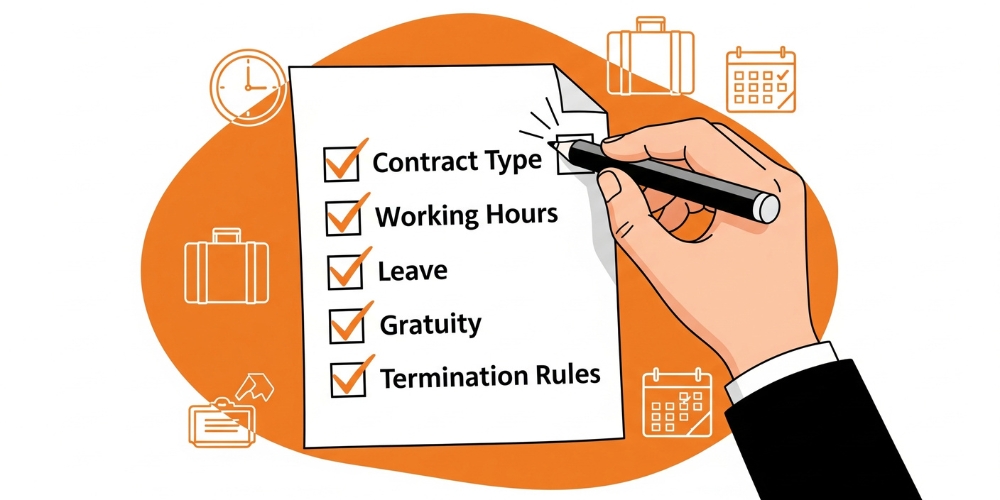
Employment contracts
All contracts must have clear start + end dates. Max 3 years, renewable. No more unlimited contracts.
Working hours and overtime
8 hours/day, 48 hours/week standard. Ramadan: reduced 2 hours per day.
- 125% of basic pay for regular overtime
- 150% for hours between 10 PM and 4 AM
Leave entitlements
- Annual leave: 30 calendar days after one year
- Sick leave: up to 90 days/year, with tiered pay
- Parental leave: 5 paid days for new parents within 6 months
- Maternity leave: 60 days total (45 fully paid, 15 half-pay)
- Compassionate + study leave: available for Emirati employees
Gratuity and end-of-service
Per UAE government gratuity rules:
- 21 days' pay per year for first 5 years
- 30 days' pay per year beyond
- Forfeitable only for specific serious misconduct
Termination protections
- Minimum 30 days' written notice
- No biased or arbitrary firings
- Settle all owed: unused leave, gratuity, final wages
Employer Obligations

1. Register with MOHRE within 14 days
Issue labour contract, health insurance, work permit, Emirates ID. Emirati workers also need GOSI enrolment.
2. Adhere to probation rules
Per HLB Hamt's overview, probation maxes at 6 months. Employers can terminate with 14 days' written notice; employees leaving must give 1 month if joining another UAE company, 14 days if leaving the country.
3. Pay through WPS
Wages Protection System ensures transparency. Late payments trigger warnings, work-permit suspensions, and fines.
4. Anti-discrimination policies
Article 4 prohibits discrimination on gender, race, colour, nationality, religion, disability. Failures can trigger fines up to AED 1M.
5. Safe work environments
Fire safety, ergonomic workspaces, proper PPE for risk-bearing jobs. Non-negotiable.
Penalties for Non-Compliance

Five risk categories.
Fines
AED 5,000 to AED 1M. Examples:
- Hiring without valid work permit: AED 50,000 per worker
- Late salary payment: AED 5,000–50,000
- Missed contract transition deadline: AED 5,000 per case
Service suspension
MOHRE may suspend services (work permits) for up to 6+ months.
Criminal liability
Forced labour, trafficking, repeat violations — possible imprisonment + deportation.
Civil liability
Wrongful termination claims: up to 3 months' compensation + unpaid wages, gratuity, distress claims.
Reputational damage
Labour disputes follow your brand in a competitive job market.
Recent Updates (2024–2025)
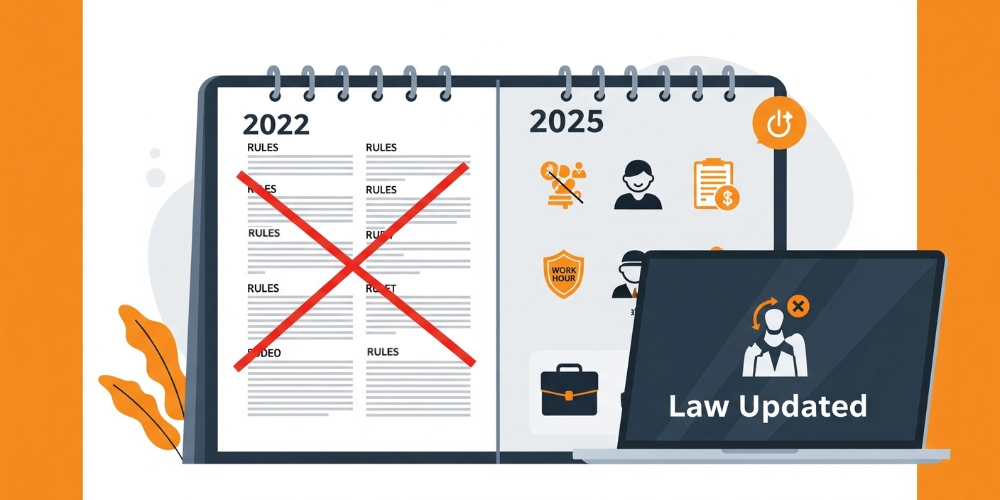
Five recent shifts.
Federal Decree-Law No. 9 of 2024 (Aug 31, 2024)
Employers must continue salary payments up to 2 months during disputes. Probation termination notice: minimum 14 days.
Fixed-term contract maturity
Per Zen HR's 2025 guide, 95% of UAE businesses now compliant. Optional renewal clauses are now standard.
Gratuity enhancements
ADGM removed the 2-year wage cap on gratuity. Mainland practice: 21 days first 5 years, 30 days after; forfeiture removed in most cases.
Worker protection updates
Midday outdoor work ban (12:30–15:00, June 15–Sept 15) at 99% compliance. Pay statements now mandatory.
Emiratisation enforcement
Per Times of India coverage, 50+ employee firms required to meet 1% Emiratisation by July 1, 2025. Avoid common Emiratisation mistakes through HR clarity on Nafis expectations.
How to Ensure Compliance
Seven practices.
1. Update contracts and policies
Fixed-term, max 3 years. Notice periods, dispute resolution, renewal clauses defined.
2. Track and document everything
WPS uploads, MOHRE registration, work permits. Detailed pay slips every cycle.
3. Monitor regulatory deadlines
Midday ban during summer. Emiratisation if 50+ employees.
4. Regular HR + management training
Wages, probation, termination rights, anti-discrimination, health and safety.
5. Strengthen gratuity + termination
Apply 21/30 day formula correctly. Pay within 14 days of termination. Archive payouts.
6. Plan for labour disputes
Budget for up to 2 months' salary continuation. Internal + MOHRE grievance routes.
7. Focus on culture
Non-discrimination, safety, simple complaint/whistleblower process.
The Bottom Line
Following UAE employment law shows your team and the wider market you're serious about doing things right. Staying current with updates and treating employees fairly avoids fines and builds a company strong talent actually wants to work for. The compliance burden is real, but the cost of non-compliance is materially higher.
FAQs
What's the difference between limited and unlimited contracts?
Limited (fixed-term): defined start + end dates, renewable, max 3 years. Now mandatory. Unlimited (phased out post-2022): no end date, caused ambiguity over benefits and notice.
How is gratuity calculated?
Under 1 year: none. 1–5 years: 21 days' basic salary/year. 5+ years: 30 days/year for years beyond 5. Capped at 2 years' salary in mainland. Example: AED 10,000/month × 7 years = 165 days = AED 54,500.
Who's covered?
Private-sector employees in mainland UAE. Full-time, part-time, flexible, expat. Excluded: DIFC/ADGM, federal/local government, armed forces, police, security.
What's the probation period limit?
Maximum 6 months. Employer notice during probation: 14 days. Employee notice to leave for another UAE role: 30 days; for leaving country: 14 days.
What's the highest-leverage compliance step?
Audit your current contracts for fixed-term compliance and your payroll for WPS coverage. These two issues drive the majority of fines and disputes.
Keep reading


