

Second Round Interview Questions: Answers That Win the Offer
Second interviews go deeper — common questions, sample answers, prep strategies, STAR examples, and smart questions to ask the panel back.
Ployo Team
Ployo Editorial
TL;DR
- Second interviews probe culture fit, thinking process, and pressure response.
- 75% of companies use behavioural questions to assess soft skills (9cv9).
- Expect behavioural + situational + technical + competency-based mix.
- STAR method (Situation, Task, Action, Result) wins behavioural rounds.
- Always come with 3+ smart questions tied to team and role, not just title.
You cleared the first round — congratulations. The second interview is where employers go deeper on thinking process, communication style, and culture fit. This guide breaks down what to expect, the 10 questions that come up most often, sample answers, and how to prepare so you walk in confident.
What Second Round Interviews Test
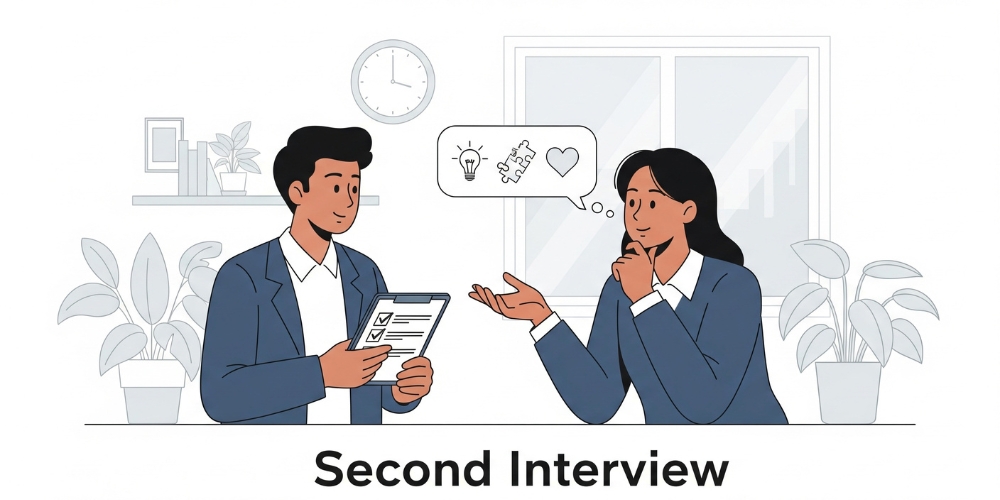
While the first interview confirms basic qualifications, the second goes deeper. Per 9cv9's 2025 data, 75% of companies use behavioural questions in interviews — and second rounds lean on them heavily.
Four question types you'll likely face:
- Behavioural: explore past actions in workplace scenarios
- Situational: hypothetical challenges, how would you handle them
- Technical: role-specific knowledge and problem-solving
- Competency-based: leadership, communication, teamwork
Often multiple stakeholders — managers, team members, sometimes cross-functional panels. Expect both narrative storytelling and structured judgment under pressure.
10 Common Questions (and How to Answer)

1. Describe a major challenge you overcame at work
Tests resilience, problem-solving, initiative. STAR-frame it; lead with specific outcome.
2. How do you handle competing priorities and tight deadlines?
Time management and organisation. Real example beats general philosophy.
3. What are your biggest strengths and areas for improvement?
Self-awareness signal. Honest weakness + specific improvement story you've already started.
4. Tell me about a team conflict and how you resolved it
Conflict resolution is critical for leadership and collaboration. STAR method keeps the answer focused.
5. Why this company, and how would you contribute?
Tests cultural fit plus understanding of the mission. Be specific — not "I love your culture".
6. How do you make decisions under uncertainty?
Judgment + risk management. Walk through your framework with a real example.
7. What are your long-term goals — and how does this role align?
Are you planning to grow with the company? Be specific but adaptable.
8. Describe a successful project you led start to finish
Leadership, initiative, follow-through. Quantify outcomes; explain trade-offs you made.
9. What motivates you to perform at your best?
Goals, learning, recognition, team success — pick what's genuinely true for you and back it with a story.
10. Do you have questions for us?
Always come with 3+ thoughtful ones. Examples below in FAQs.
Preparation Tips
Five practices that consistently lift performance.
Revisit the first interview
What did you say? What worked? Where did you fumble? Refine and refresh those exact moments.
Deepen company research
Beyond the About page. Recent news, product launches, press releases, social posts. Reveals current priorities.
Prep role-specific questions
Technical, managerial, sales — refresh on tools, metrics, methods relevant to the post.
Run mock interviews
With a mentor, career coach, or friend. Catches verbal tics, weak openings, and rambling answers.
Prepare for panels or task interviews
Many second rounds add presentations or case studies. Rehearse your rationale clearly, not just the solution.
The Bottom Line
The second round is when employers stop checking qualifications and start checking whether they want to work with you. Preparation isn't optional. Revisit round one, deepen your research, structure your stories, and walk in with smart questions. Done well, the second interview shifts perception from "qualified candidate" to "this is our hire".
FAQs
What's the difference between first and second interviews?
First confirms qualifications; second tests thinking process, judgment, communication, and culture fit. The bar is higher and questions go deeper.
How long is a typical second round?
Usually 60–120 minutes, sometimes split into multiple sessions with different stakeholders. Panel rounds often run longer.
What smart questions should I ask?
- "What does success look like in this role after 90 days?"
- "What's the team's biggest challenge right now?"
- "How do high performers here structure their first month?"
Demonstrates thinking about contribution, not just the title.
Should I bring materials?
Usually yes — portfolio, brag sheet, or case-study summary tied to a specific challenge they've discussed. Hand it over near the end; reinforces credibility.
What's the single highest-leverage prep move?
Prepare three STAR stories you can adapt to any behavioural question. Most second-round behavioural questions reduce to the same core themes — adaptable stories carry the round.
Keep reading


