

Resume Buzzwords to Avoid (And What to Write Instead)
Resume buzzwords kill applications — what to drop, what to write instead, and how AI screening exposes empty phrases hiding behind generic claims.
Ployo Team
Ployo Editorial
TL;DR
- Recruiters spend ~6–7 seconds scanning each resume — buzzwords waste them.
- 73% of hiring pros say repeated buzzwords actively turn them off.
- "Results-driven", "team player", "passionate" rank as the worst offenders.
- Replace generic claims with specific outcomes and numbers.
- AI screening tools surface measurable achievements over fluffy language.
"Dynamic team player. Results-driven. Passionate professional." If your resume reads like this, recruiters skip it before reading the second line. This guide breaks down the buzzwords killing applications, what to write instead, and how AI screening is making generic language even riskier than before.
Why Resume Buzzwords Hurt

Four reasons they backfire.
Recruiters scan, not read
Per The Ladders research, recruiters spend ~6–7 seconds on each resume before moving on. Buzzwords waste that window.
ATS systems evaluate context
Modern Applicant Tracking Systems with strong ATS integration parse context, not just keyword presence. Generic claims without supporting evidence rank lower.
Empty claims weaken your case
As Monster put it: "If you have to tell people you are something, you likely aren't that something." Show, don't claim.
Recruiter fatigue is real
Per Interview Guys' 2025 data, 73% of hiring professionals report seeing the same words repeatedly and getting actively turned off.
Buzzwords to Avoid
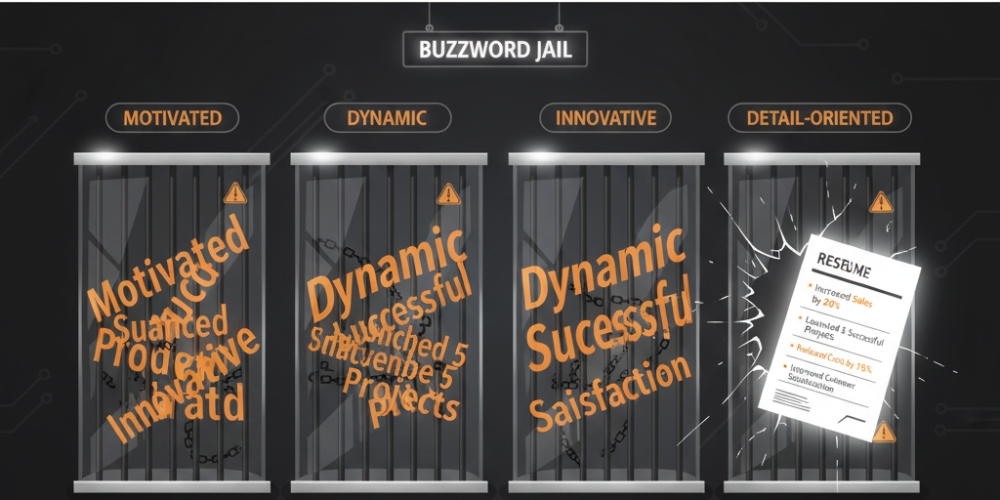
The worst offenders, with replacements.
| Buzzword | Why It Hurts | Write Instead |
|---|---|---|
| Results-driven | Too broad; says nothing about actual impact | "Delivered 20% revenue growth in 12 months" |
| Team player | Generic; no proof of contribution | "Co-led 5-person team; reduced report errors by 15%" |
| Motivated self-starter | Lacks measurable evidence | "Launched volunteer program that grew to 50 members" |
| Detail-oriented | Claims a trait without proving impact | "Identified 250 report issues; prevented $80K in losses" |
| Passionate about | Focuses on emotion, not outcomes | "Led outreach raising client retention from 75% to 88%" |
| Strategic thinker | Vague and overused | "Built retention plan lowering churn by 10%" |
| Innovative | Self-praise without evidence | "Automated monthly reporting; cut cycle from 5 days to 2" |
| Dynamic | Adjective signalling nothing | Cut entirely; describe an action instead |
How Recruiters See Past Buzzwords

Five practices recruiters use to filter fluff.
Look for proof, not pitch
Statements like "strong communicator" prompt the next question: how, when, what improved? Bullets that answer those questions outperform those that don't.
Use ATS tools smartly
Per Select Software Reviews, 88% of employers believe they lose qualified candidates because resumes aren't ATS-friendly. Tune filters to surface achievements, not just keywords.
Watch for generic redundancy
Stacked adjectives ("experienced", "dynamic", "proactive") without specifics often signal weak evidence. Per TechScreen, up to 75% of qualified candidates get auto-rejected when systems focus on keywords over context.
Tune interview questions accordingly
Replace "Are you a team player?" with "Walk me through a time you improved a specific metric." Eliminates pep-talk answers; surfaces real outcomes.
Educate hiring managers
Guide hiring teams to distinguish filler from achievement. Focus on metrics, ownership, and concrete outcomes.
Best Practices for Job Seekers
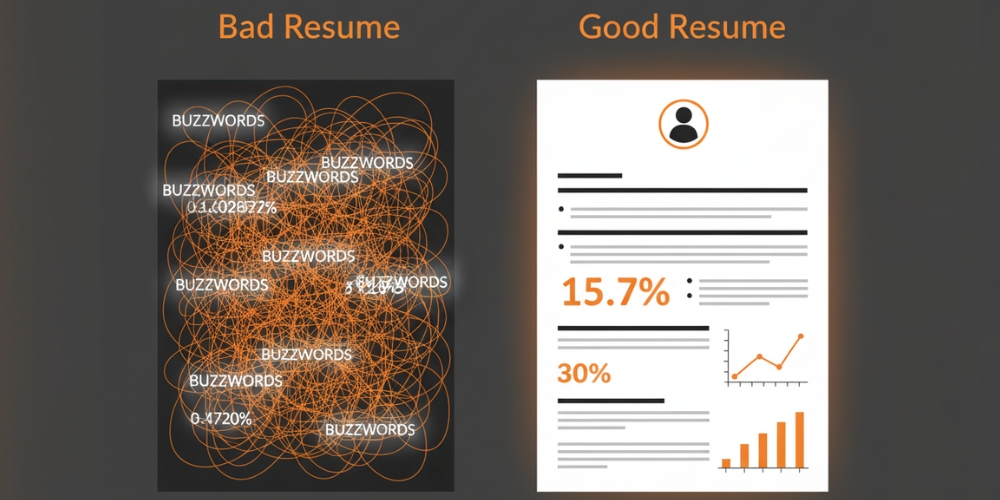
Five practices that consistently beat buzzword-stuffed resumes. The good resume vs bad resume comparison hinges on these.
Be specific, not "special"
"Presented weekly sales reports to a 10-person team; secured 3 new contracts" beats "excellent communicator" every time.
Match the JD smartly
Tailor without stuffing. Mention skills with measurable results tied to business impact. Keyword repetition without meaning trips ATS spam filters.
Replace fluff with facts
"Reduced workflow from 5 days to 2" beats "innovative problem solver". Measurable verbs (delivered, reduced, built, automated) carry weight even in blind resume screening.
Keep it human-readable
ATS does the first pass; humans read second. Over-optimisation produces robotic tone. A good resume reads like a clear story of growth.
Use soft skills with context
"Leadership" alone is filler. "Led cross-department project of 8 people, delivered ahead of schedule" demonstrates it. Show the skill through action.
How AI Screening Changes the Game

Four ways AI tools reshape what wins.
Context-based analysis
Modern AI reads resume and job description together. "Strong communicator" gets evaluated against actual evidence — client calls, cross-functional projects, campaigns. Generic claims rank lower.
Real-time bias detection
Blind screening modules strip identifying details (name, age, photo) while keeping job-related data, producing fairer evidence-based decisions.
Deep ATS integration
Direct connection to recruiting systems ensures accurate filtering — surfacing candidates who match role intent, not just keyword presence.
Human + AI partnership
AI doesn't replace recruiters — it amplifies them. Surfaces achievements buried under buzzwords, saves manual screening hours, gives every candidate a fair shot.
The Bottom Line
Buzzwords once sounded impressive. Today they blur individuality, block clarity, and hide real talent. Candidates win by replacing generic claims with measurable outcomes. Recruiters win by using tools that surface substance over style. The candidate with the flashiest words doesn't get hired — the one whose work speaks for itself does.
FAQs
How do I make my resume stand out without buzzwords?
Focus on measurable results. Replace "team player" with the specific outcome you helped achieve — efficiency gain, cost reduction, revenue lift. Numbers make stories unique.
Does AI help recruiters find better candidates?
Yes. AI surfaces patterns in language and performance metrics that highlight which candidates back claims with data versus those who don't.
Should resumes still include soft skills?
Yes — but always with context. "Led project of 8 people, delivered ahead of schedule" beats "leadership" every time.
What's the single highest-leverage rewrite?
Replace adjective claims with quantified outcomes. Every adjective ("dynamic", "innovative", "detail-oriented") that becomes a specific metric meaningfully strengthens your resume.
Do ATS systems penalise buzzwords directly?
Not always, but they rank context and specificity above keyword presence. Buzzword-heavy resumes score lower against ATS that evaluate match quality, not just keyword counts.
Keep reading

Working in Japan as an American: The Recruiter's Reality Check

Salary vs Hourly Pay: Which Compensation Model Wins in 2026?
