

AI Interviewing Across the Recruitment Lifecycle: A Practical Guide
AI interviewing turns the recruitment cycle from chaotic to systematic — where AI helps, where humans stay, and the benefits and pitfalls of integration.
Ployo Team
Ployo Editorial
TL;DR
- 60% of applicants quit hiring processes that feel slow or confusing (SHRM).
- 71% of AI adopters say AI has already changed company job roles (Deloitte).
- AI handles repetitive early-stage work; humans handle judgment and final decisions.
- Strong AI workflows reduce delays, score consistently, and improve candidate experience.
- Bad integration creates worse problems than no integration — design carefully.
The recruitment lifecycle gets messy in most companies — late job posts, piled-up resumes, delayed interviews, dropped-off candidates. AI interviewing changes the picture, but only when integrated thoughtfully across the full cycle. This guide walks through where AI helps most, the concrete benefits, and the mistakes that derail well-intentioned deployments.
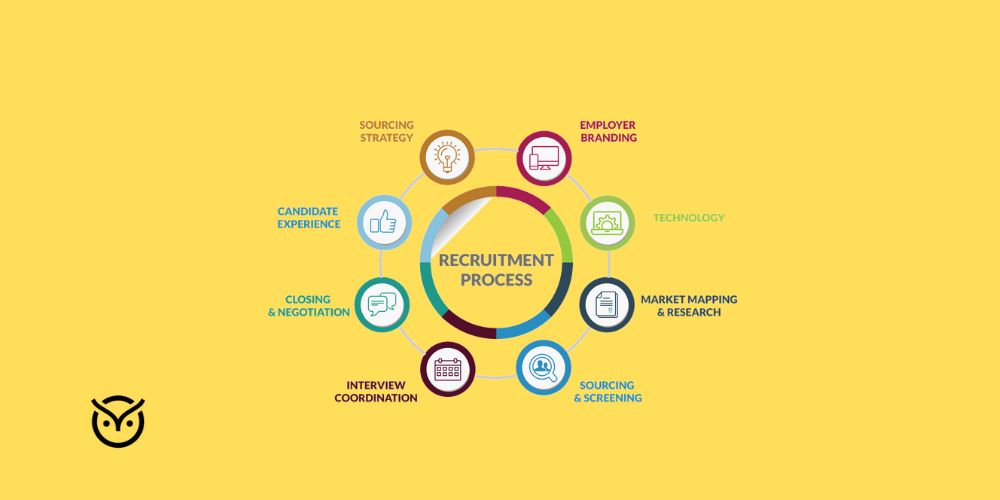
What the Recruitment Cycle Actually Is
The end-to-end sequence from job opening to offer acceptance.
Core steps:
- Planning the role
- Posting the job
- Screening applicants
- Interviewing
- Assessing skills
- Offering the job
- Onboarding
SHRM data shows 60% of applicants quit the process if it feels slow or confusing. Every stage affects every other stage — the 360 recruiting cycle concept captures this interdependence.
How AI Interviewing Fits
Five integration points worth knowing. None of them replace humans — they reduce the manual work that distracts humans from where they add value.
1. Early screening
AI scans resumes, matches skills, surfaces strong candidates fast. Hours of manual review compressed into minutes — recruiters focus on the top of the ranked list.
2. Interview coordination
Automated invites, prep instructions, scheduling. Combines well with no-code AI recruitment workflows for consistent process at scale.
3. Consistent scoring
Human interviewers vary day to day. AI applies the same rubric to every candidate, producing fairer scoring and cleaner cross-candidate comparison.
4. Schedule discipline
Reminders, follow-ups, timeline nudges. AI keeps the team on track when manual coordination would slip.
5. Candidate experience
Status updates, prep materials, basic question answering. AI keeps candidates informed even when recruiters are stretched thin. Pair with interview communication best practices for compound effect.
Per IBM's analysis, companies integrating AI into talent processes report significant time-to-hire reductions.
Benefits of an AI-Enhanced Lifecycle
Five concrete gains.
Faster screening
Recruiters spend their time on top candidates, not pile-sifting. Automated resume screening takes the bottleneck out of the funnel.
Better-quality decisions
Structured questions plus consistent scoring reduce accidental bias and improve early-stage decision accuracy.
Smoother candidate journey
Quick, consistent communication keeps candidates engaged even when the recruiting team is busy.
Team alignment
When the lifecycle is supported by AI, everyone follows the same steps. Shared workflow, less reinvention per role.
Better data
AI tools collect process metrics automatically. HR sees where delays happen and can fix them. The lifecycle becomes a learning system.
Per Deloitte, 71% of AI adopters report AI has already changed company job roles, and 82% expect moderate or substantial changes to roles and skills over the next three years.
Common Mistakes
Six patterns that consistently produce bad outcomes.
No clear job plan
Hiring without a clear role specification confuses recruiters, candidates, and AI alike. Define before posting.
Slow communication
Candidates lose interest fast. Automated status updates fix the most common drop-off cause.
Excessive manual work
Heavy manual sorting creates errors. AI removes it; recruiters focus on real conversations.
Unstructured interviews
Without consistency, scoring drifts. AI-supported structured interviewing produces comparable, defensible decisions.
Skipping human review
AI should never make final hiring decisions alone. Personality, values, and real fit need human judgment.
Ignoring data
The lifecycle produces signals about what works. Tracking and acting on them turns hiring into a measurable system.
The Bottom Line
The recruitment lifecycle gets better when AI handles repetitive coordination and humans handle judgment — and worse when those boundaries blur. Set up AI to support early screening, scheduling, scoring consistency, and candidate communication. Keep humans firmly in the loop on shortlisting decisions, culture and values assessment, and offer conversations. The companies that get this right hire faster, score more fairly, and produce better candidate experiences. The ones that don't end up with the same lifecycle problems, just at machine speed.
FAQs
Is the recruitment cycle the same as the recruiting lifecycle?
Yes. Both describe the same end-to-end sequence from job opening to onboarding.
Does every company use the same recruitment cycle?
The core steps are similar. Specifics vary by industry, company size, and role complexity. The principle of treating it as a connected system applies everywhere.
How does AI interviewing help the cycle?
By making screening faster, scoring cleaner, communication more consistent, and scheduling smoother. The cycle stays steady when AI handles the repetitive coordination work.
Should AI ever make hiring decisions alone?
No. AI should always be an input to human decisions, not a substitute. Personality, culture, and fit need human judgment.
What's the highest-leverage integration point?
Resume screening and scheduling. Together they reclaim the most recruiter time and produce the most immediate funnel improvement. Other integrations follow naturally once those are working well.
Keep reading


How AI Tools Reduce Candidate Stress in Hiring (and Improve Outcomes)
