

Inbound Recruiting: Attract Talent Instead of Chasing It
Inbound recruiting attracts candidates through content, brand, and culture signals — the methodology, best practices, and how it compares to outbound.
Ployo Team
Ployo Editorial

TL;DR
- Companies with strong employer brands see 50% more qualified applicants and cut cost-per-hire by 43% (Pulse Recruitment).
- Inbound leads are 61% cheaper than outbound (MarketingProfs).
- 58%+ of job seekers apply on mobile (eqorefer).
- Methodology: Attract → Engage → Convert → Delight.
- Best results come from sustained content investment, not one-off campaigns.
Most companies still post jobs and hope. The teams hiring well have shifted to inbound recruiting — attracting candidates through valuable content, authentic culture signals, and well-designed candidate experiences. The approach takes longer to compound but produces higher-quality candidates at lower cost over time. This guide walks through how it actually works.
What Inbound Recruiting Is

Inbound recruiting adapts inbound marketing principles to talent acquisition. Rather than pushing job ads outward, you pull the right candidates in through valuable content, authentic employer brand, and engaging candidate experiences.
The shift: instead of waiting for roles to open and scrambling to fill them, you build relationships with potential candidates continuously. Employee stories, transparent careers pages, behind-the-scenes content, and useful career resources all contribute. When the right person is ready for a move, you're already top-of-mind.
The Core Pillars
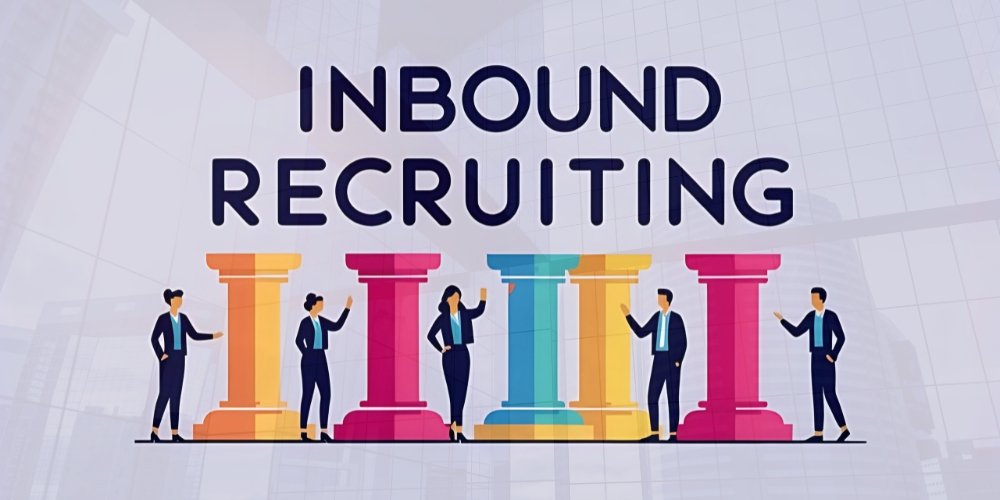
Four pillars that together produce inbound recruiting success.
1. Employer branding
The impression candidates form about your company before they apply. Per Pulse Recruitment, strong employer brands see 50% more qualified applicants and reduce cost-per-hire by up to 43%.
2. Content marketing
Day-in-the-life videos, employee blog posts, career tips, virtual office tours. Content lets candidates imagine themselves at your company and builds trust ahead of any application.
3. Candidate experience
Every interaction — from job listings to recruiter responsiveness — shapes perception. Strong experiences turn passive candidates into advocates; bad experiences damage brand even when no application happens.
4. Talent nurturing
Not every great candidate is ready to move today. Email updates, social engagement, events, and career communities keep you top-of-mind for when they are ready.
Applying Marketing Principles to Recruiting
The four-stage funnel.
Attract
Content, SEO, social media, employee advocacy. Blog posts about life at your company, short-form videos on relevant platforms, employee LinkedIn shares.
Engage
Personalised, helpful experiences. Curated job alert newsletters, career resources, interactive quizzes that help candidates find fit.
Convert
Make it easy to apply or join the talent network. Clear CTAs, short forms, mobile-friendly career pages.
Delight
Keep candidates engaged post-application. Follow-up emails, status updates, real human interaction. Even non-hires become brand advocates.
MarketingProfs research shows inbound leads cost 61% less than outbound. The same dynamic applies in recruiting.
The Inbound Recruiting Methodology

Four stages that map cleanly to the candidate journey.
Awareness
Make it easy for candidates to discover you. Show up on platforms where the right candidates already spend time.
Consideration
Candidates are curious. Career site, team stories, values — give them substance.
Interest
Behind-the-scenes content, employee Q&As, tailored newsletters. Deepen the connection before any application happens.
Action
Streamline the application path. Short forms, easy resume upload, clear role expectations. Remove friction.
11 Best Practices

1. Define your employer brand clearly
Why would someone choose you over a competitor? Mission, values, culture, benefits, career development — make these specific.
2. Build a recruiting content calendar
Plan monthly content like a marketing campaign — company life, team spotlights, event recaps, hiring tips. Align with hiring goals.
3. SEO your careers page and job posts
Search-optimised job titles, meta descriptions, and content. Add schema markup for job postings to boost search visibility.
4. Engage on the right social platforms
Tech candidates often live on GitHub and Twitter; creatives on Instagram; corporate candidates on LinkedIn. Show up where your audience already is.
5. Promote employee-generated content
Employees carry more credibility than company spokespeople. Provide an internal toolkit with branded templates to make sharing easy.
6. Create candidate personas
"Sofia — mid-level marketer, values flexibility, active on LinkedIn, wants mentorship." Specific personas sharpen all downstream content.
7. Provide value before asking for applications
Career advice, resume templates, industry trends, skill-building workshops. Become a trusted resource, not just a job poster.
8. Mobile-first applications
Per eqorefer, 58%+ of job seekers apply via mobile. Keep applications under 5 minutes; enable resume parsing.
9. Use automated nurturing emails
Stay connected through personalised updates and relevant alerts. Keep candidates engaged even when not actively hiring.
10. Track meaningful metrics
Careers page traffic, application completion rate, time-to-fill, source-of-hire, content engagement. Use ATS analytics or external tools.
11. Collaborate with marketing
Your marketing team already runs campaigns, writes copy, and measures engagement. Partner with them — invite marketing leads to monthly syncs with HR.
Inbound vs Outbound

| Dimension | Inbound | Outbound |
|---|---|---|
| Approach | Attract through content and brand | Direct outreach to candidates |
| Focus | Long-term relationship building | Short-term role filling |
| Tools | Blogs, careers page, SEO, social, email | Job boards, cold email, LinkedIn DMs, agencies |
| Candidate experience | Candidate-led, personalised | Recruiter-led, transactional |
| Cost over time | Lower | Higher per hire |
| Scalability | Compounds with brand | Linear with recruiter effort |
Inbound works best for building pipelines and hiring for cultural fit. Outbound remains useful for urgent niche roles where the right candidate is already known.
Trade-offs to Acknowledge
| Pros | Cons |
|---|---|
| Higher-quality, brand-aligned candidates | Takes time to compound |
| Long-term talent pipeline | Requires strong content/marketing |
| Brand value even from non-applicants | Less control over applicant types |
| Better candidate experience | Attribution harder to measure |
| Cost compounds in your favour over time | Ongoing resource investment |
The Bottom Line
Inbound recruiting isn't a quick fix; it's a compounding investment. Start with employer brand basics, build a sustained content cadence, optimise the candidate experience, and track meaningful metrics. The companies that commit to inbound consistently outperform on candidate quality, cost-per-hire, and retention over 2–3 year horizons. The ones that don't keep chasing the same talent the inbound companies have already engaged.
FAQs
How long does inbound recruiting take to produce results?
Initial signals (engagement, applications) within 3–6 months. Compounding pipeline benefits become substantial at 12–18 months.
Can small companies run inbound recruiting?
Yes — and they often outperform large companies because authentic employee stories carry more weight than polished corporate content.
Should I abandon outbound recruiting entirely?
No. Outbound stays useful for urgent specialist hires. Inbound supplements rather than replaces outbound — the combination outperforms either alone.
What's the most important content to produce?
Employee stories. They carry the most credibility, signal culture authentically, and consistently outperform corporate content on engagement.
What's the highest-leverage starting move?
Audit your current careers page. Most candidates form their first real impression there, and most careers pages underdeliver. A focused redesign produces visible improvements within weeks.
Keep reading


Reverse Recruiters: What They Do and When They Actually Help
