

Answering "What Motivates You?" — Strategy and Real Examples
"What motivates you?" tests fit, self-awareness, and engagement potential — how to answer authentically with structure and specific examples.
Ployo Team
Ployo Editorial

TL;DR
- The question tests whether your drivers align with the role and culture.
- Only 33% of US employees feel engaged at work (Gallup) — fit matters.
- Strong answers tie motivation to specific past examples with results.
- Avoid generic answers, money-only motivation, or motivation that conflicts with the role.
- Practice authentic delivery rather than memorising a script.
"What motivates you?" sounds simple but trips up plenty of candidates. Generic answers ("I want to help people") land as forgettable; money-only answers signal disengagement; rambling answers lose the interviewer. The candidates who answer well demonstrate self-awareness through specific past examples and connect their drivers to what the role actually offers. This guide walks through what the question is really probing and how to answer with substance.
Why Interviewers Ask About Motivation
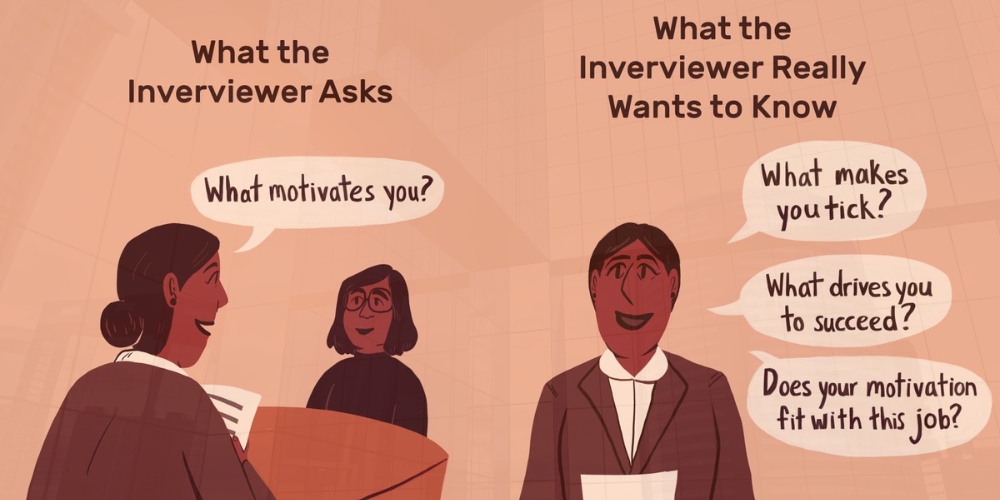
Three things the question tests.
Role and culture fit
Does what energises you match what the role and team actually offer? Misalignment predicts low engagement and short tenure.
Self-awareness
Have you genuinely thought about what drives you? Or are you reciting generic platitudes?
Long-term engagement potential
Gallup engagement research shows only 33% of US employees feel engaged at work. Hiring managers want to maximise the chance you'll be in the engaged minority.
The question isn't testing whether you have motivation — it's testing whether your motivation pattern fits.
How to Answer "What Motivates You?"

Five strategies that consistently produce strong answers.
1. Reflect on past wins
When have you felt most energised at work? Those moments reveal real drivers. The candidate who thrives solving complex problems under pressure should say so; the candidate who lights up mentoring should say that.
2. Connect to the specific role
Generic motivation answers waste the opportunity. Customise to what this role actually offers.
"What motivates me about this position is the direct client work. I'm energised by real-time impact and the feedback loop that comes from working closely with users."
3. Anchor to values or goals
If your personal values align with the company's mission, name it specifically. Connection to purpose signals depth.
"I'm motivated by continuous learning. This role's mentorship culture and complex project mix is exactly the environment where I grow fastest."
4. Use "Why + How + Result" structure
Give your answer a mini-story arc — why this motivates you, how it shows up in your work, and a specific result that demonstrates it.
"I'm motivated by mentoring junior colleagues because seeing them grow forces me to communicate more clearly. In my last role, the two interns I worked with were promoted within six months."
5. Practise but don't memorise
Prepared but natural beats scripted. The answer should feel like a thoughtful response, not a recital.
Examples of Motivations That Work
Five motivation categories that consistently resonate with interviewers.
Making measurable impact
"I'm driven by seeing my work make a measurable difference. In my last role, I led a process change that cut operational costs by 15% — that direct impact is what keeps me energised."
Solving complex problems
"Tough problems are what I look forward to. I'm at my best when I can dig into data, test creative solutions, and figure out why something isn't working."
Continuous learning and growth
"I'm motivated by environments where I can keep building skills. Last year I added AI analytics certification to my toolkit specifically because I wanted to be more effective in data-heavy roles."
Helping others succeed
"Mentoring others gives me real energy. Watching a teammate grow under my guidance is one of the most fulfilling parts of my career."
Trust and responsibility
"I'm motivated when I'm trusted with high-stakes work. Earning that trust through consistent execution is what drives me to perform at the highest level."
The right answer for you depends on what genuinely motivates you and what the specific role offers.
Common Motivation Sources Recruiters Respond To
| Motivation source | Why it works in interviews |
|---|---|
| Challenge and problem-solving | Signals initiative and critical thinking |
| Achieving goals | Indicates focus, ambition, follow-through |
| Collaboration and team success | Highlights interpersonal skills |
| Professional growth | Signals growth mindset and longevity |
| Building or creating | Fits product, design, innovation roles |
| Making impact | Connects to leadership and purpose roles |
| Recognition and results | Fits sales, marketing, performance roles |
Match your answer to what the role actually rewards.
Using STAR for Motivation Questions

STAR works for motivation questions too — turns abstract claims into demonstrable performance stories.
Situation
"In my previous role as marketing coordinator, our team faced a major product launch delay."
Task
"I was responsible for revising the campaign strategy within 72 hours."
Action
"Tight deadlines bring out my best work. I aligned the team on revised priorities, restructured the launch sequence, and personally took on the messaging rewrite."
Result
"The campaign launched on time and drove 15% higher engagement than our previous launch. The pressure-driven sprint was the most energising work I'd done all year."
The structure turns motivation from claim to demonstrated pattern.
Sample Answers by Role Type

Project management
"Organising chaos into structure motivates me. In my last role, I took over a delayed product launch, built a new workflow, and got the team aligned. We launched 10 days ahead of the revised schedule. That sense of bringing alignment from disorder is what keeps me going."
Technical roles
"Solving hard problems motivates me. I love digging into bugs or performance issues that others might avoid. In one case, I reduced load time on a critical feature by 45%. The mix of logic and creativity in debugging keeps me energised."
Sales or marketing
"Seeing measurable results energises me. I get genuinely excited about building campaigns that drive engagement and conversions. One email campaign at my previous company exceeded the industry benchmark by 3x. The feedback loop between work and impact is what drives me."
Mission-driven roles
"I'm motivated by knowing my work serves a larger purpose. That's what drew me to this position. I've always been at my best when working toward something that helps others — which is also why I volunteered with education nonprofits alongside my operations role."
Mistakes to Avoid

Five answer patterns that consistently weaken candidates.
Being too generic
"I just like doing a good job" sounds polite but says nothing. Specifics land; generics evaporate.
Money-only motivation
"I'm motivated by good pay" signals disengagement with the work itself. Compensation matters; sole motivation by money signals problematic fit.
Rambling without structure
Long winding answers lose attention. Pick one motivation, tie to specifics, keep tight.
Mismatched motivation
Saying you're motivated by working alone while interviewing for a deeply collaborative role signals poor self-awareness or poor preparation.
Memorised delivery
Scripts produce robotic answers. Practise the structure; deliver naturally.
The Bottom Line
"What motivates you?" is an opportunity to demonstrate self-awareness and role fit through specific examples. The candidates who answer well combine genuine reflection on what energises them with research about what the role actually offers. The candidates who answer poorly recite generic platitudes or fail to connect motivation to demonstrated past behaviour. Reflect honestly, connect specifically, structure with STAR, and deliver naturally — the question stops feeling like a curveball and starts feeling like a chance to land your strongest signal.
FAQs
Should I mention salary as motivation?
Not as the primary motivator. Compensation can be a brief honest acknowledgment, but motivation rooted in the work itself produces stronger interview signal.
What if I'm not sure what motivates me?
Reflect on your past work — when have you felt most energised vs most drained? Patterns emerge that reveal actual drivers. Generic answers come from skipping this reflection.
How long should the motivation answer be?
60-90 seconds. Long enough to give context and a specific example; short enough to invite follow-up.
Can I have multiple motivations?
Yes — but pick one or two for the answer. Listing five motivations dilutes the impact. Choose the most relevant to the specific role.
What's the strongest way to demonstrate motivation?
A specific past example with measurable outcome. "I'm motivated by mentoring; I coached two team members to promotion last year" beats "I'm motivated by helping others succeed" without proof.
Keep reading


