

How Long Should Interview Answers Be? The Concise Guide
The ideal interview answer length is 1-2 minutes — how to structure responses, read the room, and avoid the rambling that costs strong candidates offers.
Ployo Team
Ployo Editorial

TL;DR
- Aim for 1-2 minutes per answer for most interview questions.
- Use STAR (Situation, Task, Action, Result) for behavioural questions — it naturally fits the timing.
- "Tell me about yourself" should land in 30-90 seconds.
- Watch the interviewer's body language and wrap up earlier when they look ready.
- Start with the direct answer, then add the supporting detail — never the other way around.
The single most common interview mistake is rambling. Most candidates know what they want to say; far fewer know how long they should take to say it. Answers that wander too long bore the interviewer; answers that are too short read as unprepared. The sweet spot is narrower than candidates expect — and hitting it consistently is one of the highest-leverage interview skills you can build. This guide breaks down the right length per question type, how to structure responses that fit naturally, and the small habits that prevent rambling in real time.
Why Answer Length Actually Matters
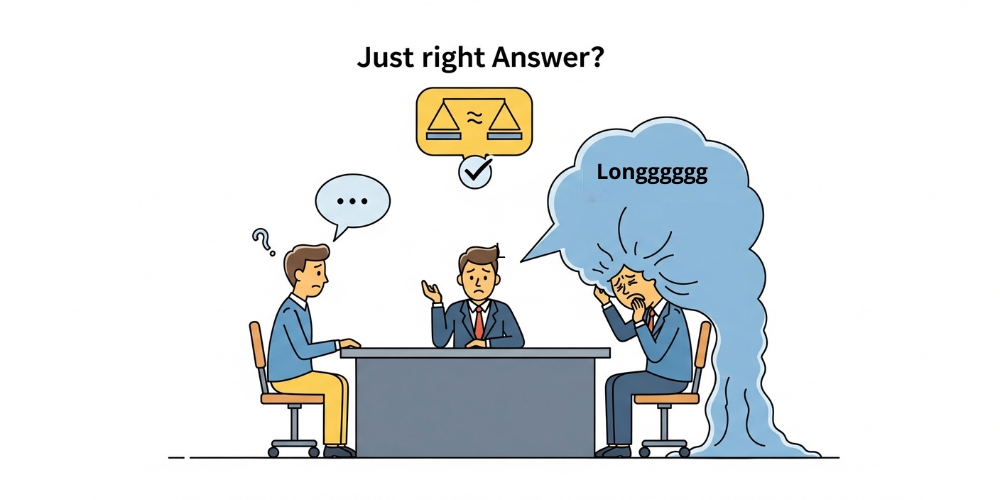
Length is signal. Five specific ways it matters:
- Concise answers demonstrate clear thinking. Hiring managers infer that candidates who organise spoken responses cleanly can organise written work, projects, and meetings cleanly too.
- Long answers overload the interviewer. The strongest point in a five-minute answer is often invisible because the listener has already drifted.
- Short answers signal unpreparedness. A 20-second answer to "tell me about a time you handled conflict" reads as "I do not have a specific example ready."
- Interview time is finite. Filling 25 minutes of a 30-minute interview with one rambling answer means you have skipped the questions that would have shown your strengths.
- Self-aware pacing reads as respect. Candidates who clearly value the interviewer's time make a stronger impression than candidates who do not.
General Guidelines for Interview Answer Length

Five principles that consistently produce well-calibrated answers.
Be concise but thorough
The aim is full answers without unnecessary tangents. Quality of detail beats quantity of detail every time.
Target 1-2 minutes per substantive answer
Indeed's career-advice research consistently recommends a 1-2 minute target for most interview answers. The range leaves room for context and example without losing the interviewer's attention.
Use STAR for behavioural questions
Situation, Task, Action, Result — the structure naturally fits in the 1-2 minute window and keeps the answer focused on evidence rather than self-description.
Read the interviewer's cues
Engaged nodding and follow-up questions mean you are on track. Distracted body language, interrupting, or looking at the clock means it's time to wrap up. Adjust in real time.
Practise with a timer
Run your strongest stories aloud and time them. Most candidates discover their answers are 2x longer than they imagined. The first few rounds of practice are calibration; subsequent rounds are refinement.
How to Structure Answers to Stay Inside the Target

Five techniques that consistently land tight, well-calibrated answers.
1. Use the STAR method for behavioural questions
The STAR framework keeps every answer organised:
- Situation. Set the scene in a sentence or two.
- Task. Define your specific responsibility.
- Action. Walk through what you did — this is where most of the speaking time should go.
- Result. Name the outcome, ideally with a measurable element.
The structure naturally lands in the 1-2 minute range.
2. Match length to question type
- "Tell me about yourself" → 30-90 seconds. A short narrative, not a life history.
- Behavioural ("tell me about a time...") → 1-2 minutes using STAR.
- Technical or factual ("what is X?") → under a minute unless they ask for depth.
- Situational questions → 60-90 seconds; walk through your reasoning, not just the conclusion.
3. Lead with the direct answer
Open with the answer; add the supporting detail second. "Yes — and the strongest example is..." beats "Well, let me think about this. There was that time at my previous company..." Direct openings respect the interviewer's time and frame everything that follows.
4. Practise active listening
Watch for the interviewer's body language. If they are leaning in or nodding, keep going. If they are trying to interject or glancing away, wrap up. Adjusting in real time is one of the strongest interview skills you can demonstrate.
5. Time yourself in practice
Before the interview, practise your answers out loud and time them. Recording yourself is uncomfortable but unbeatable for catching pacing issues. Most candidates discover they speak faster (or slower) than they think.
Real-Time Tactics for Managing Answer Length

In-the-moment moves that consistently keep answers well-calibrated.
Watch the clock without watching the clock
Develop an internal sense of when 90 seconds has passed. After two or three practice rounds, the timing becomes intuitive.
Pause and let the interviewer step in
It is fine to wrap up a point with a brief pause. This lets the interviewer ask a follow-up or move on naturally. Silence for a beat is professional, not awkward.
Use mental bullet points
Before answering, identify two or three points you want to make. Mental structure prevents wandering.
Practise brevity without rushing
Speak clearly and at a moderate pace. Rushing through an answer to keep it short is worse than going slightly long with a clear, well-paced response.
When unsure, ask
"Would you like me to go deeper on any of that?" is a respectful and self-aware way to gauge how much more detail the interviewer wants. Many candidates skip this; it consistently lands well.
The Bottom Line
Interview answer length is one of the highest-leverage skills you can practice. The right target — 1-2 minutes for substantive questions, 30-90 seconds for openers, structured by STAR or a similar framework — fits naturally into a well-paced interview without feeling forced. Practise out loud, time yourself, watch the interviewer's body language, and lead every answer with the direct point. The candidates who master this consistently come across as sharper, more confident, and more respectful of the interviewer's time than candidates with stronger content but weaker pacing.
FAQs
What is the ideal length for "tell me about yourself"?
30-90 seconds. A short professional narrative — current focus, relevant prior experience, one specific reason this role and company are interesting. Long autobiographies hurt more than they help.
How long should a STAR answer be?
1-2 minutes total. Roughly 15-20 seconds on situation, 10 seconds on task, 60-90 seconds on action, 15-20 seconds on result.
What if the interviewer asks me to "go deeper"?
Take that as permission to extend. Add specific detail, a concrete example, or a related learning. Going deeper on request is different from rambling unprompted.
Is it OK to take a moment before answering?
Yes — and it actually helps. A 2-3 second pause before responding signals that you are thinking carefully rather than reciting a rehearsed answer.
What is the single biggest mistake on interview answer length?
Burying the strongest point. Long answers without clear structure put the most important information halfway through, where the interviewer's attention is already drifting. Lead with the point; add supporting detail second.
Keep reading


